
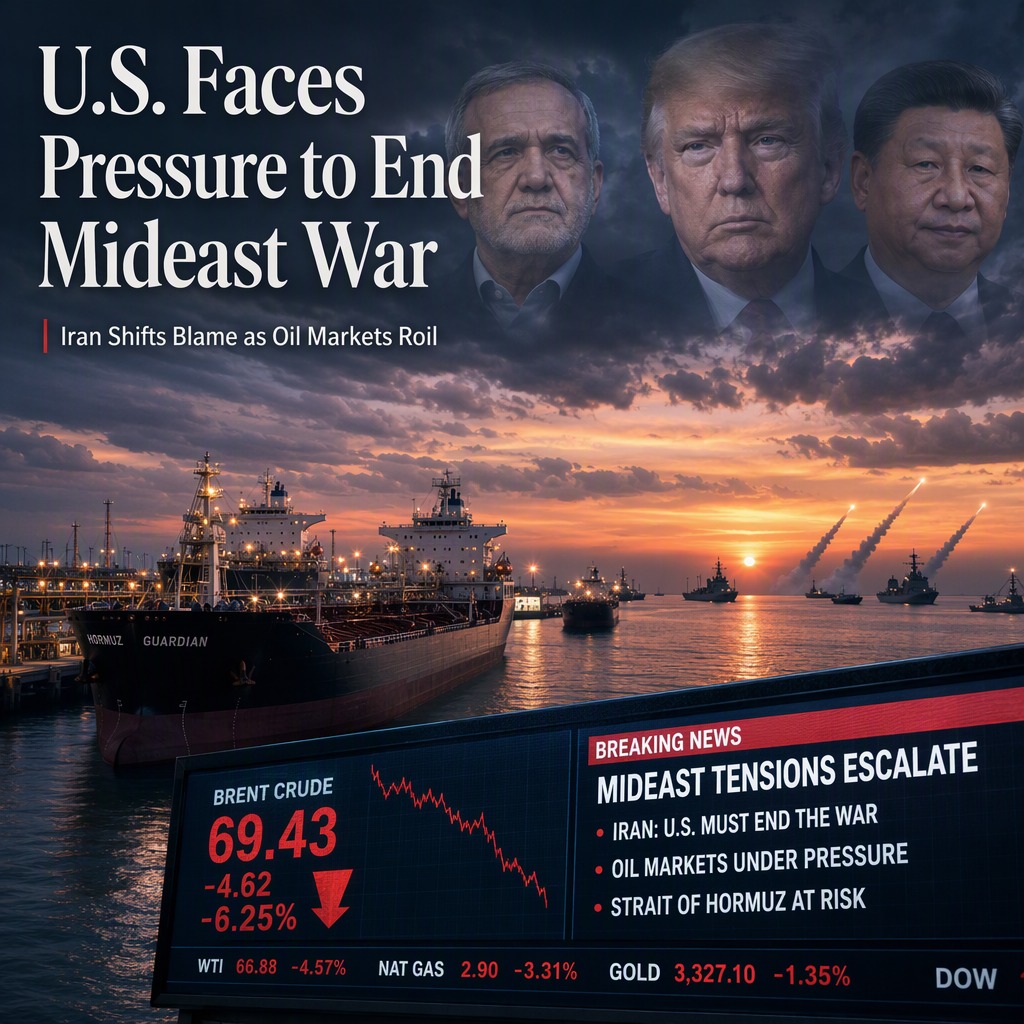
Iranian President Masoud Pezeshkian stated that it is up to the United States to decide whether to end the ongoing seven-month war in the Middle East, amid continued missile strikes and heightened regional tensions [1]. In an interview aired on Fox News, Pezeshkian emphasized, "It's America that must choose whether it wants to end this or not," when asked about the possibility of the war concluding by year-end [1].
The situation escalated as the Houthis launched dozens of missiles and drones at Saudi targets, with Saudi authorities reporting the interception of six ballistic missiles and issuing emergency alerts in Mecca, Jeddah, and Yanbu [1]. In response, Saudi Arabia, Turkey, and Pakistan planned an urgent meeting of their chiefs of staff under the Mecca Joint Defense Agreement to discuss support for the kingdom [1]. Pezeshkian distanced Iran from the Houthi attacks, stating, "the Houthis are responsible for their own actions" and that Iran is "not at war with Saudi Arabia" [1]. Conversely, Saudi Arabia's Grand Mufti urged troops to be ready "to lay down their lives" to fight the Houthis until their ouster [1].
The conflict's expansion has kept oil markets volatile. Brent crude futures for November delivery fell 1% to $93.66 a barrel, while U.S. West Texas Intermediate futures for November dropped 0.68% to $105.86 per barrel [1]. Vessel transits through the Strait of Hormuz, a key route for global oil supply, decreased to 9, significantly below peacetime levels, according to preliminary ship-tracking data [1].
Diplomatic efforts have intensified, with the war becoming a central topic during the U.S.-China summit in Washington. Chinese President Xi Jinping met with President Donald Trump, discussing the Middle East among other issues [1]. China's special envoy for the Middle East, Zhai Jun, highlighted that the consensus reached during the summit would be critical for de-escalation [1]. Trump has sought China's assistance in pressuring Tehran, following the resumption of indirect U.S.-Iran talks at the UN General Assembly [1]. Iranian officials indicated they could reopen the Strait of Hormuz within seven days if the U.S. begins easing its naval blockade of Iranian ports [1].
CONCLUSION
The ongoing Middle East conflict has heightened geopolitical tensions and significantly impacted oil markets, with vessel transits and crude prices reflecting the instability. Diplomatic efforts involving the U.S., China, and regional powers are underway, but the resolution remains contingent on U.S. policy decisions, according to Iranian leadership.