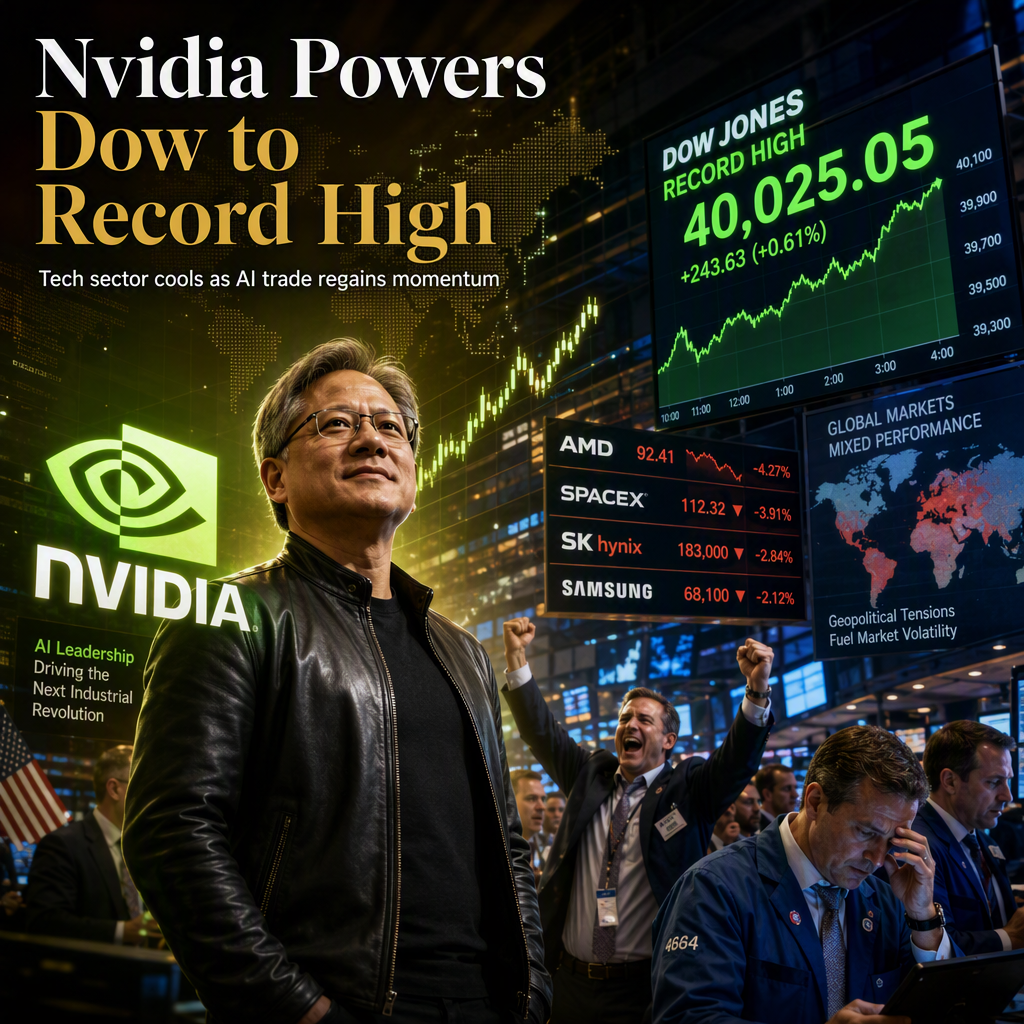
The global equity rally has lost momentum near record highs, with technology shares showing weakness, according to Deutsche Bank strategists. The S&P 500 edged lower by 0.17%, finishing just shy of its previous record high, while the Nasdaq underperformed. AMD shares fell 7.04% after its guidance failed to meet optimistic expectations, and SpaceX dropped 13.61% following its earnings results. Despite the broader tech sector cooling, Nvidia stood out, rising 3.43% on positive commentary about its next-generation Rubin architecture and after SpaceX announced during its earnings call that it would exclusively use Nvidia AI chips [1][2].
Asian technology-heavy markets also declined, with the Kospi down 4.18%, led by SK Hynix (-6.68%) and Samsung Electronics (-4.55%). The Nikkei 225 fell 1.06%, Hang Seng dropped 1.75%, and CSI 300 slipped 0.42%. In contrast, the S&P/ASX 200 rose 0.37% to a record high. European markets were mixed, with the Stoxx 600 (+0.04%) and CAC 40 (+0.03%) reaching all-time highs, while the DAX (-0.29%) and FTSE MIB (-0.18%) declined [1].
US stock futures showed mixed results: Dow Jones futures rose 0.19% to around 54,600, S&P 500 futures gained 0.09% near 7,760, and Nasdaq 100 futures declined 0.35% near 29,510. The Dow Jones Industrial Average reached another record high, propelled by tech gains, particularly Nvidia, but broader pressure across tech stocks weighed on the S&P 500 and Nasdaq Composite [2].
Market sentiment was affected by geopolitical developments, including an Israeli airstrike in southern Lebanon, which killed one person and injured 11. Additionally, reports of a new maritime agreement between Iran and Oman on a shipping route through the Strait of Hormuz have eased supply disruption fears, although Tehran clarified that the temporary two-to-four-month route does not mark a full reopening [1][2].
Deutsche Bank analysts noted that the rebound in semiconductors is gathering pace, with the Philadelphia Semiconductor Index posting its strongest daily gain since March and its best four-day advance since 2020. They argue that investors are re-engaging with the AI trade as improving corporate outlooks and capex-related news help rebuild confidence in the broader AI investment cycle [2].
CONCLUSION
Nvidia's strong performance and renewed AI optimism have helped drive the Dow Jones to record highs, even as broader tech sentiment remains cautious. Semiconductor stocks are rebounding, but mixed results across global equity markets and ongoing geopolitical tensions are keeping investors vigilant. The AI trade appears to be regaining momentum, supported by positive corporate outlooks and capex developments.