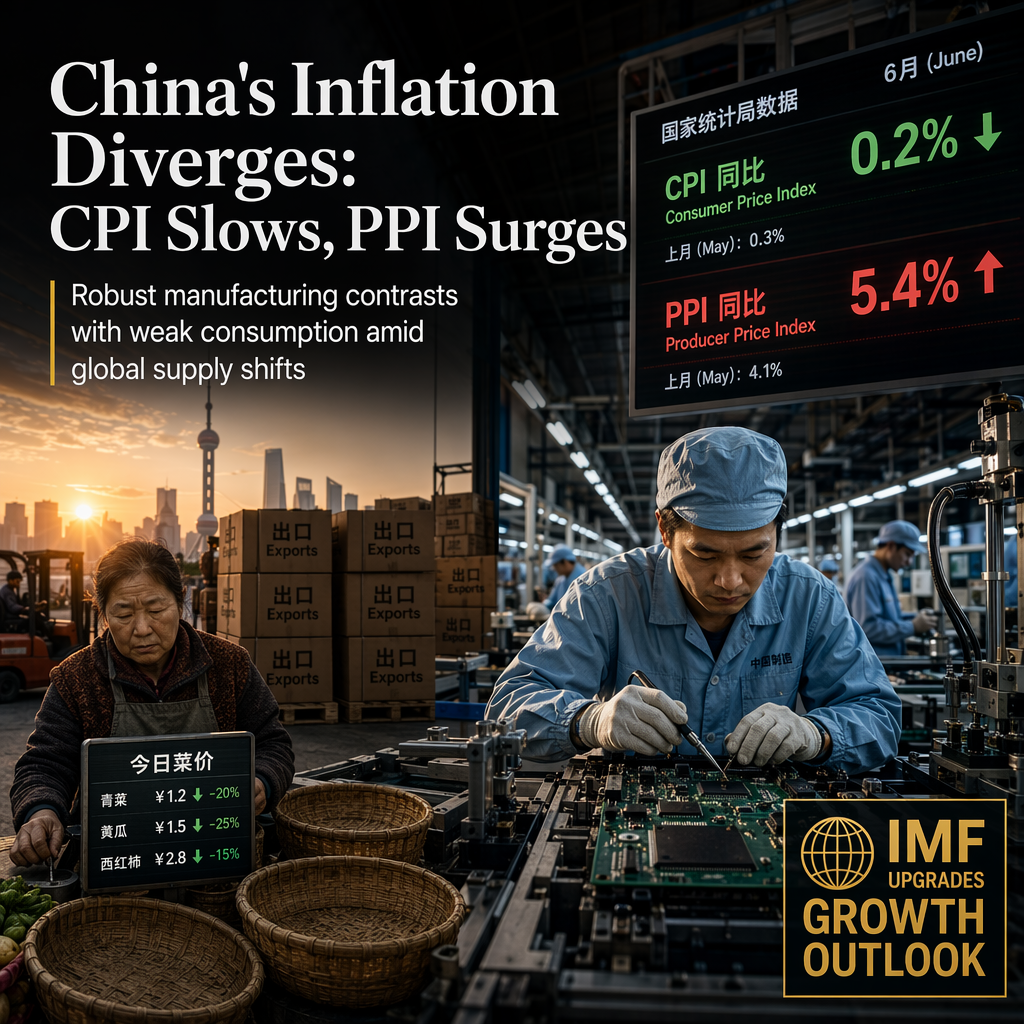
China's Consumer Price Index (CPI) inflation slowed to 1.0% year-on-year in June, falling short of the market consensus of 1.1% and down from 1.2% in May, according to data from the National Bureau of Statistics released on Thursday [1][2]. On a month-on-month basis, CPI declined by 0.3% in June, a sharper drop than the 0.1% fall in May and softer than the expected 0.2% decrease [1]. Core CPI, which excludes volatile food and energy prices, also rose 1% year-on-year in June, slightly lower than the 1.1% increase in May [2]. Food prices fell 1.6% year-on-year, easing from a 1.7% decline in May [2].
In contrast, China's Producer Price Index (PPI) surged 4.1% year-on-year in June, matching economists' forecasts and accelerating from a 3.9% increase in May [1][2]. The rise in factory-gate prices was attributed to higher commodity costs driven by supply disruptions from the Middle East conflict and increased demand for artificial intelligence computing power, which pushed up prices for tech equipment and semiconductors [2]. However, June's official Purchasing Managers' Index (PMI) indicated that input cost inflation eased to a six-month low of 54.2 from 60.5 in May, while the output price sub-index contracted to 48.2 from 51.9, signaling a pullback in industrial prices after recent surges [2].
Market reaction to the data was muted, with the China-proxy Australian Dollar (AUD) edging slightly lower; the AUD/USD pair was down 0.01% on the day, trading at 0.6927 at press time [1].
Looking ahead, the International Monetary Fund (IMF) raised its growth forecast for China to 4.6% for the year, up from 4.4%, citing robust high-tech manufacturing, strong exports, and frontloaded public infrastructure investments. China has set a growth target of 4.5%-5% for the year [2]. Analysts note that the Chinese economy is exhibiting a two-speed pattern, with strong export and manufacturing performance but weak domestic consumption and a sluggish housing market. Policymakers are expected to refrain from major new stimulus measures unless the slowdown persists beyond the current conflict, with a key policy meeting by the Politburo in late July seen as the next opportunity for potential policy escalation [2].
CONCLUSION
China's June inflation data highlights a divergence between slowing consumer prices and accelerating producer prices, reflecting ongoing challenges in domestic demand amid robust export-driven growth. Market reaction was limited, and analysts expect policymakers to maintain a cautious stance on stimulus unless economic weakness deepens. The IMF's upgraded growth outlook underscores continued confidence in China's manufacturing and export sectors.