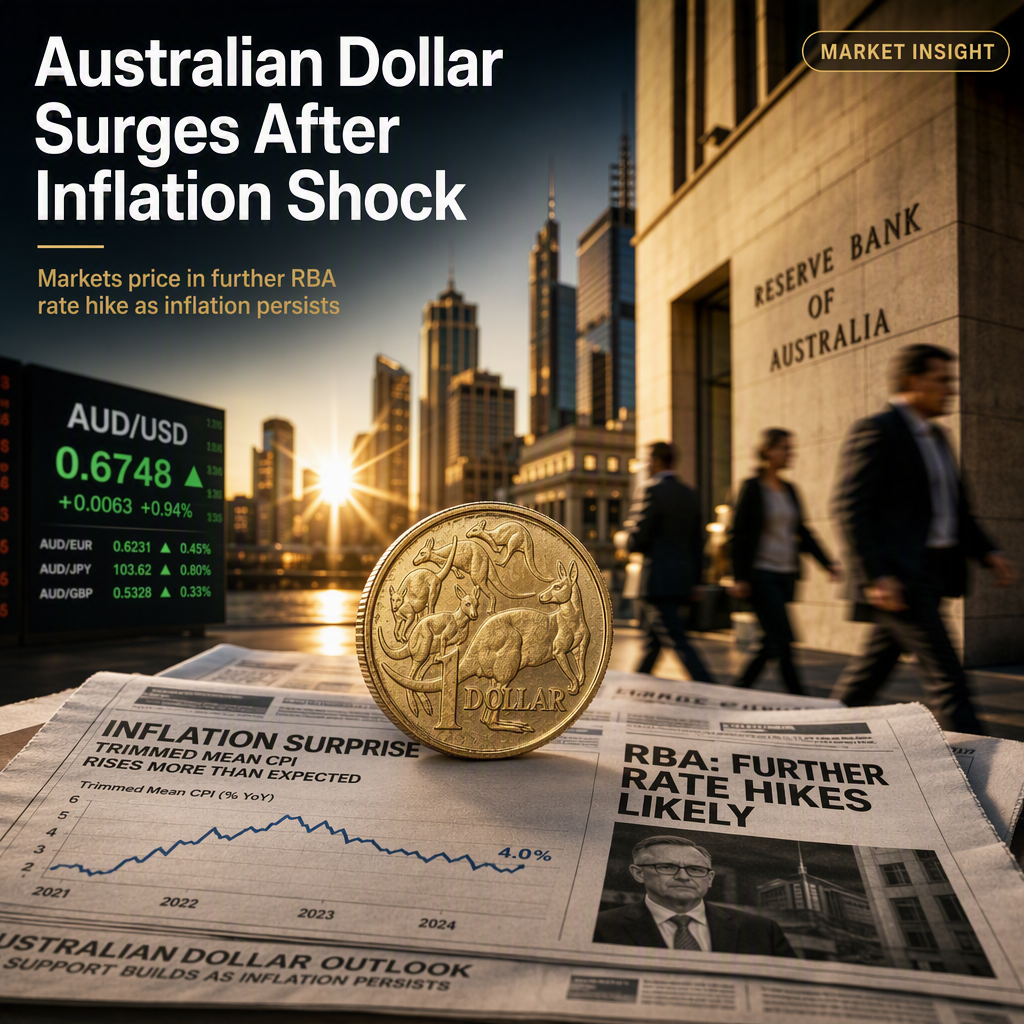
Australian inflation data for July came in above market expectations, with headline inflation easing from 3.8% year-over-year in June to 3.5% in July, and trimmed mean inflation holding steady at 3.6% year-over-year. Both measures exceeded market forecasts, prompting a reassessment of the Reserve Bank of Australia's (RBA) policy outlook [1]. The RBA is targeting an average trimmed mean inflation rate of 3.3% year-over-year in the second half of 2026, making the July reading an 'unhelpful start' to the period according to OCBC Bank strategists Sim Moh Siong and Christopher Wong [1].
Following the inflation release, markets fully priced in an additional 25 basis point hike by February 2027, up from around a 70% probability beforehand. This shift in expectations helped the AUD/USD currency pair retest resistance in the 0.7180–0.7200 range [1]. OCBC strategists remain constructive on the Australian Dollar over the next one to two quarters, citing its attractive carry and the potential for further Chinese policy stimulus as supportive factors [1].
While the base case is that the RBA's tightening cycle has ended, the persistence of above-target inflation means that another rate hike cannot be ruled out. Over the medium term, OCBC expects gains in the Australian Dollar to become more gradual as economic growth slows, inflation moves closer to target, and the RBA begins to shift away from a restrictive policy stance [1].
CONCLUSION
Australian inflation data exceeded expectations, prompting markets to fully price in a further RBA rate hike by early 2027 and boosting the Australian Dollar. While the RBA is likely finished tightening for now, persistent inflation keeps the risk of another hike alive, supporting a constructive outlook for the AUD in the near term.