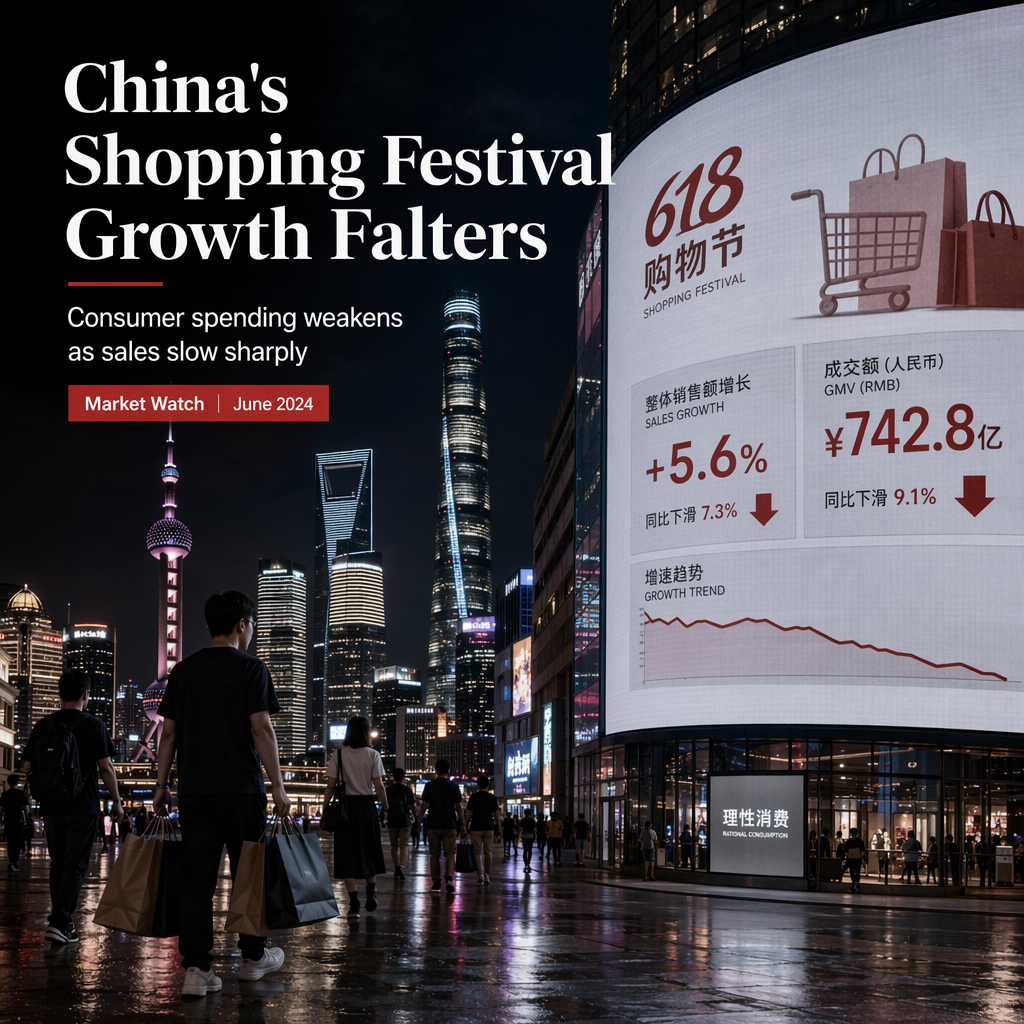
China's 618 shopping festival, a major annual e-commerce event, saw its sales growth slow significantly this year, reflecting ongoing weakness in consumer spending. According to retail data firm Syntun, total online sales during the festival, which ran from May 13 to June 18, increased by just 4% compared to the previous year—a sharp decline from the 15.2% growth recorded during last year's event [1]. The total sales reached 934 billion yuan ($137.86 billion), including same-day 'instant' delivery orders and group purchases [1].
This subdued growth comes amid broader signs of consumer malaise in China. Retail sales fell 0.6% in May year-over-year, marking the first decline since China lifted pandemic restrictions in 2022 [1]. Goldman Sachs highlighted that AI-driven job losses could further dampen consumer spending and housing demand, noting a widening divergence between the high-tech/AI sector and property/consumption in both industrial production and capital market data [1]. As a result, Goldman Sachs lowered its forecast for second-quarter real GDP growth to 4.5% from a year earlier, down from a previous estimate of 4.7%, though the full-year outlook remains at 4.7% [1].
Among e-commerce platforms, Alibaba's Tmall led in sales, followed by JD.com and ByteDance's Douyin, but the segment as a whole saw only 0.9% sales growth, according to Syntun [1]. In contrast, secondhand electronics platform ATRenew reported nearly 80% year-over-year growth in sales of preowned products during the festival, indicating a shift toward lower-cost goods [1]. Last year, state subsidies fueled a 400% surge in home appliance sales, but this year, demand shifted to home cleaning services, according to Jacob Cooke, CEO of WPIC, citing JD.com data [1].
Cooke also noted strong performance in fashion, lifestyle, beauty, and health supplements, as well as increased demand for AI-related hardware and the use of AI tools by online shopping platforms, which have helped boost brands' profit margins [1]. However, the broader economic impact of AI remains uncertain, with concerns that AI-related job displacement could exacerbate macroeconomic challenges [1].
CONCLUSION
The sharp slowdown in 618 shopping festival sales growth underscores persistent weakness in Chinese consumer spending, despite pockets of strength in specific categories and platforms. With retail sales declining and GDP growth forecasts being trimmed, market sentiment remains cautious as structural shifts and AI-driven changes continue to reshape the economic landscape.