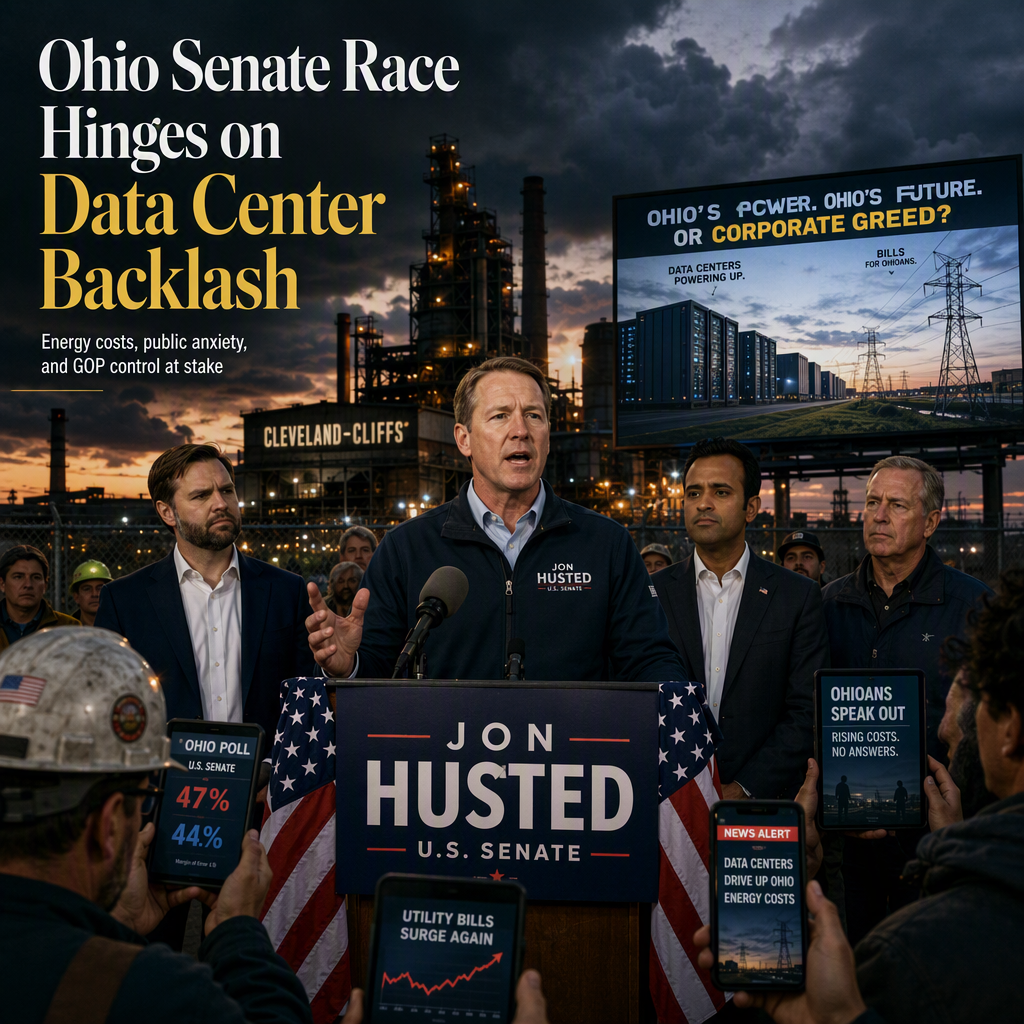
Sen. Jon Husted, R-Ohio, currently seeking reelection, publicly defended President Donald Trump's energy and economic policies amid growing voter anxiety over the impact of data centers on utility prices in Ohio [1]. Husted made these remarks during an appearance at the Cleveland-Cliffs steel plant in Middletown, Ohio, alongside Vice President JD Vance and other Republican officials, including GOP gubernatorial candidate Vivek Ramaswamy [1].
The National Republican Senatorial Committee (NRSC) recently warned that backlash against data centers could jeopardize Husted's Senate seat, labeling the issue a 'sleeper' concern this election cycle as Americans express increasing worry about rising utility costs [1]. Ohio is home to several large data center projects, including a proposed 10-gigawatt campus in Pike County with an estimated cost exceeding $500 billion [1].
Husted attributed higher electricity costs to Democratic policies, specifically citing the closure of 23 power plants in Ohio under the Obama and Biden administrations, which he claims represented half of the state's daily electricity usage [1]. He argued that 'radical climate policies' were responsible for these closures, not the construction of data centers [1].
Polling data indicates that Husted is narrowly trailing former Democratic Sen. Sherrod Brown in the upcoming election, with his seat considered crucial for Republicans to retain their Senate majority [1]. The GOP remains favored to keep the Senate, but concerns persist due to Trump's declining approval ratings, rising inflation, the ongoing Iran war, and the intensifying debate over data centers [1]. The NRSC memo cautioned that if negative perceptions of data centers are not addressed, opposition could spread beyond Ohio [1]. Husted also highlighted the Trump administration's investment in Ohio manufacturing, referencing a $500 million Department of Energy grant to Cleveland-Cliffs for a hydrogen-powered furnace, initially awarded by the Biden administration [1].
CONCLUSION
The Ohio Senate race has become a focal point for debates over energy policy and the economic impact of data centers, with Sen. Husted defending Republican positions amid rising voter concerns. The outcome of this contest is seen as pivotal for Senate control, and the GOP faces mounting pressure to address public anxieties over utility costs and data center expansion. Market and political observers are closely watching how these issues influence voter sentiment leading up to the election.