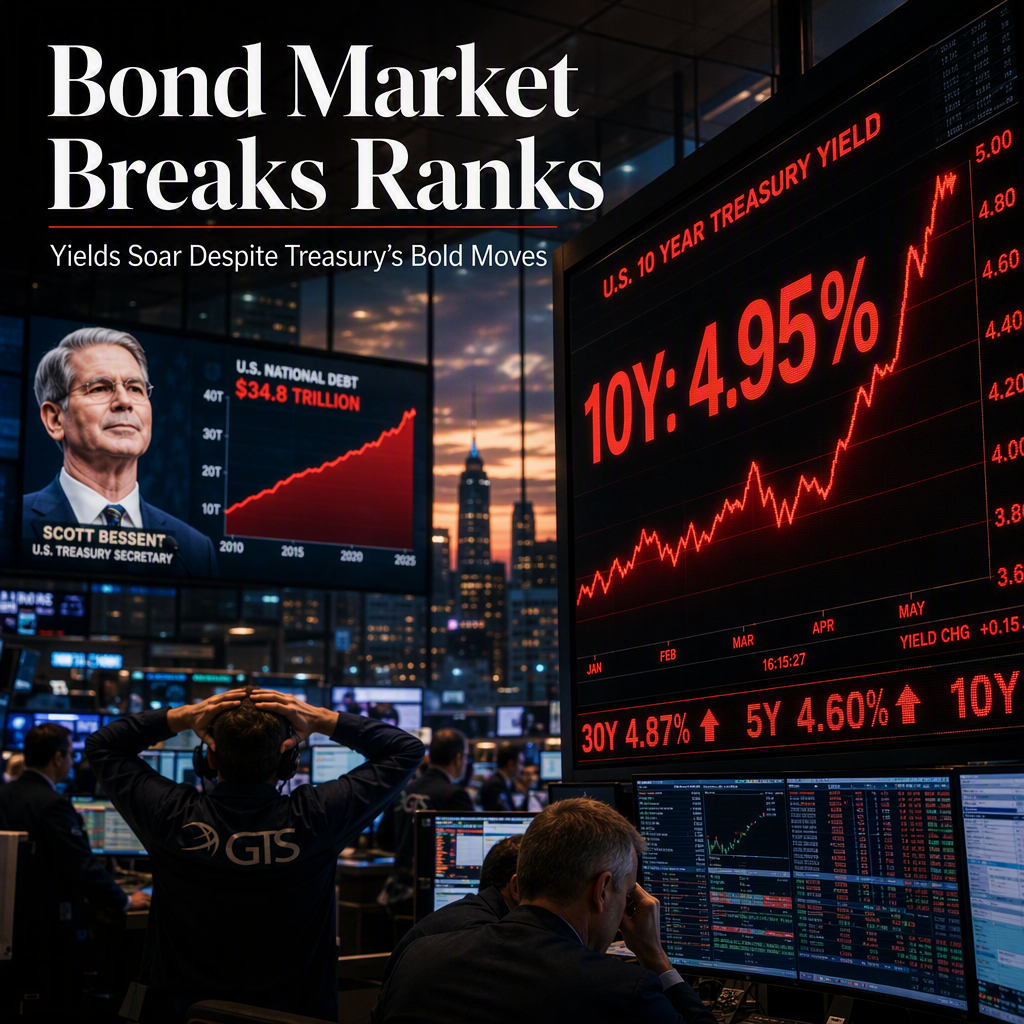
Treasury Secretary Scott Bessent is facing resistance from bond traders as his efforts to lower longer-term interest rates and reduce the government's borrowing costs have not succeeded, with yields on U.S. Treasurys surging to multiyear highs [1]. Bessent had promised to 'at least double' the government's typical repurchases of government debt last month, aiming to increase demand for bonds and lower interest rates, especially as the nation's debt surpassed $40 trillion [1]. On September 8, Bessent declared, 'I have asymmetric information. I am the house now. You can bet against me if you want,' signaling confidence in his strategy [1].
Despite these moves, including a $6 billion repurchase of longer-dated 10- to 20-year government bonds announced by the Treasury Department, the market responded by pushing 10-year yields up to 4.85%, and further to 4.95% by the end of Thursday. This marks the highest rate since November 2023 and a roughly 0.30-point increase since Bessent began the repurchase announcements in August [1]. Bond strategist Guy LeBas commented that the size of the buybacks is 'at this point, not enough to make a difference' on interest rates, highlighting the limited impact of the Treasury's actions [1]. On the same day as the $6 billion buyback, the Treasury issued $39 billion in 10-year notes, further underscoring the scale of ongoing debt issuance [1].
Wall Street analysts have observed that Bessent's approach is unusual, with the Bank of America research team noting that 'Treasury debt management is entering a new regime' [1]. Bessent has indicated openness to further increases in buybacks, but with both yen intervention and buybacks failing to depress longer-term rates, the Treasury Department may be running out of effective tools, short of more drastic measures such as discontinuing some longer-dated bond issuance entirely [1].
Market reactions have been negative, as evidenced by the continued sell-off in U.S. Treasurys and rising yields, with bond traders clearly betting against the administration's strategy [1].
CONCLUSION
The bond market has responded unfavorably to Treasury Secretary Bessent's debt management strategies, driving yields to their highest levels in years. Analysts and strategists suggest that current buyback measures are insufficient to influence interest rates, raising concerns about the administration's remaining options. The ongoing sell-off signals high market impact and uncertainty regarding future Treasury actions.