
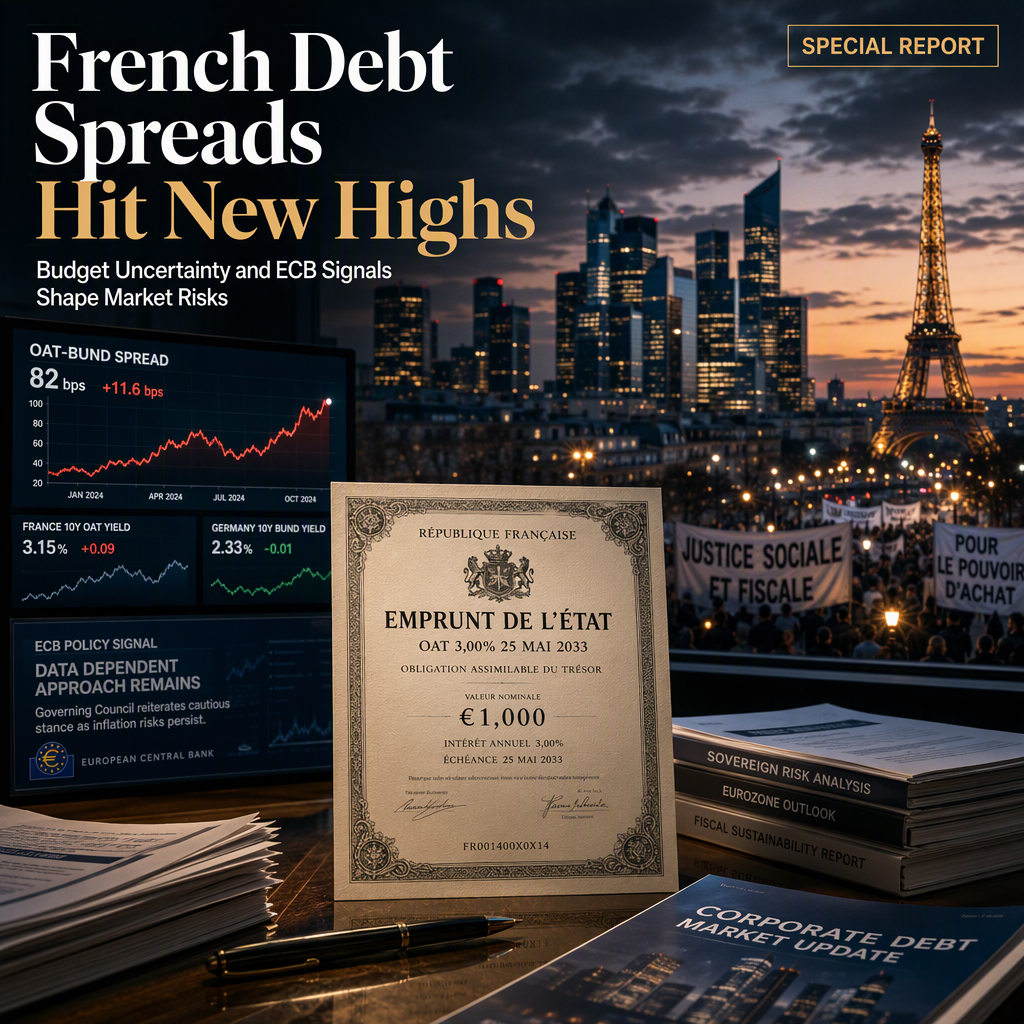
Rabobank's Senior Economist Maartje Wijffelaars reports that the OAT-Bund spread in Europe has edged up to near last week's post-GFC peak, reflecting increased risk perceptions surrounding French debt. Notably, 38% of French high-grade corporate debt now yields less than government bonds, indicating lower perceived credit risk among corporate issuers compared to the government itself [1]. The French government has not yet reassured markets regarding its budget plans, which has contributed to growing protests and political uncertainty ahead of next year's presidential election [1].
Despite these risks, Wijffelaars suggests that most of the spread widening may be over for now, as the current levels have become attractive to buyers of French debt. This is underpinned by the belief that France is 'too big to fail' and the existence of ECB instruments and programmes such as the ESM, OMT, and TPI, which could be deployed if necessary [1]. ECB President Christine Lagarde reiterated that the central bank has tools to counter unwarranted market dynamics, while Governing Council member Moulin and French finance minister Lescure stated that conditions for direct ECB intervention are not currently met [1].
For now, ECB action is expected to remain limited to guidance, with policy intervention considered unlikely. Other eurozone countries may meet TPI conditionality, but intervention is not warranted based on current spreads. Should France become eligible for ECB support, it would likely require proof of a credible budget, compliance with EU structural expenditure rules, and evidence that markets remain unresponsive to verbal intervention and a pause in quantitative tightening [1].
September's ECB minutes revealed policymakers debating another rate hike versus growth risks, viewing a 2.5% rate as neutral. They cited economic resilience and maintained deliberately non-committal communication. Future ECB decisions will take into account long-term yields, which have risen since the meeting and could materially impact growth and inflation [1].
CONCLUSION
French debt spreads have widened amid budget uncertainty and political unrest, but most of the widening appears to be over, with buyers attracted by current levels and ECB backstops. The ECB is expected to limit its response to guidance unless France demonstrates a credible budget and market conditions deteriorate further. Future ECB decisions will be influenced by long-term yields and their impact on growth and inflation.