
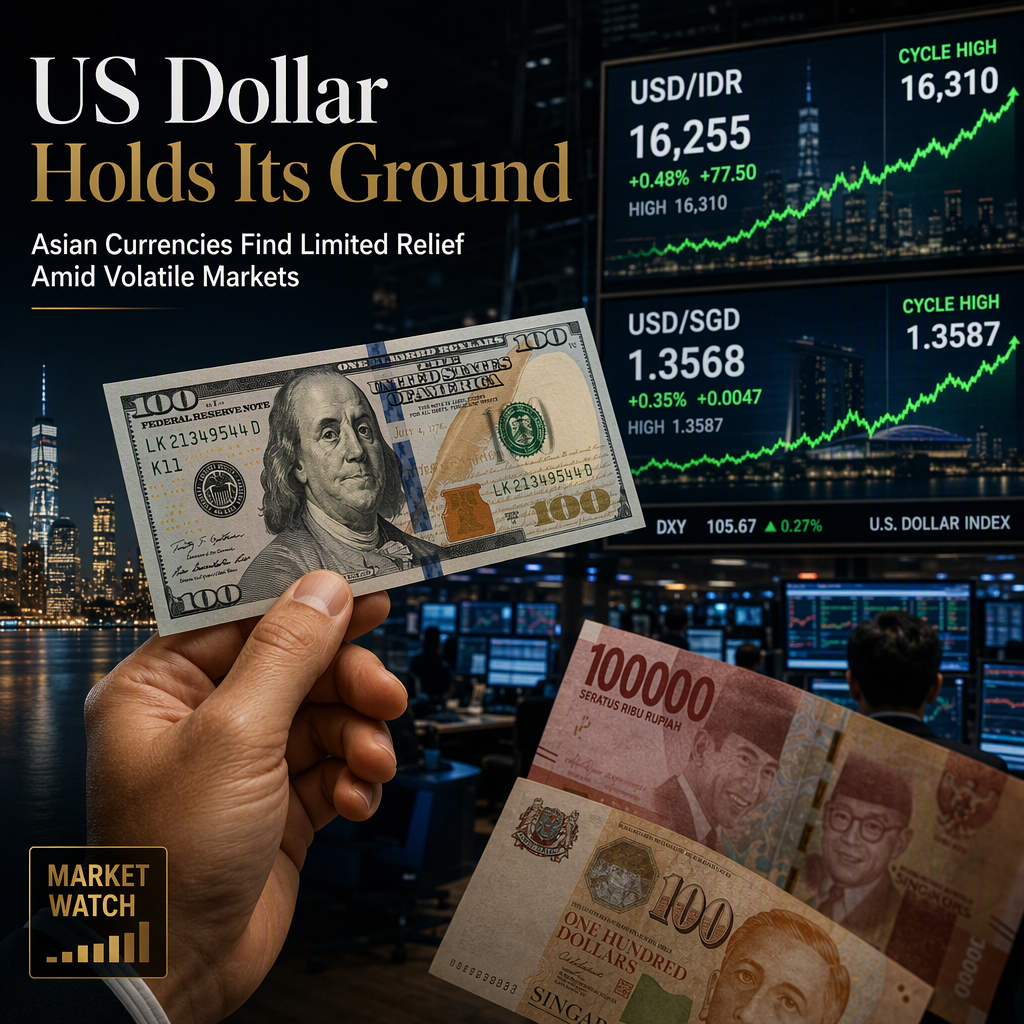
The US Dollar (USD) continued its broad rally last week, with the DXY index reaching new cyclical highs, supported by widening US-G6 interest rate differentials and a deepening global bond market selloff, according to Brown Brothers Harriman (BBH) [3]. Despite a softer September nonfarm payrolls (NFP) report, which reduced the odds of a consecutive Federal Reserve rate hike in October, BBH notes that US growth outperformance and strong foreign demand for US securities keep upside risks for the USD intact [3]. The brief relief in Treasuries following the NFP was short-lived, as the report still indicated a stable labor market and did not challenge the Fed’s tightening bias [3].
In the context of emerging markets, OCBC’s Christopher Wong highlights that the Indonesian Rupiah (IDR) may experience some near-term relief due to the softer US payrolls and a wider-than-expected August trade surplus, which provides an additional buffer [1]. However, this improvement in the trade balance was partly attributed to weaker-than-expected imports and may not signal a sustained external position improvement [1]. Policymakers in Indonesia remain focused on IDR stability, with Bank Indonesia (BI) emphasizing continued FX stabilization efforts and the Ministry of Finance underscoring coordination with BI and the importance of maintaining SBN attractiveness [1]. Despite the potential for a modest IDR recovery, a more sustained move would require a clearer moderation in US yields and oil prices, as elevated long-end US Treasury yields and high Brent prices continue to pose challenges [1]. The USD/IDR last closed at 17,875, with technical support at 17,820/40 and resistance at 17,950 and 18,000 [1].
For the Singapore Dollar (SGD), United Overseas Bank (UOB) strategist Quek Ser Leang observed that USD/SGD slipped to 1.2781 on Friday, with the SGD NEER remaining well above its midpoint [2]. The pair is expected to range-trade between 1.2775 and 1.2815 in the near term, with a recovery toward 1.2835 possible as long as the 1.2765 support holds [2]. UOB maintains a cautiously positive outlook for the USD against the SGD over a 1–3 week and 1–3 month horizon, though recent momentum has eased [2].
Overall, while the softer US payrolls data provided some short-term relief for Asian currencies like the IDR and SGD, the broader market environment remains challenging due to persistent USD strength, elevated US yields, and global bond market volatility [1][2][3]. Forward-looking statements from analysts suggest that a more sustained recovery for emerging market currencies would require a clearer decline in US yields and oil prices, while the USD retains upside risks due to US economic resilience and foreign capital inflows [1][3].
CONCLUSION
The US Dollar remains resilient, with upside risks persisting despite softer payroll data, as US growth and foreign demand for US assets continue to support the currency. While the Indonesian Rupiah and Singapore Dollar saw limited relief, their outlooks remain constrained by challenging external conditions. Sustained recovery for these currencies would likely require a significant moderation in US yields and oil prices.