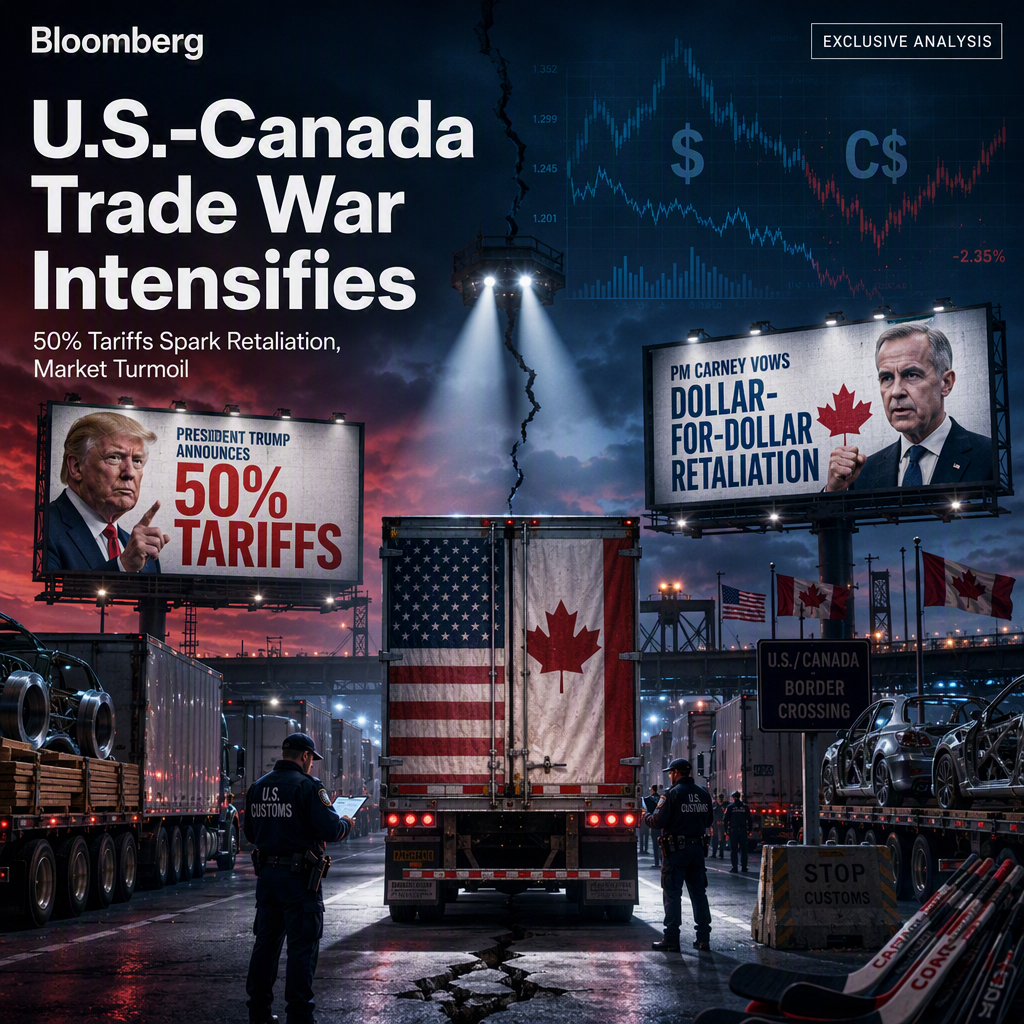
Trade tensions between the United States and Canada have sharply escalated following the collapse of negotiations between Washington and Ottawa on Friday, leading to the imposition of significant new tariffs. The U.S. imposed 50% tariffs on a range of Canadian goods, including cars, trucks, automotive parts, steel, and other products, with the new rates set to take effect on January 1, 2027 for autos and metals, and already in effect for a broad swath of goods as of 12:01 a.m. ET on Saturday [1][4]. President Donald Trump announced the measures on Monday, accusing Canada of taking advantage of the U.S. and encouraging companies to move production to the U.S. to avoid the tariffs [1][4].
Canadian Prime Minister Mark Carney responded by vowing to retaliate 'dollar for dollar' starting September 8, stating that Canada would not accept a bad deal and would protect its workers, farmers, families, and businesses [1][4]. Carney withdrew Canadian negotiators from the talks after the U.S. proposed what he described as 'uneconomic' and 'unfair' terms [4]. The tariffs, which cover goods such as hockey sticks and building materials, represent about 5% of Canada’s exports to the U.S., with sectors like plastics, electrical machinery, furniture, and wood products most affected. The economic impact is expected to be concentrated in Quebec, British Columbia, and Ontario [2].
Market reactions have been swift, with the Canadian Dollar (CAD) coming under selling pressure. The USD/CAD pair rose to around 1.3830, up 0.52% on the day, reflecting concerns about the outlook for the Canadian economy, which is heavily dependent on trade with the U.S. [1]. However, U.S. Trade Representative Jamieson Greer attempted to downplay the impact, stating that the tariffs affect a very small amount of trade and rejecting the term 'trade war' [4].
According to Royal Bank of Canada (RBC), while the tariffs are significant for certain sectors, they are not large enough to derail Canada’s overall economic growth. RBC does not expect the Bank of Canada to consider interest rate cuts in response, but notes that the intensification of trade uncertainty and recent moderation in underlying inflation trends increase the likelihood that the Bank will not hike rates this year. Fiscal policy is seen as a more appropriate tool for targeted relief, and there are reports that fiscal supports will follow the tariffs [2].
Broader market implications include increased uncertainty for North American trade flows and the potential for trade to reorient within the region to avoid tariff costs [2]. Additionally, ongoing geopolitical developments in the Middle East, particularly the Iran conflict and its impact on oil prices, could provide some support to the Canadian Dollar as higher energy prices benefit Canada as a major oil exporter [1][3]. TD Securities notes that the Iran-related oil shock and higher input costs pose stagflationary and recession risks for the U.S., with a 25% chance of recession over the next year and a forecast for U.S. GDP growth to remain slightly below trend in 2026 [3].
CONCLUSION
The escalation of U.S.-Canada trade tensions, marked by new 50% tariffs and reciprocal threats, has heightened uncertainty for key sectors and weighed on the Canadian Dollar. While the overall macroeconomic impact is expected to be contained, the situation introduces significant risks for affected industries and adds to broader market volatility. Ongoing geopolitical developments and policy responses will be critical in shaping the outlook for both economies.