
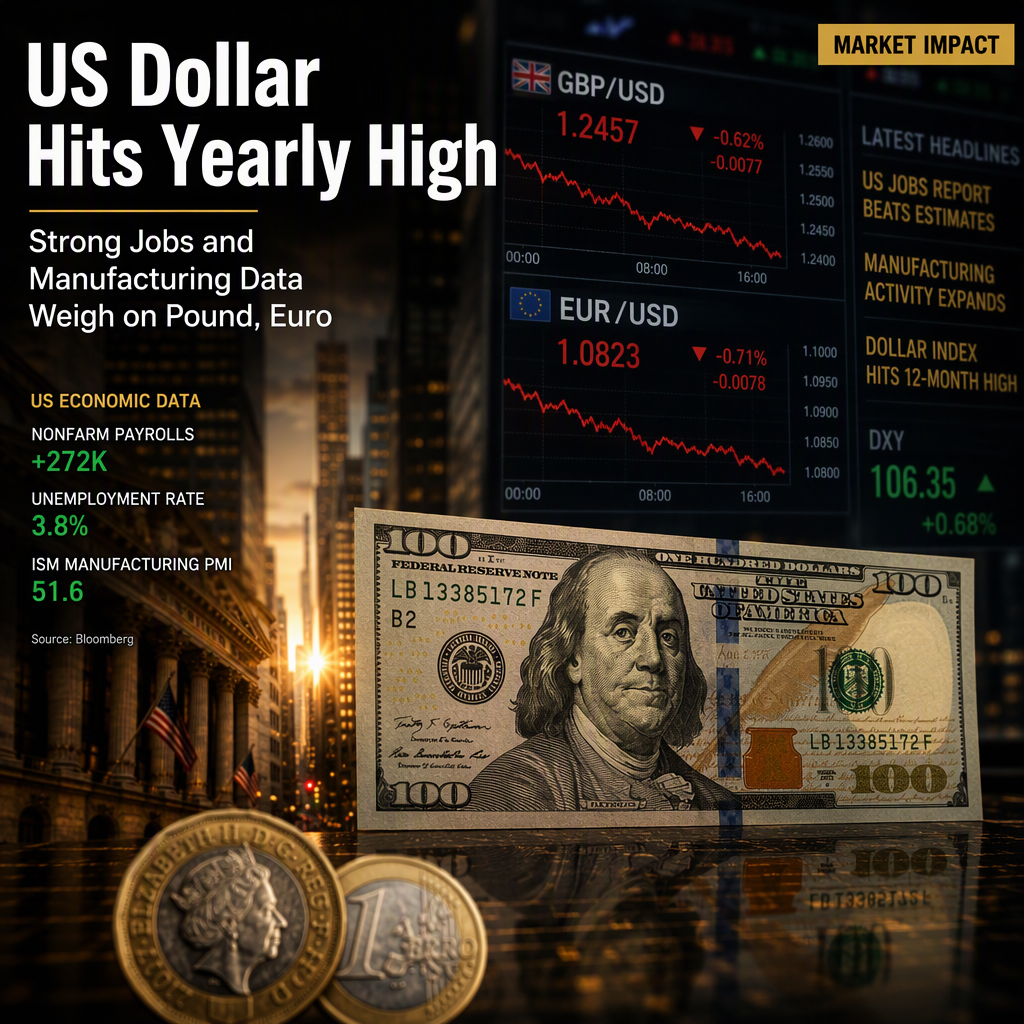
On Thursday, the US Dollar (USD) strengthened significantly against both the British Pound (GBP) and the Euro (EUR), driven by robust US economic data and elevated Treasury yields. The GBP/USD pair dropped by over 0.44%, trading at 1.320 after hitting a low of 1.3182, its weakest level since June 26, while EUR/USD fell to 1.1253, down 0.67% and marking its lowest level since May 2025 and a fresh year-to-date low [1][2]. The US Dollar Index (DXY), which tracks the USD against six major currencies, rose 0.47% to 101.94 and set a new yearly high at 101.96 [1][2].
US economic data showed continued strength. The ISM Manufacturing PMI for September was 54.5, slightly below the forecast of 55 and August's 54.6, but still well above the 50 mark indicating expansion [1][2]. The ISM Prices Paid Index surged to 77.1 according to [1] and 77.9 according to [2], both exceeding expectations of 72.3, signaling rising inflationary pressures. Initial Jobless Claims for the week ending September 26 came in at 197K, below the forecast of 200K and the previous week's 198K, while the four-week moving average declined to 200K from 202.5K [1][2]. The ADP report showed private-sector employment increased by 90K in September, beating expectations of 70K and rising sharply from 36K in August [2].
Despite the strong data, the Fed's preferred inflation measure, core PCE, rose 0.2% month-on-month in August, below the 0.3% forecast, and the annual rate remained at 3.0%, under expectations of 3.3% [2]. This has led traders to decrease the probability of a rate hike at the Fed's October meeting, with estimates dropping from around 38% to 30% according to Prime Terminal [1], and the CME FedWatch Tool showing about a 36% chance [2]. Fed officials remain concerned about inflation, with Kansas City Fed President Jeff Schmid stating, "Officials have work to do on inflation," and Boston Fed President Susan Collins noting, "Economic growth is near trend, if not more than that; labor market near full employment, but inflation is too high" [2].
Geopolitical tensions, particularly between the US and Iran, are contributing to elevated energy prices and market uncertainty. Reports indicate that the US plans to deploy three aircraft carriers and two landing groups around Iran by the end of November, keeping oil prices bid and US Treasury yields near levels last seen in the 2000s [1][2].
In the UK, the economic docket was sparse, with attention turning to Prime Minister Andy Burnham's speech, which hinted at potential changes to pensions and the possibility of rejoining the European Union. ING strategist Chris Turner commented that such a move "would likely be seen as a positive by the foreign exchange market, having witnessed sterling's crash following the Brexit vote in 2016" [1]. In the Eurozone, the final HCOB Manufacturing PMI rose to 52.9 in September from 52.7, its highest since May 2022, but offered limited support to the Euro [2]. The European Central Bank has raised rates twice this year, with markets expecting further tightening as inflation remains elevated [2].
CONCLUSION
Strong US jobs and manufacturing data, alongside rising inflationary pressures, have propelled the US Dollar to new highs against both the Pound and Euro. While the Fed remains cautious on inflation, traders see a reduced likelihood of an October rate hike. Geopolitical tensions and elevated energy prices continue to support the Greenback, resulting in high market impact and increased volatility across major currency pairs.