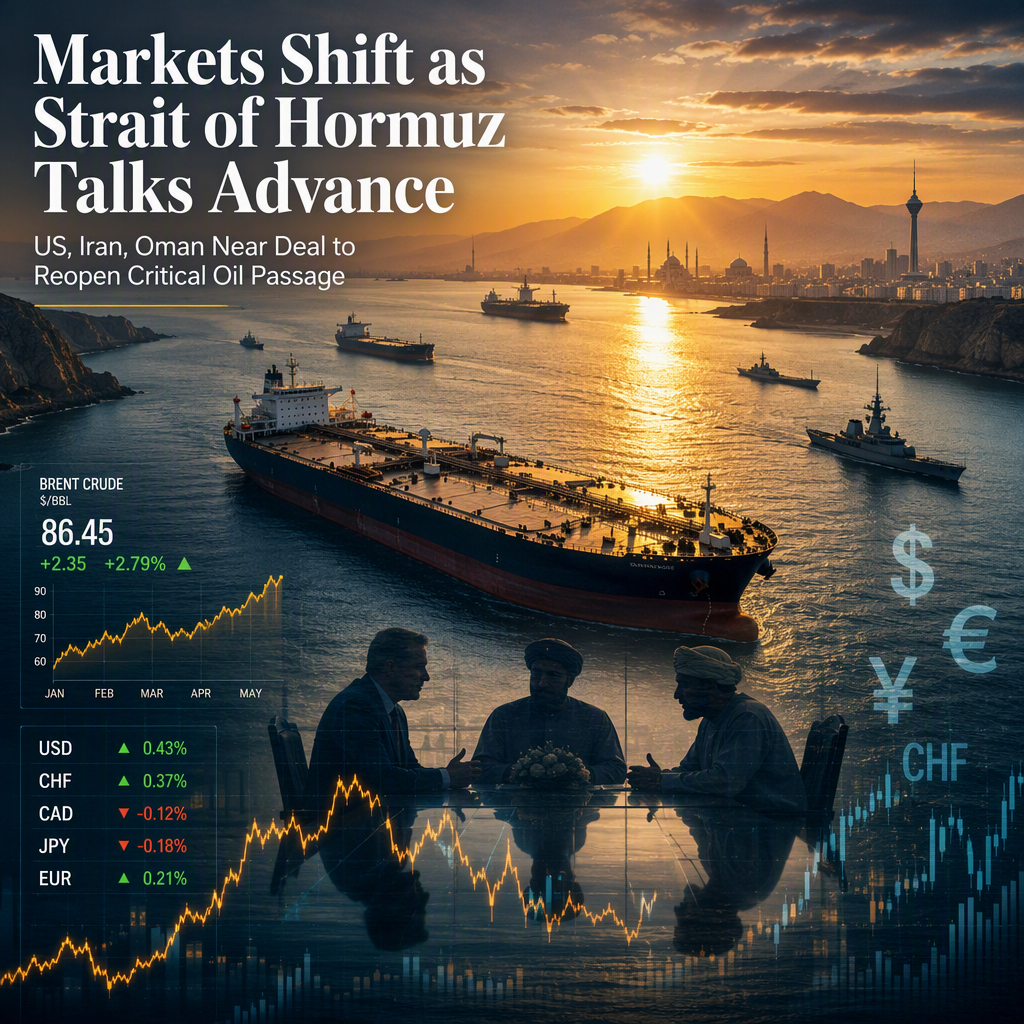
Multiple financial markets responded on Wednesday to reports that the United States, Iran, and Oman are close to reaching an interim agreement to reopen the Strait of Hormuz, a critical chokepoint for nearly 20% of global energy supply. Axios reported that the deal under discussion would establish a 60-day temporary arrangement between Oman and Iran, with the US aiming for a Wednesday announcement. This development has contributed to easing risk aversion and receding safe-haven demand for the US Dollar (USD) [1][2][3].
The Swiss Franc (CHF) gained against the US Dollar, with USD/CHF extending losses for the second consecutive day and trading around 0.8080 during Asian hours. The depreciation of the USD was attributed to diminished safe-haven demand amid growing diplomatic momentum over the Hormuz Strait talks. However, the US Dollar found some support from a recovery in the 10-year US Treasury yield, which dipped toward 4.61% on Tuesday due to falling energy prices. These lower energy prices helped cool inflation fears and tempered expectations of a hawkish Federal Reserve response [1].
In the Canadian Dollar (CAD) market, USD/CAD traded with a positive bias for the fourth straight day, hovering around 1.4070, near a one-week high. Weak oil prices, driven by optimism over the potential US-Iran deal, undermined the commodity-linked Loonie. While weaker oil prices eased inflation fears and tempered Fed rate hike expectations, receding geopolitical tensions also weighed on the safe-haven USD, capping further upside for the currency pair. US Treasury Secretary Scott Bessent commented that the US could reach a deal with Iran to reopen the strategic waterway by Wednesday, fueling optimism for a diplomatic resolution. Despite these developments, traders are still pricing in a greater chance of a US rate hike by year-end, supported by comments from Fed officials backing higher rates to fight inflation [2].
The EUR/JPY cross softened below 182.00, trading around 181.70, as the Japanese Yen (JPY) strengthened on intervention risks and improved risk sentiment stemming from the US-Iran-Oman talks. The potential agreement to reopen the Strait of Hormuz was seen as a factor that could improve risk sentiment and support riskier assets like the Euro against the Yen. Societe Generale analysts noted that a sustained recovery in the Yen would require a credible improvement in Japan’s growth outlook, not just faster Bank of Japan rate hikes. Technical analysis indicated a bearish near-term tone for EUR/JPY, with downside pressure persisting but possibly nearing exhaustion [3].
Across all sources, the focus remains on the anticipated Wednesday announcement regarding the Strait of Hormuz, with market participants also watching upcoming US economic data and further geopolitical headlines for additional direction [1][2][3].
CONCLUSION
Markets across currencies and commodities are reacting to reports of a potential interim deal between the US, Iran, and Oman to reopen the Strait of Hormuz. The prospect of eased geopolitical tensions has weakened the US Dollar's safe-haven appeal, pressured oil prices, and influenced major currency pairs. Investors remain attentive to the official announcement and upcoming economic data for further market direction.