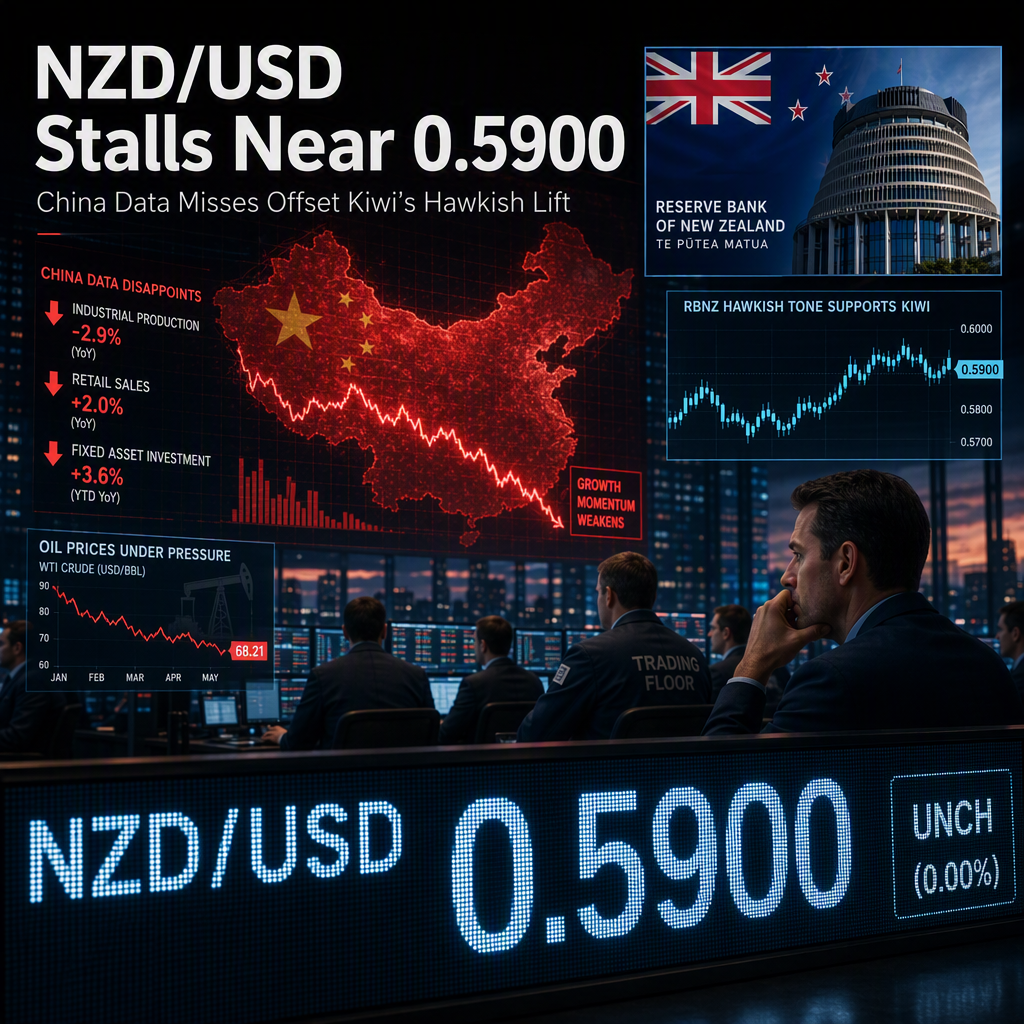
The New Zealand Dollar (NZD) remained nearly flat against the US Dollar (USD), trading around the 0.5900 level, despite a generally weaker Greenback and a hawkish stance from the Reserve Bank of New Zealand (RBNZ) [1]. The USD's softness was attributed to a series of cooler US economic data in August, which has led to reduced expectations for further Federal Reserve rate hikes, with a Reuters poll now indicating rates are likely to remain on hold for the rest of the year [1].
However, the NZD's inability to capitalize on these supportive factors was primarily due to disappointing economic data from China, New Zealand's largest export market. Over the weekend, Chinese industrial production and retail sales both slowed and missed forecasts, signaling weaker activity and dampening demand for commodity-linked currencies like the Kiwi [1]. This underperformance in China was significant enough to offset the positive influences from both the RBNZ's hawkishness and the soft USD, leaving the NZD/USD pair stagnant while the Australian Dollar outperformed among major currencies [1].
Additionally, rising geopolitical tensions involving Iran have pushed oil prices higher. For New Zealand, a net energy importer, this presents a mixed scenario: higher energy costs could weigh on the economy, but they also contribute to inflationary pressures, potentially reinforcing the RBNZ's case for a rate hike in September [1].
From a technical perspective, NZD/USD is trading at 0.5903, maintaining a modest bullish bias as it consolidates above the 20-period SMA (0.5877) and the 100-period SMA (0.5855) on the 4-hour chart. The RSI near 60 suggests firm, but not excessive, upside momentum. Key resistance levels are noted at 0.5907, 0.5911, and 0.5922, with a break above these potentially opening the way to 0.5965. On the downside, support is seen at 0.5899, followed by the 20-period SMA at 0.5877 and the 100-period SMA at 0.5855 [1].
CONCLUSION
The NZD/USD pair is currently range-bound, as weaker Chinese data offsets the supportive effects of a dovish Fed outlook and the RBNZ's hawkish stance. Market participants are watching for further developments in China and energy markets, as well as the RBNZ's next policy move, to determine the pair's next direction.