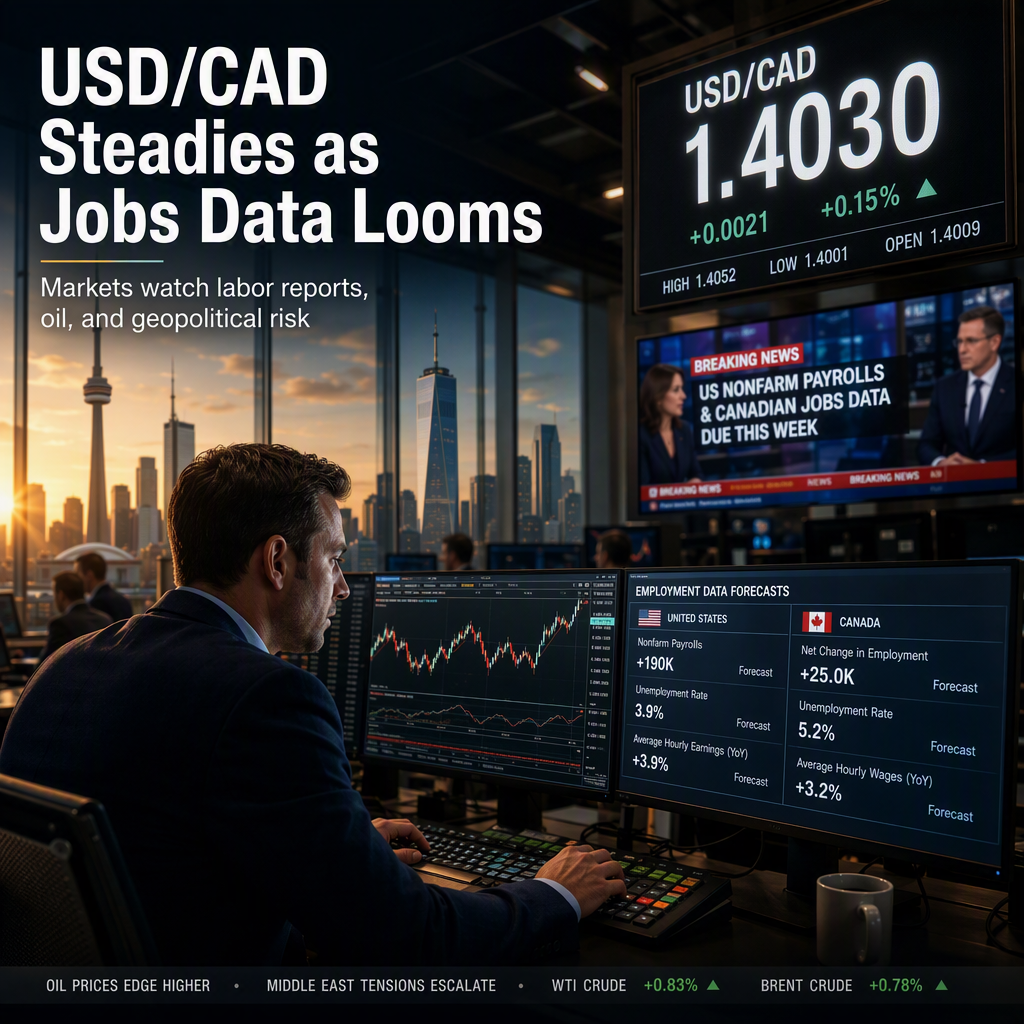
The USD/CAD currency pair rebounded on Thursday, trading around 1.4030 and up 0.12% on the day, after briefly dipping below the key 1.4000 support level. This move comes as the US Dollar snapped a two-day losing streak, with traders repositioning ahead of the highly anticipated employment reports from both the United States and Canada scheduled for Friday [1].
Market expectations for the US Nonfarm Payrolls (NFP) report are for an increase of 80,000 jobs in July, up from 57,000 in June, while the US Unemployment Rate is forecast to remain steady at 4.2%. This follows a series of softer US labor market data earlier in the week, including the ADP Employment Change and JOLTS Job Openings. However, Thursday's Initial Jobless Claims data showed only a slight rise to 199,000 from 198,000, coming in below the forecast of 202,000, which may have contributed to the USD's stabilization [1].
In Canada, employment is projected to rise by 15,000 following an 18,200 increase in June, with the Unemployment Rate expected to hold at 6.5% [1]. The Canadian Dollar was the strongest against the Swiss Franc among major currencies, and gained 0.14% against the US Dollar on the day [1].
Broader market sentiment remains fragile due to ongoing tensions in the Middle East. Iran and Oman are reportedly close to finalizing a temporary shipping route agreement through the Strait of Hormuz, though no final deal has been announced. Tehran has denied direct talks with the US, despite Washington's claims of ongoing negotiations. These geopolitical developments have kept energy-driven inflation risks in focus, with West Texas Intermediate (WTI) Crude Oil prices rising nearly 3.5% to around $77.00 per barrel, halting their recent decline [1].
CONCLUSION
The USD/CAD pair's resilience above 1.4000 reflects cautious market positioning ahead of key US and Canadian labor data. While recent US jobless claims were better than expected, broader sentiment remains fragile due to geopolitical risks and rising oil prices. The upcoming employment reports are likely to set the near-term direction for both currencies.