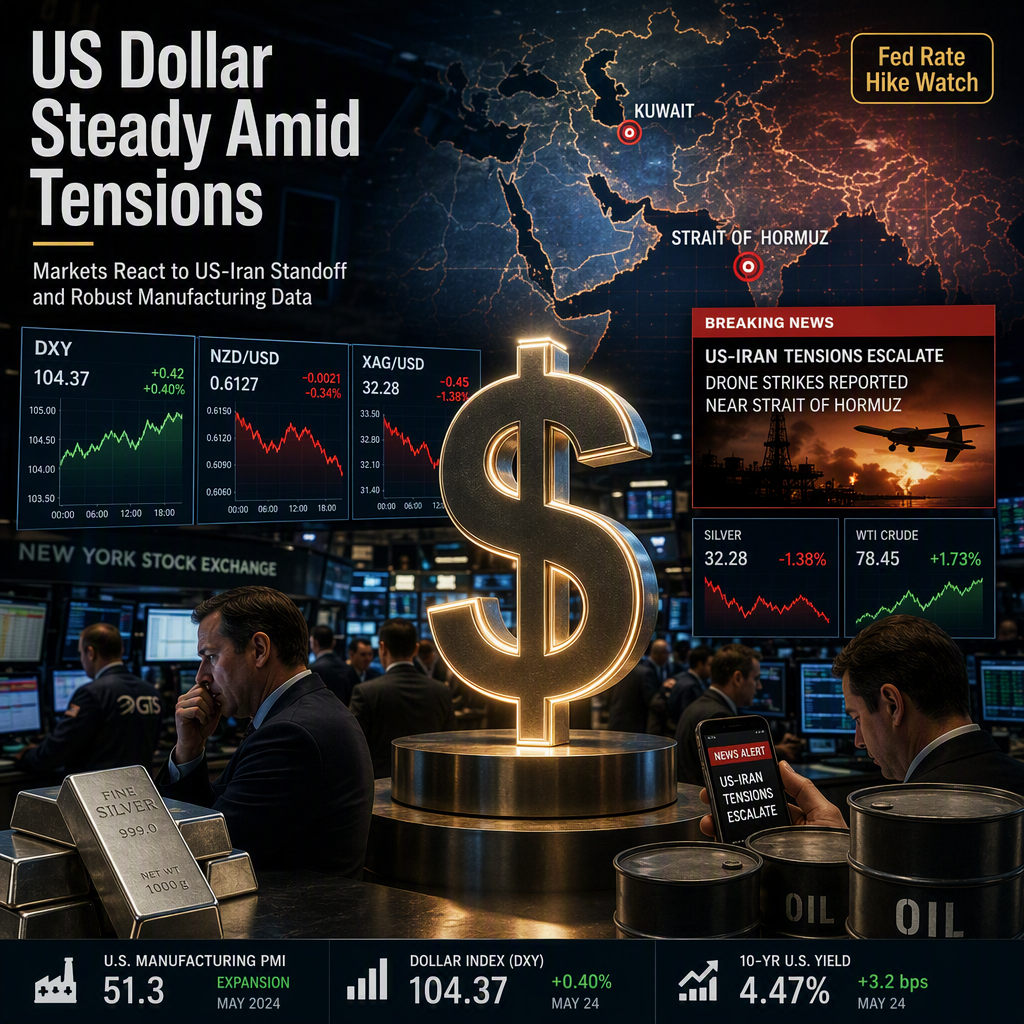
The US Dollar Index (DXY) remained steady around the 100.00 mark during Asian trading hours, as geopolitical tensions between the US and Iran lent support to the safe-haven currency. The index paused after a previous recovery from its lowest level since mid-June, with traders cautious ahead of upcoming US employment data. The optimism over a potential US-Iran peace deal faded quickly after Iran stated there were no talks underway with the US and no plans for meetings, contradicting US President Donald Trump's assertion that negotiations would resume soon. Unconfirmed reports of drone strikes on US assets in Kuwait further heightened geopolitical risk, supporting the US Dollar [1][3].
Mohsen Rezaee, a senior adviser to Iran's Supreme Leader, warned that Tehran would not allow any shipping route through the Strait of Hormuz other than the one designated by Iran, and threatened that US vessels and forces could face serious risk if the standoff continues. This rhetoric supported crude oil prices and revived inflation concerns, keeping expectations for at least one Federal Reserve rate hike alive [1][2].
On the economic front, US manufacturing sector activity accelerated, with the ISM Manufacturing PMI rising to 55.6 in July from 53.3 in June, surpassing consensus estimates of 54.0. This data reinforced hawkish expectations for the Federal Reserve, with markets pricing in a roughly 65% chance of a 25 basis point rate hike at the September meeting, according to the CME FedWatch tool. Fed’s Williams reiterated confidence in the current policy path, emphasizing a steady approach to inflation targeting, while the FXS Fed Sentiment Index showed a modest pullback in perceived hawkishness but remained in hawkish territory [1][2][3].
Silver (XAG/USD) extended gains for a second day, trading around $58.70 per troy ounce, as investors sought non-yielding assets amid geopolitical uncertainty and ongoing Fed policy recalibration. The New Zealand Dollar (NZD/USD) softened below 0.5900, pressured by the stronger US Dollar and uncertainty over US-Iran talks. Analysts expect the Reserve Bank of New Zealand to continue tightening policy, with forecasts for the Official Cash Rate to reach 3.25% to 3.75% by year-end, though immediate market focus remains on New Zealand’s upcoming employment report [2][3].
According to [1] and [3], President Trump claimed an agreement with Iran was imminent, but Iranian officials denied direct talks, stating negotiations were only occurring with mediators in Oman. This discrepancy underscores the ongoing uncertainty and market sensitivity to geopolitical developments.
CONCLUSION
The US Dollar remains supported by heightened geopolitical tensions and robust manufacturing data, while silver benefits from safe-haven flows and the New Zealand Dollar faces pressure from USD strength. Market participants are closely watching upcoming US employment data and central bank policy signals, with expectations for further Fed tightening still in play. The situation remains fluid, with geopolitical headlines continuing to drive market sentiment.