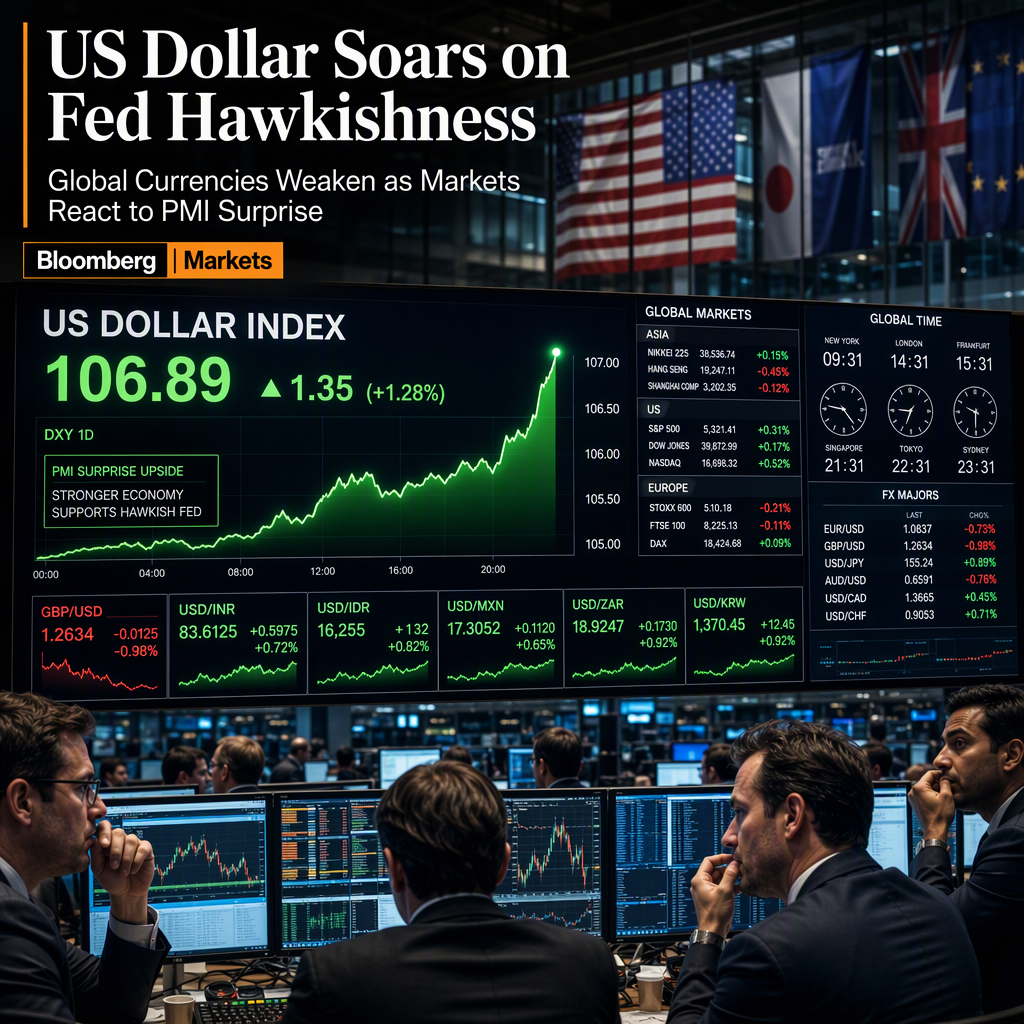
A series of robust US economic data releases and hawkish commentary from Federal Reserve officials have driven the US Dollar to multi-week highs, pressuring major global currencies and impacting equity markets across Asia. The US S&P Global Flash Purchasing Managers Index (PMI) for September showed significant improvement, with the Composite PMI rising to 58.4 from 56.0 in August and the Manufacturing PMI climbing to 57.0 from 53.9, both exceeding forecasts [1][3]. The Services PMI also surprised to the upside at 58.7, compared to 56.5 in August and an expected 56.0 [3]. These strong data points have reinforced expectations for further Fed rate hikes, with market odds for an October increase surging to 69.7%, up from 48.7% the previous week [2].
Federal Reserve officials, including Governor Michael Barr and Richmond Fed President Thomas Barkin, have reiterated the need for additional policy tightening to combat persistent inflation, with Barkin stating that a single rate hike may not suffice [1][3]. This hawkish stance has propelled the US Dollar Index to its highest level since late July, with broad gains against major currencies and particular weakness in high beta FX such as the NZD, MXN, ZAR, and KRW [2].
The British Pound (GBP/USD) has managed modest gains near 1.3240 but faces headwinds from the widening policy gap between the hawkish Fed and a more cautious Bank of England (BoE) [1]. While markets are pricing in a 67% chance of a BoE rate hike in November and another in December, strategists at Brown Brothers Harriman warn that the BoE may not need to tighten as much as markets expect, given the UK economy's current state and restrictive fiscal policy [1]. Technical analysis shows GBP/USD remains bearish and oversold, suggesting selling pressure could moderate but the downside bias persists [1].
In Asia, the Indonesian Rupiah (USD/IDR) and Indian Rupee (USD/INR) have both depreciated against the US Dollar. The USD/IDR traded around 17,920 as the Rupiah faced pressure from fiscal concerns and higher oil prices, with Bank Indonesia holding its benchmark rate at 5.75% [2]. The USD/INR jumped to near 95.90, with the Rupee under pressure from rebounding oil prices and strong US Dollar demand, as higher energy costs weigh on India's import-dependent economy [3].
Asian equity markets traded mixed ahead of a key meeting between US President Donald Trump and Chinese leader Xi Jinping, with the Nikkei 225 up 1.65%, KOSPI up 0.9%, but Shanghai and Hang Seng indices down 1% and 0.75% respectively, and India's Nifty 50 falling 0.9% [4]. The rally in US 10-year Treasury yields to 5.13%, the highest in 19 years, has diminished the appeal of risk-sensitive assets, with the CME FedWatch tool indicating expectations for Fed rate hikes at both remaining policy meetings this year [4].
CONCLUSION
Stronger-than-expected US economic data and hawkish Fed rhetoric have fueled a broad rally in the US Dollar, pressuring global currencies and weighing on risk assets. Market participants are bracing for further Fed tightening, with high US bond yields and rising rate hike expectations driving volatility in both currency and equity markets worldwide.