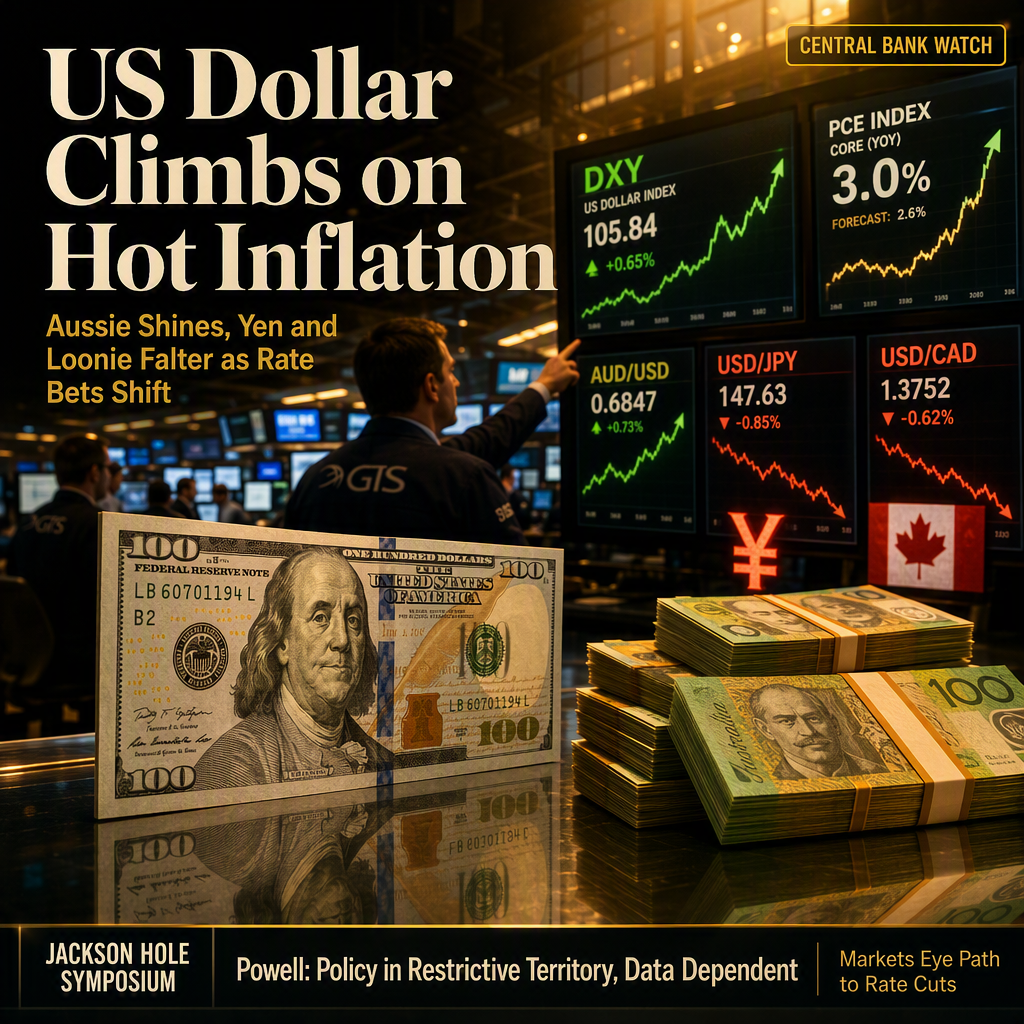
The US Dollar firmed across major currency pairs on Wednesday following the release of hotter-than-expected US inflation data. The Personal Consumption Expenditures (PCE) Price Index, the Federal Reserve's preferred inflation gauge, rose 0.2% month-on-month in July, surpassing the 0.1% forecast and reversing June's 0.1% decline. On an annual basis, headline PCE inflation held steady at 3.7%, above the 3.6% consensus, while core PCE remained at 3.3% year-on-year, matching expectations but accelerating from June's 0.1% monthly rise [1][2][3]. The US Dollar Index (DXY) climbed roughly 0.25% to 99.17 on the day [3].
The Australian Dollar (AUD) initially stumbled against the firmer US Dollar, with AUD/USD trading around 0.7170, but later outperformed global FX peers as Australia's July Consumer Price Index (CPI) surged 1% month-on-month, beating the 0.8% forecast and lifting annual inflation to 3.5%. The trimmed mean, the Reserve Bank of Australia's (RBA) preferred core measure, rose 0.5% on the month and held at 3.6% year-on-year, above the 3.5% forecast [1][4]. This hot inflation print sharply lifted market expectations for an RBA rate hike, with futures markets nearly fully pricing in a 25-basis-point increase to 4.60% by year-end [4]. TD Securities noted that the July CPI 'firmly lines up the September RBA meeting as live,' while BBH cautioned that restrictive financial conditions and a cooling labor market could still prompt a prolonged hold [4]. Technical analysis from multiple sources indicated that AUD/USD retains a bullish tone, with resistance at 0.7175 and 0.7188, and a potential push toward 0.7200 if support at 0.7120 holds [1][4].
Elsewhere, the Japanese Yen (JPY) reversed earlier gains as the US Dollar strengthened post-PCE data, with USD/JPY recovering to 159.41 from an intraday low of 158.88 [3]. Despite expectations that the Bank of Japan (BoJ) may raise rates at its September meeting—57% of economists in a Reuters poll expect a hike from 1.00% to 1.25%—the Yen remained under pressure due to persistent fiscal concerns and limited impact from recent joint intervention efforts [3]. Rabobank strategists highlighted that a more proactive BoJ stance and reassurances about Japanese government bond supply would be needed for a sustained Yen recovery [3].
In North America, the Canadian Dollar (CAD) fell despite a 0.60% rise in oil prices to $81.20, as renewed trade tensions between the US and Canada weighed on the Loonie. USD/CAD rose 0.30% to around 1.3880, supported by sticky US inflation and threats of retaliatory tariffs between the two countries. Canadian Finance Minister Francois-Philippe Champagne announced tariffs of up to 50% on US products, while US President Donald Trump threatened further tariffs on Canadian autos and steel [2]. Technicals showed USD/CAD in a bullish structure, though overbought conditions suggested potential for consolidation [2].
Looking ahead, market participants are focused on the upcoming Jackson Hole Symposium, where Federal Reserve Chair Kevin Warsh is expected to provide further guidance on the US monetary policy outlook, particularly in light of persistent inflation [2][3].
CONCLUSION
Hotter-than-expected US and Australian inflation data drove significant currency market moves, with the US Dollar strengthening broadly and the Australian Dollar rallying on heightened RBA rate hike expectations. Persistent trade tensions pressured the Canadian Dollar, while the Japanese Yen struggled despite anticipated BoJ tightening. Markets now await further policy signals from central bank leaders at the Jackson Hole Symposium.