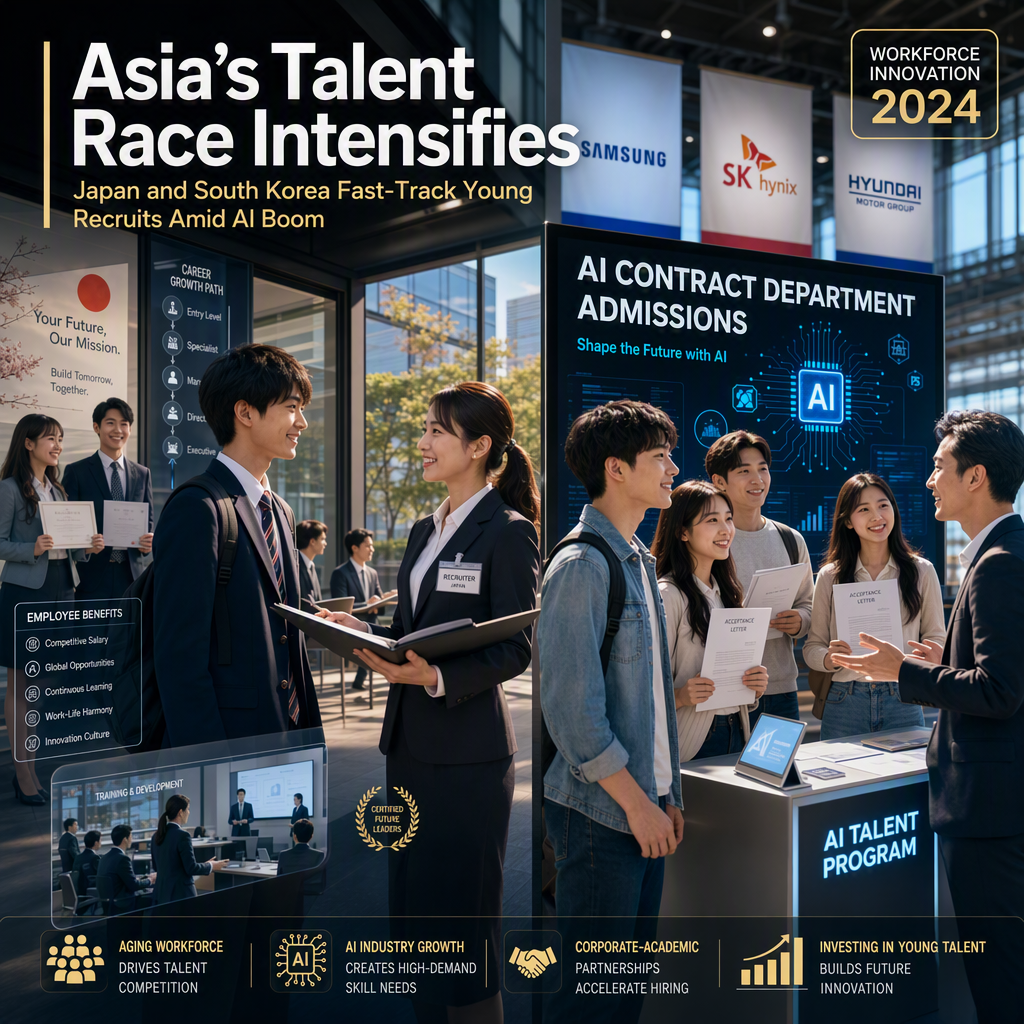
In Japan, companies are ramping up hiring perks for high school graduates as the country faces a persistent labor shortage and demographic challenges limiting the available workforce. Starting Wednesday, hiring screenings for students graduating in spring 2027 will see businesses offering expanded training programs, support for earning certifications, and revised promotion systems to attract young talent. Employers are providing comprehensive support structures, including assistance in obtaining professional qualifications and accelerated promotion pathways, aiming to boost retention rates and fill critical positions. Industry analysts note that these enhanced perks reflect a broader trend toward workforce development and talent cultivation, with further innovations expected in the coming months [1].
Meanwhile, South Korea is witnessing a surge in applications to university programs directly linked to major corporations such as Samsung Electronics and SK Hynix. These 'contract departments' offer financial support and guaranteed or preferential job pathways to students, with applications to Samsung-linked departments rising 6.5% and SK Hynix-linked programs increasing 12.7% for the 2026 regular-admission cycle. Data from Jongro Academy shows that applicants to contract departments tied to large companies increased by more than 38% year-on-year, including courses linked to Hyundai Motor and LG Uplus. The programs are particularly attractive amid the AI boom, as Samsung and SK Hynix offer lucrative pay packets, intensifying competition for entry. Students report that these programs provide greater certainty of employment and financial support, while companies benefit from a pipeline of skilled workers [2].
Both countries are responding to labor market pressures by innovating talent recruitment and development strategies. In Japan, companies are revamping hiring incentives and training to differentiate themselves in a competitive market and counteract hesitancy among students to enter the workforce directly after graduation [1]. In South Korea, corporate partnerships with universities are helping to fast-track entry into the AI sector, with some programs guaranteeing jobs upon graduation and others requiring additional hiring processes. The rising demand for these programs is reflected in the increasing number and academic caliber of applicants [2].
Analysts in Japan expect the push to attract and retain young talent to intensify, with further innovations in training and promotion likely in the coming months [1]. In South Korea, the competition for places in company-linked university programs is expected to remain fierce, as the AI sector continues to expand and offer attractive compensation packages [2].
CONCLUSION
Japan and South Korea are aggressively addressing labor shortages and the demand for skilled workers by expanding hiring perks and forging corporate-university partnerships. These strategies are driving up competition and applicant numbers, signaling a high market impact as companies invest in workforce development and talent pipelines. The trend is expected to accelerate, with further innovations anticipated in both countries.