
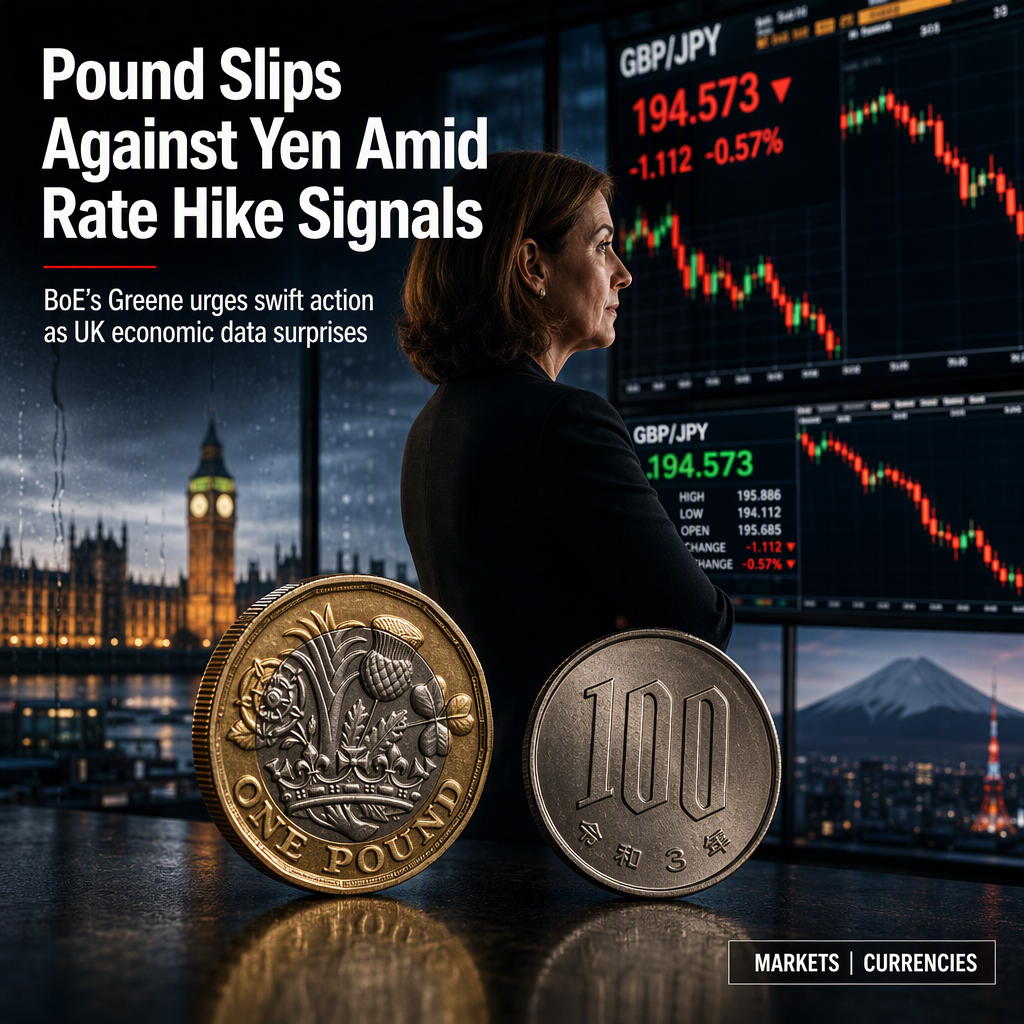
The British Pound (GBP) traded marginally lower against the Japanese Yen (JPY), with the exchange rate around 209.25 during late Asian trading on Tuesday, reflecting mild selling pressure on the Pound despite hawkish commentary from Bank of England (BoE) policymaker Megan Greene. Greene advocated for the central bank to act promptly to contain inflationary pressures before they spread to wages and broader consumer prices [1].
Throughout the year, the BoE has maintained interest rates at 3.75%. However, market experts now anticipate a rate hike at the November meeting, citing an improved economic outlook. Commerzbank analysts noted the UK's economic resilience, highlighting a 0.6% quarter-on-quarter GDP growth in Q1 and a revised 0.5% growth in Q2. Additionally, July's monthly GDP data showed a 0.4% month-on-month increase, indicating solid momentum into Q3 [1].
Commerzbank now expects the BoE to raise rates in November, with another hike anticipated in February, potentially bringing the Bank Rate to 4.25%. This marks a shift from their previous expectation of no further hikes, driven by recent positive economic developments [1]. Investors are awaiting the August GDP data, scheduled for Thursday, with estimates suggesting a 0.1% contraction following July's 0.4% expansion [1].
Meanwhile, the Japanese Yen outperformed major peers, including the US Dollar, despite market experts arguing against consecutive rate hikes from the Bank of Japan (BoJ). On the day, the Yen strengthened 0.10% against the Pound and 0.17% against the US Dollar, making it the strongest among major currencies [1].
CONCLUSION
The British Pound's subdued performance against the Yen comes amid expectations of imminent BoE rate hikes, supported by resilient UK economic data and hawkish policymaker commentary. The Japanese Yen's relative strength further pressured the Pound, even as the BoJ is not expected to pursue back-to-back rate increases. Market participants are closely watching upcoming UK GDP data for further direction.