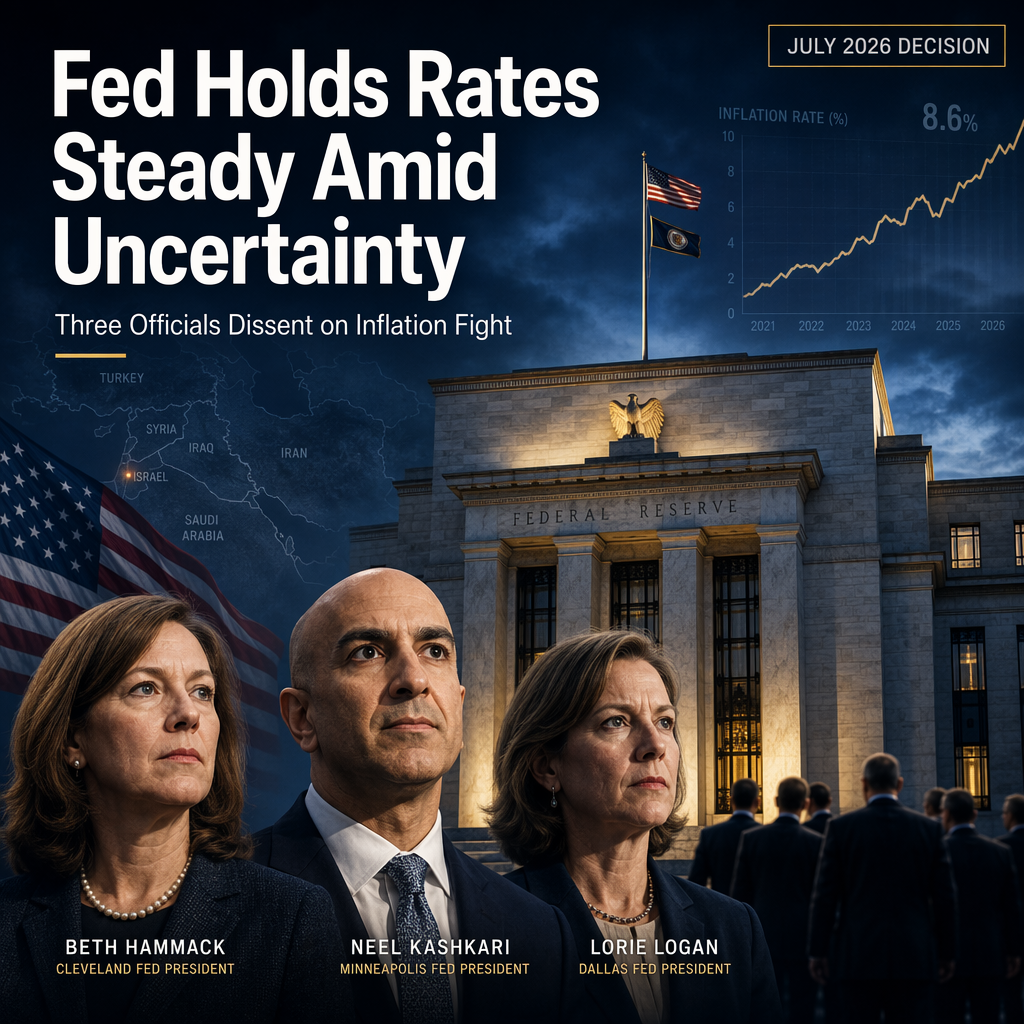
On July 29, 2026, the Federal Reserve announced it would keep its benchmark federal funds rate unchanged at 3.5% to 3.75%, citing persistent inflation and elevated uncertainty stemming in part from the ongoing conflict in Iran [1][2]. The Federal Open Market Committee (FOMC) voted 9-3 in favor of holding rates steady, with dissent from Cleveland Fed President Beth Hammack, Minneapolis Fed President Neel Kashkari, and Dallas Fed President Lorie Logan, who advocated for a 25-basis-point rate hike to address inflation that has remained above the Fed's 2% target for more than five years [1][2].
The FOMC's post-meeting statement highlighted that "economic activity is expanding at a solid pace despite elevated uncertainty that owes, in part, to the conflict in the Middle East" and reaffirmed its commitment to delivering price stability [1][2]. Inflation pressures were attributed to supply shocks, particularly in the energy sector, and tariffs imposed by President Donald Trump, which have contributed to higher prices [1][2]. Job growth was noted to have kept pace with the workforce, while the unemployment rate has changed little, even as the U.S. labor force has contracted [2].
The decision marks the second meeting under Fed Chair Kevin Warsh, who has removed forward guidance from FOMC statements, leading to increased uncertainty about future policy moves [1][2]. Markets had largely expected the Fed to hold rates, though CME Group's FedWatch indicated about a 1-in-3 chance of a surprise hike, and prediction markets showed higher certainty for a hold [2]. The post-meeting statement was nearly identical to the one issued after the June 17 decision, maintaining the Fed's cautious stance following three rate cuts in late 2025 [2].
Officials favoring tighter policy argued that inflation continues to burden households and is not showing clear signs of abating [2]. Governor Christopher Waller recently expressed concerns about inflation and suggested higher rates could be necessary if progress stalls, though he voted in favor of holding rates at this meeting [2]. The full committee in June had penciled in one quarter-percentage-point increase by the end of 2026 [2].
CONCLUSION
The Fed's decision to hold rates reflects ongoing concerns about inflation and geopolitical uncertainty, with notable dissent from three regional presidents advocating for a hike. While markets anticipated the hold, the lack of forward guidance under Chair Warsh has heightened uncertainty about future policy moves. Inflation remains a central challenge, and the Fed's commitment to price stability suggests further action may be considered if progress stalls.