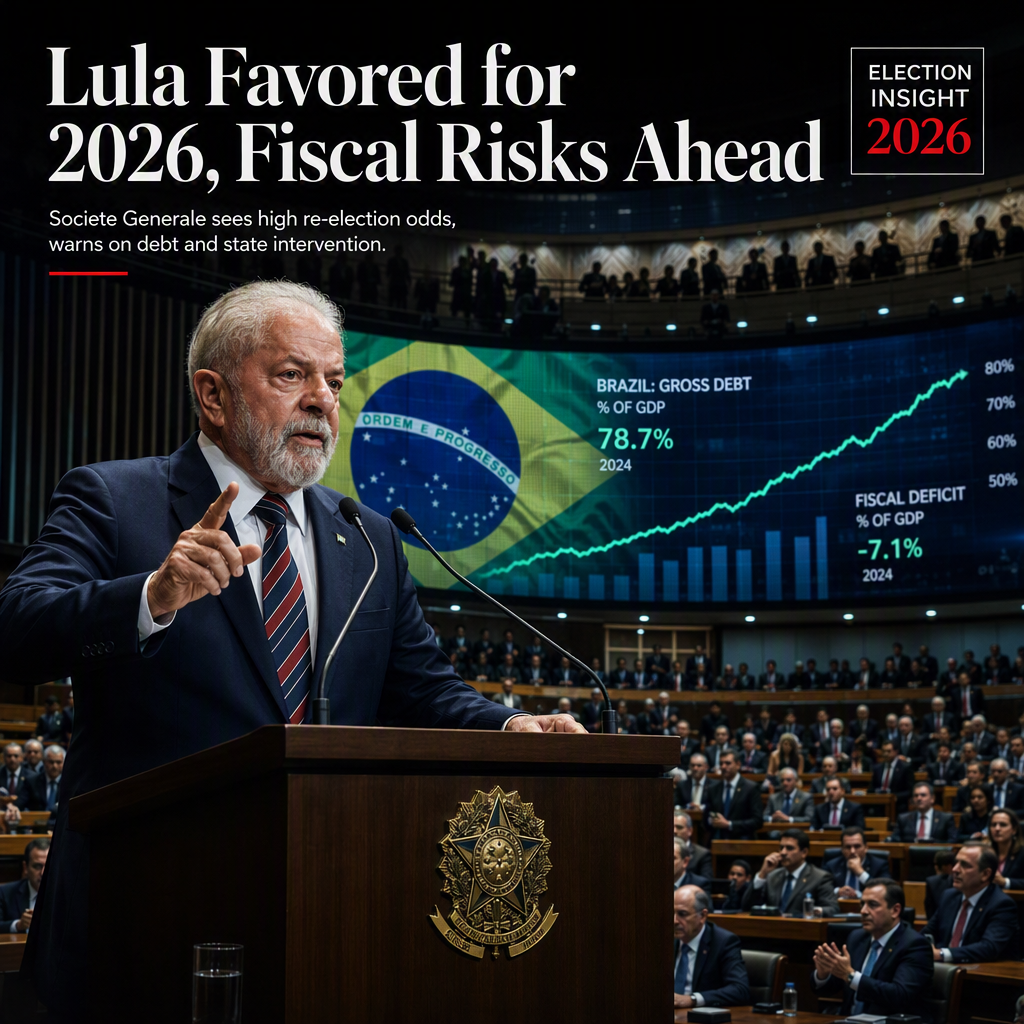
Societe Generale analysts Brendan McKenna and Dev Ashish have outlined their scenarios for Brazil's 2026 presidential election, assigning a 65% probability to President Lula winning a fourth term and a 30% probability to Flavio, contingent on Flavio being cleared of alleged connections to local scandals or Lula making a policy mistake [1]. The analysts note that if Lula secures another term, his administration is likely to continue with loose fiscal policy, rising debt, and ongoing state intervention in the economy, similar to his previous terms [1].
The composition of congress is highlighted as a crucial factor for Brazil’s debt trajectory and broader macroeconomic stability, suggesting that legislative dynamics will play a significant role in shaping fiscal outcomes [1]. Societe Generale's base case scenario sees Lula capitalizing on resilient local economic and market trends, as well as slowing opposition momentum, to secure re-election [1].
A less likely scenario, with a 5% probability, involves Lula winning in the first round if allegations against Flavio intensify and the opposition is forced to replace their candidate too late in the electoral cycle [1]. The report underscores that another Lula administration could deepen fiscal risks for Brazil, given expectations of continued loose fiscal policy and increased state intervention [1].
CONCLUSION
Societe Generale forecasts a high likelihood of President Lula winning Brazil's 2026 election, but warns that his potential re-election could exacerbate fiscal risks due to expected loose fiscal policy and rising debt. The composition of congress will be a key determinant for Brazil’s fiscal and macroeconomic stability.