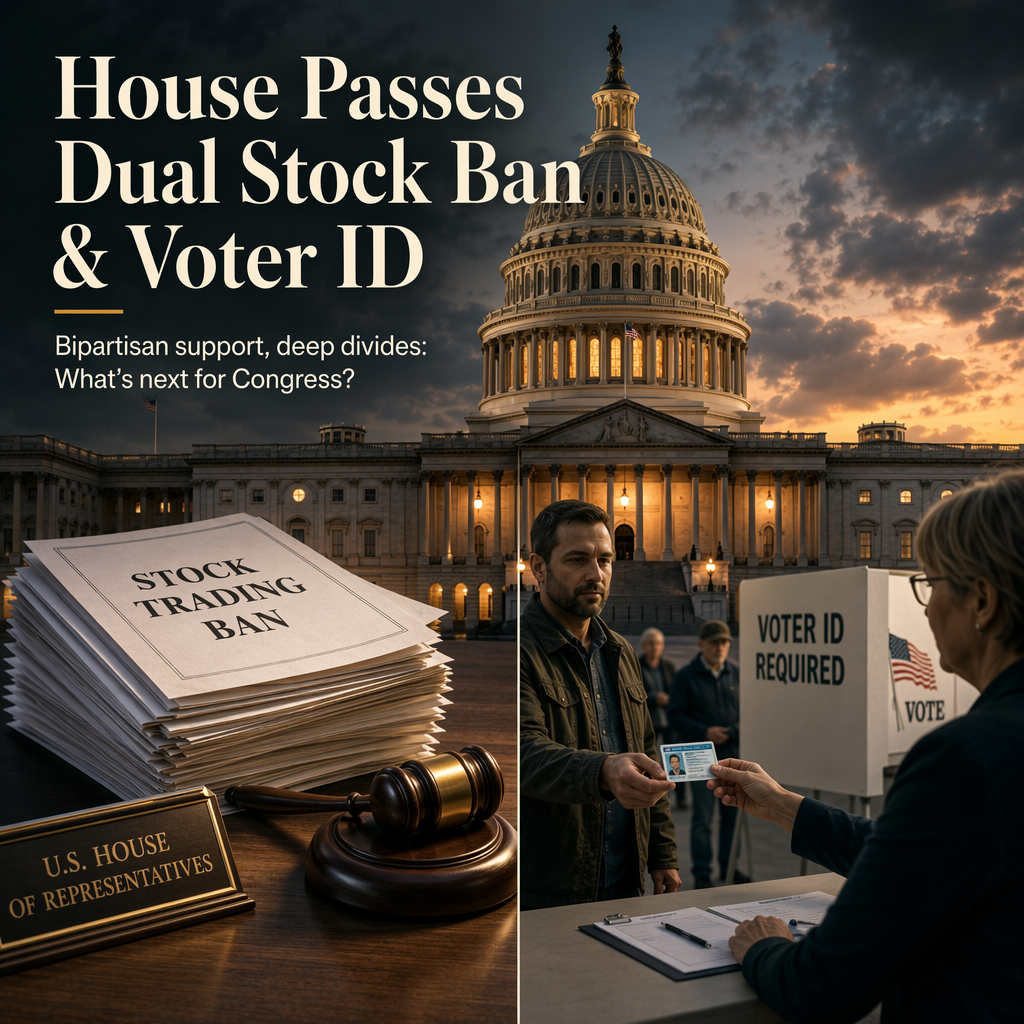
The U.S. House of Representatives passed a legislative package that combines a ban on congressional stock trading with the implementation of federal voter ID requirements, following months of debate and bipartisan negotiations on both issues [1]. The package, though containing two unrelated measures, was presented together and has garnered overwhelming support in multiple public polls, with an August 2025 Pew Research Center poll indicating that 83% of U.S. respondents favored requiring all voters to show government-issued photo identification to vote [1].
Despite the broad public support, the bill faced significant opposition from House Democrats, many of whom argued that the voter ID provision was too stringent and that the stock trading ban did not go far enough. Rep. Joe Morelle, D-N.Y., stated that while House Democrats support a stock trading ban for members of Congress, they also advocate for extending the ban to the president, vice president, and federal judicial officers, which was not included in the current legislation [1].
Republican supporters, such as Rep. Zach Nunn, R-Iowa, emphasized the popularity of both measures and the opportunity to pass the bill before the August recess, stating, "the overwhelming majority of Americans want this" and that the legislation could reach the president's desk soon [1]. Rep. Stephanie Bice, R-Okla., highlighted the importance of the stock trading ban in restoring public trust in Congress by ensuring transparency and accountability [1].
However, not all Republicans were in agreement. Rep. Thomas Massie, R-Ky., criticized the strategy of combining the two measures, suggesting that the inclusion of voter ID was intended to deter Democratic support for the stock trading ban, thereby creating a political talking point for the upcoming November election. Massie argued that a standalone stock trading ban could have achieved a large bipartisan majority and a better chance of passing in the Senate [1].
CONCLUSION
The House's passage of the combined stock trading ban and federal voter ID bill marks a significant legislative development, though it has exposed partisan divisions and strategic maneuvering. While the measures enjoy broad public support, the combination of the two has limited bipartisan consensus, raising questions about the bill's prospects in the Senate and its ultimate impact on congressional accountability and election integrity.