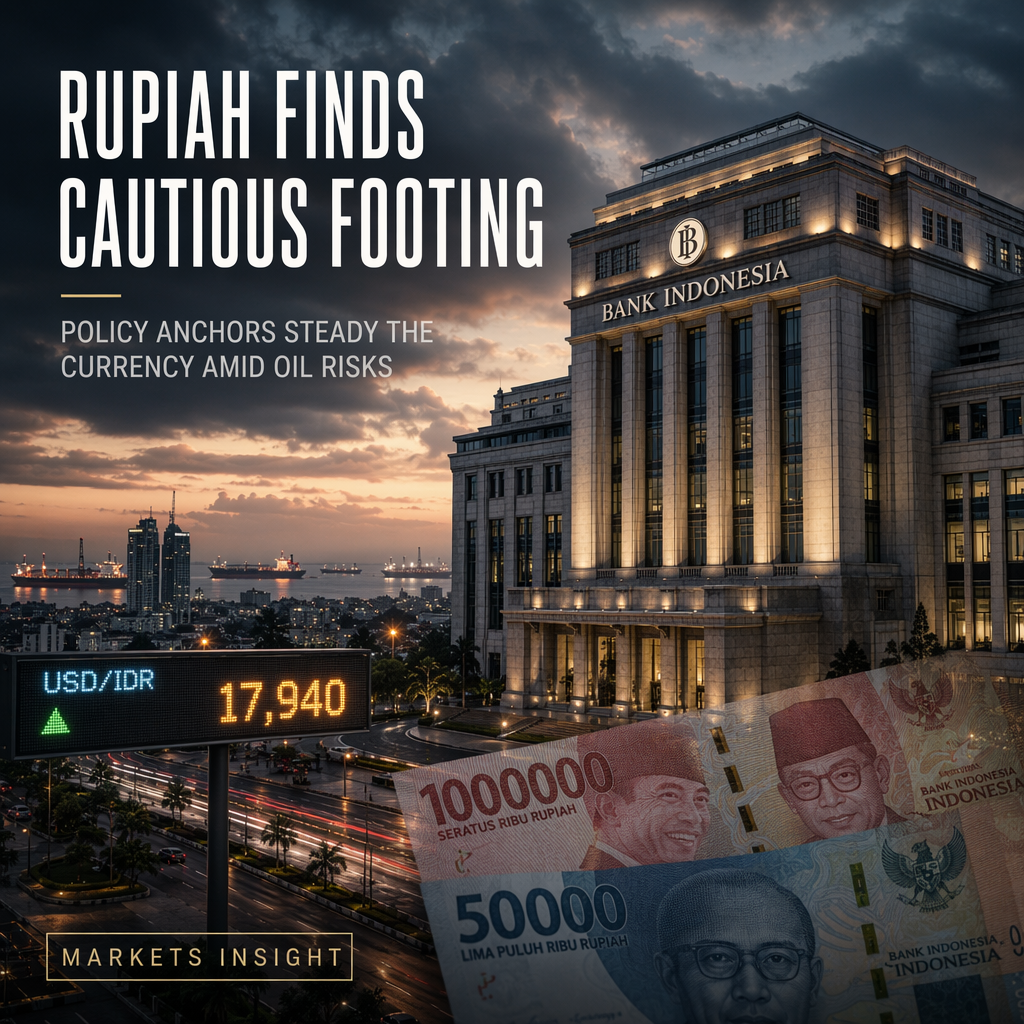
The Indonesian Rupiah (IDR) has experienced a modest easing from recent highs against the US Dollar (USD), with the USD/IDR pair last observed at 17,940 levels [1]. According to OCBC analysts Sim Moh Siong and Christopher Wong, this pullback is primarily attributed to domestic factors rather than a broad-based weakening of the USD [1]. Key supportive elements include S&P’s affirmation of Indonesia’s BBB rating with a stable outlook, which has alleviated some near-term concerns regarding the country’s sovereign credit profile [1]. Additionally, Bank Indonesia’s (BI) previous monetary tightening and its ongoing commitment to supporting the IDR have provided a firmer policy anchor [1].
Despite these positive factors, the analysts caution that elevated oil prices, ongoing fiscal concerns, and subdued foreign portfolio inflows continue to constrain further gains for the IDR [1]. The 17,970/18,000 range is identified as a cap for USD/IDR, with downside supports at 17,820/840, suggesting that two-way trading is likely in the near term [1]. The upcoming BI Monetary Policy Committee meeting on July 22 will be closely watched for any additional policy tightening, which could influence the currency’s trajectory [1].
Technical indicators show mild bearish daily momentum for USD/IDR, with the Relative Strength Index (RSI) displaying tentative signs of rising [1]. Resistance levels are noted at 18,020 and 18,140, while the 50-day moving average and 23.6% Fibonacci retracement provide support at lower levels [1]. The analysts view the recent IDR recovery as a tentative stabilisation rather than the beginning of a sustained appreciation trend, given the persistent headwinds [1].
CONCLUSION
The Indonesian Rupiah’s recent modest recovery is underpinned by policy support and improved sovereign credit sentiment, but gains remain limited by external and domestic challenges. Market participants are expected to monitor the upcoming Bank Indonesia policy meeting for further direction. Overall, the outlook suggests cautious stabilisation rather than a strong appreciation for the IDR.