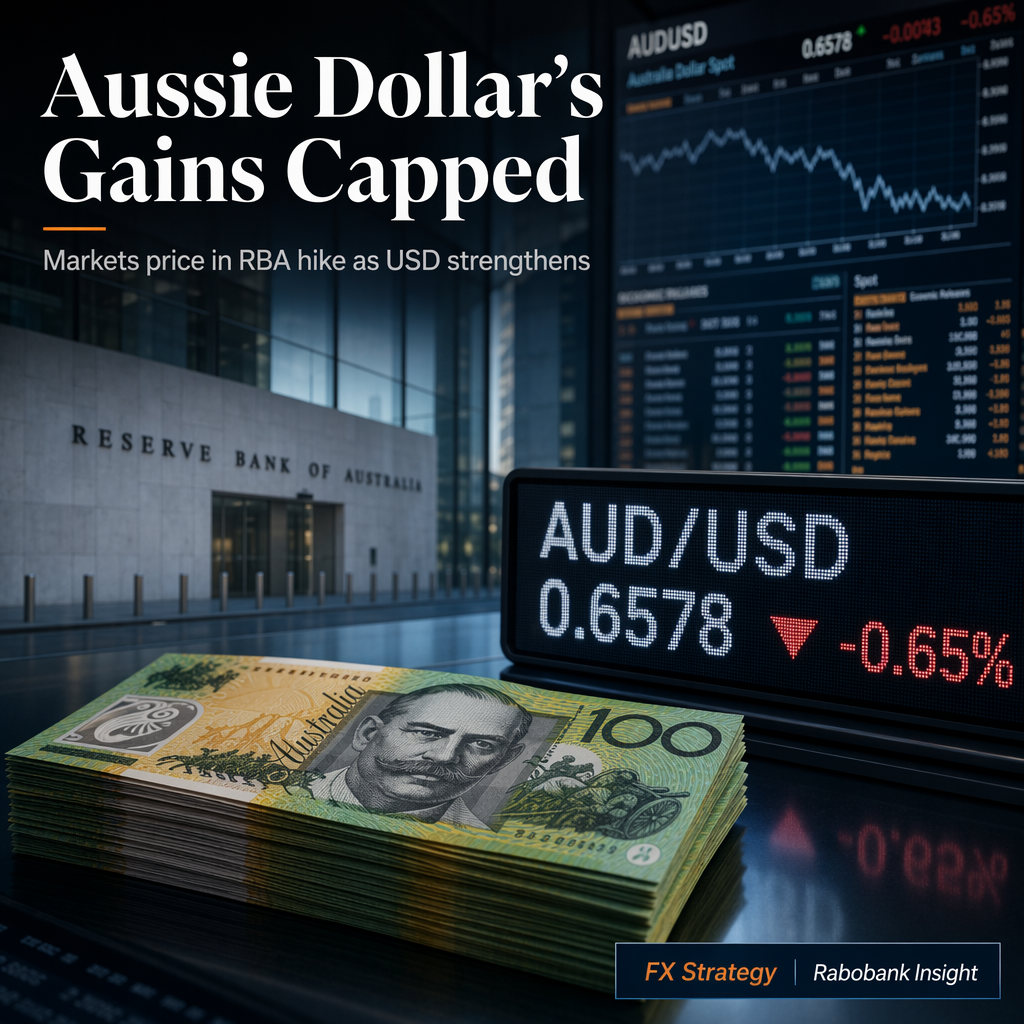
Rabobank’s Senior FX Strategist Jane Foley notes that the Australian Dollar (AUD) has shown strong performance year-to-date, bolstered by the Reserve Bank of Australia’s (RBA) hawkish policy stance and Australia’s commodity-linked economic profile [1]. However, Foley highlights that the upside for the AUD is now limited due to several factors, including a stronger US Dollar (USD) and a weakening Australian trade balance [1].
The June employment data revealed an increase of 76.3K jobs, which was much stronger than market expectations and led to increased market bets on an RBA rate hike in August [1]. Despite this, the market is already pricing in a 25-basis-point RBA rate hike over the next six months [1]. The RBA previously described financial conditions as 'probably somewhat restrictive' and observed that underlying household consumption momentum had started to ease even before the onset of the Iran war [1].
Looking ahead, the upcoming release of the Australian quarterly CPI inflation report and a scheduled speech by RBA Governor Bullock are expected to be closely watched for further policy signals [1]. The Q2 trimmed mean CPI inflation is anticipated to be 3.7% year-over-year, up from the previous 3.5%, according to a Bloomberg survey [1].
Rabobank expects the AUD/USD to consolidate around the 0.70 level over a three-month horizon, citing the current strength of market expectations regarding further RBA tightening and external headwinds such as the USD recovery and Australia’s trade balance deterioration [1].
CONCLUSION
The Australian Dollar’s recent gains appear capped as markets have already priced in further RBA tightening, and external factors such as a stronger US Dollar and weaker trade balance present additional challenges. Analysts expect AUD/USD to consolidate near 0.70 in the coming months, with upcoming inflation data and RBA communications likely to guide market sentiment.