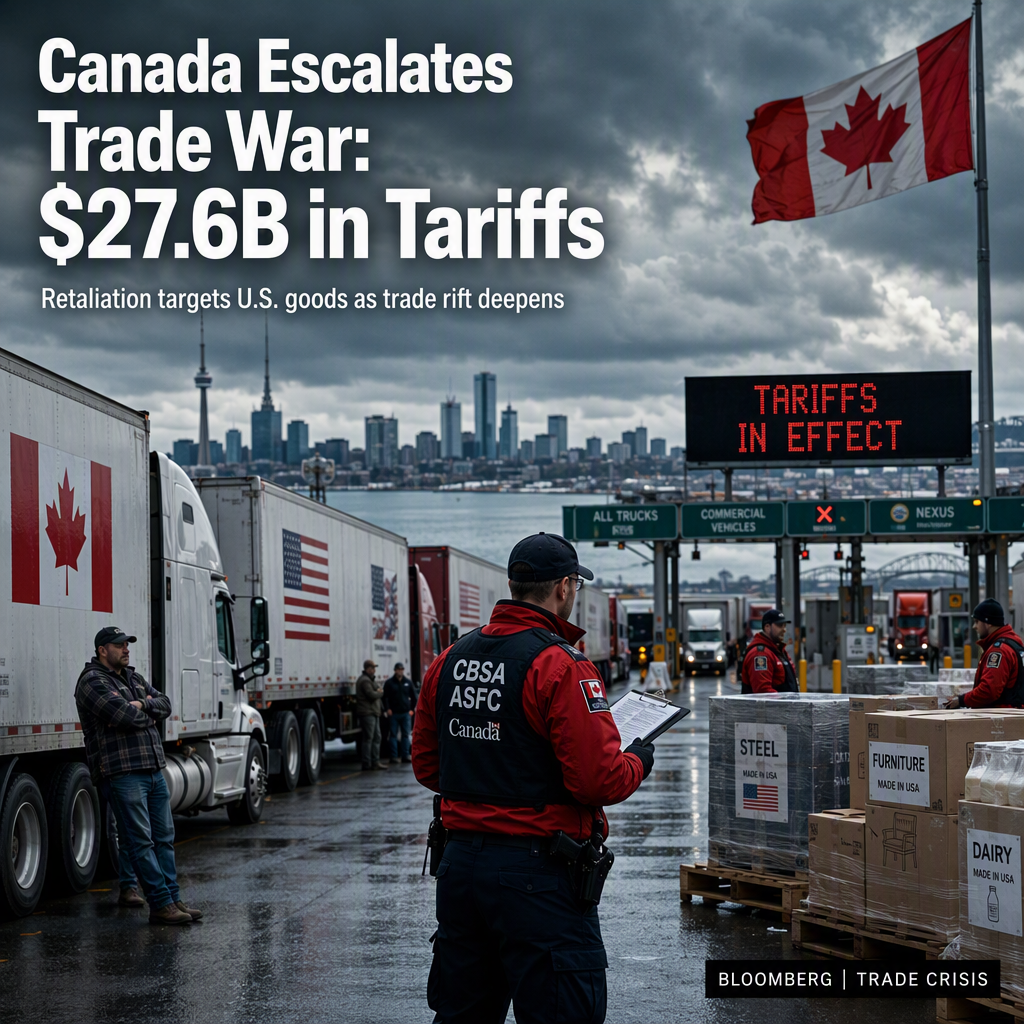
Canada has implemented retaliatory tariffs on $27.6 billion worth of U.S. goods, following the collapse of trade talks with the United States at the end of August 2026 [1]. The tariffs, which took effect on Tuesday, target a wide range of products including dairy, agricultural equipment, paper, household appliances, and electronics. The highest tariff rate of 50% was imposed on U.S. steel, aluminum, iron products, furniture, and clothing [1]. These measures are described by Canada as a 'dollar for dollar' response to U.S. Section 338 tariffs on Canadian goods, aiming to protect Canadian workers, producers, and manufacturers by enhancing their competitiveness in the domestic market [1].
Existing Canadian counter-tariffs, such as the 25% duty on the politically sensitive autos sector, remain in place [1]. The trade dispute escalated after both sides failed to reach a compromise, with officials publicly blaming each other for the breakdown in negotiations [1]. U.S. President Donald Trump further heightened tensions by calling for a boycott of Canadian airplane manufacturer Bombardier, stating, 'NO MORE SELLING BOMBARDIER IN THE UNITED STATES!' on Truth Social [1].
The U.S. exported $333.6 billion worth of goods to Canada and imported $381.9 billion from Canada, with both countries trading in sectors such as energy, vehicles, heavy machinery, aircraft, pharmaceuticals, gems and jewelry, furniture, clothing, and various foods and drinks [1]. Economists note that while the affected goods represent a relatively small portion of overall trade, small- to medium-sized businesses and those in the most impacted sectors are expected to suffer significant losses [1].
In response to the ongoing trade tensions, Ottawa announced a $7.5 billion support package for businesses and workers last month, supplementing an existing $25 billion package introduced in April 2025 to counter the U.S. global tariff offensive [1].
CONCLUSION
Canada's sweeping retaliatory tariffs mark a significant escalation in the trade dispute with the U.S., targeting $27.6 billion in goods and imposing steep duties on key sectors. The move is expected to severely impact affected industries and small- to medium-sized businesses, prompting Ottawa to expand support measures. The deepening rift signals heightened uncertainty for cross-border trade and ongoing volatility in bilateral relations.