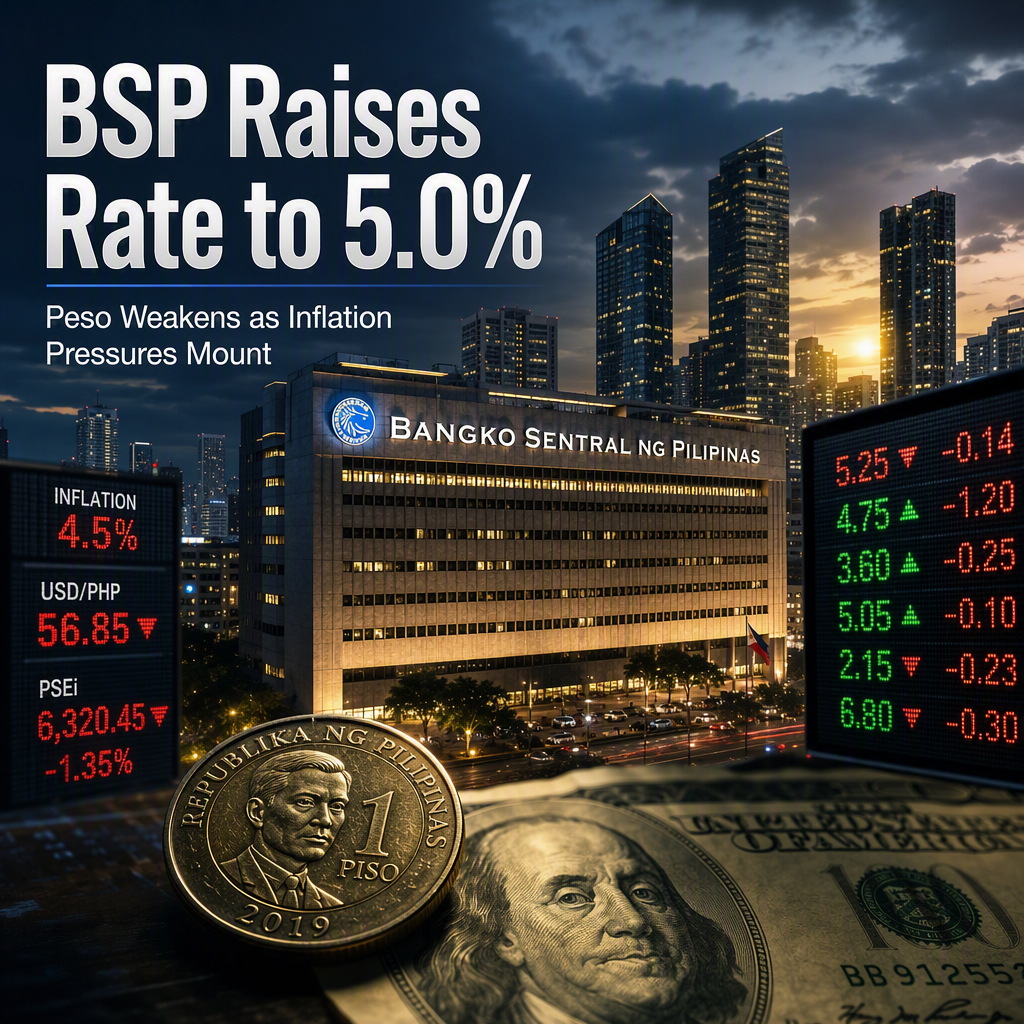
DBS Group Research economists Radhika Rao and Chua Han Teng reported that the Bangko Sentral ng Pilipinas (BSP) increased its policy rate by 25 basis points to 5.0% in an effort to anchor inflation expectations and support the Philippine Peso (PHP) [1]. The move comes as the Peso has underperformed its ASEAN-6 peers in the third quarter of 2026, declining by 0.8% against the US Dollar, while other regional currencies have appreciated between 0.9% and 1.7% during the same period [1].
DBS notes that above-target inflation in the Philippines leaves room for one more measured BSP rate hike this year, making the Philippines the only ASEAN-6 country where further monetary tightening is anticipated in 2026 [1]. The economists' baseline view is that other ASEAN-6 central banks will likely remain on hold for the rest of the year, with the Philippines as the sole exception due to persistent inflation risks [1].
DBS also suggests that developments in inflation and currency performance could prompt both Bank Indonesia (BI) and BSP to re-enter the tightening cycle ahead of their regional peers, while other central banks are expected to respond more gradually [1].
CONCLUSION
The BSP's recent rate hike to 5.0% highlights ongoing inflationary pressures and the Peso's relative weakness among ASEAN-6 currencies. Market participants should monitor the potential for an additional rate increase this year, as the Philippines stands out for its tightening bias amid regional central bank caution.