
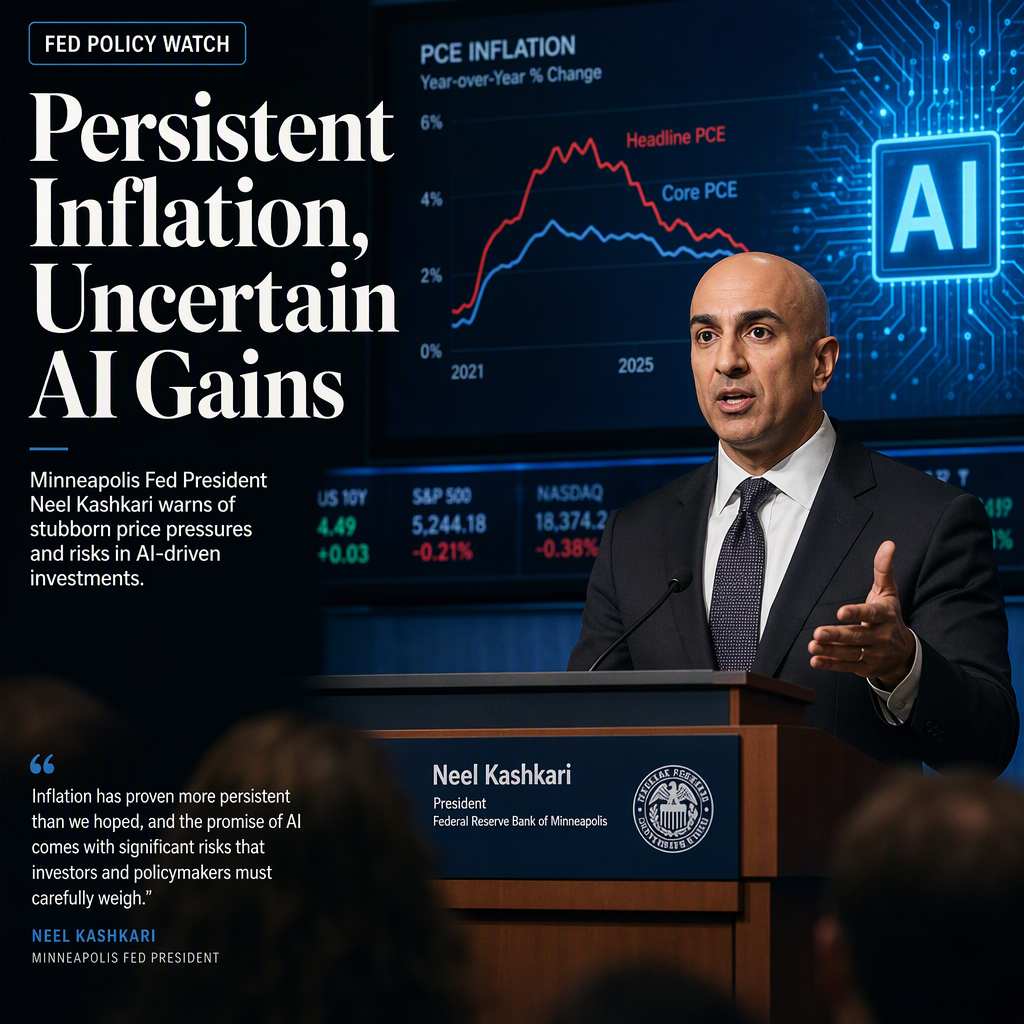
Minneapolis Federal Reserve President Neel Kashkari stated that inflation remains a significant concern, even after the August personal consumption expenditures (PCE) price index—considered the Fed's preferred inflation gauge—came in lower than economists had forecasted, with the core PCE rising 3% year-over-year. Kashkari emphasized, 'Inflation is still too high,' and noted that inflation has been elevated for more than five years, suggesting that the latest data did not materially change his outlook on price stability [1].
Kashkari also commented on the broader economy, highlighting that consumer spending and gross domestic product data released the same day indicated ongoing economic resilience. He described the labor market as 'pretty good' but not 'great,' referencing ADP's report that private payrolls expanded more than expected in September [1].
The Federal Reserve recently implemented its first interest rate hike in three years and signaled that another increase could be forthcoming, underscoring the central bank's commitment to curbing inflation. Kashkari revealed that he has raised his estimate for the neutral funds rate to 3.25%, attributing this adjustment in part to increased demand for investment capital amid the artificial intelligence (AI) boom. However, he expressed concerns that the surge in corporate investment related to AI may not yield the anticipated productivity gains, warning that if these investments do not deliver, it could result in 'malinvestment' with significant negative consequences for the broader economy [1].
Kashkari suggested that the AI industry may need to become more efficient with capital and resources, especially in an environment of tighter monetary policy. He acknowledged that the full benefits of AI-driven investment have yet to materialize, and cautioned that the outcome remains uncertain [1].
CONCLUSION
Fed President Kashkari's remarks underscore persistent inflation concerns despite softer-than-expected PCE data and a resilient labor market. The Fed's recent rate hike and the possibility of further increases reflect ongoing vigilance. Kashkari's caution regarding AI-related investments highlights potential risks to economic productivity and stability.