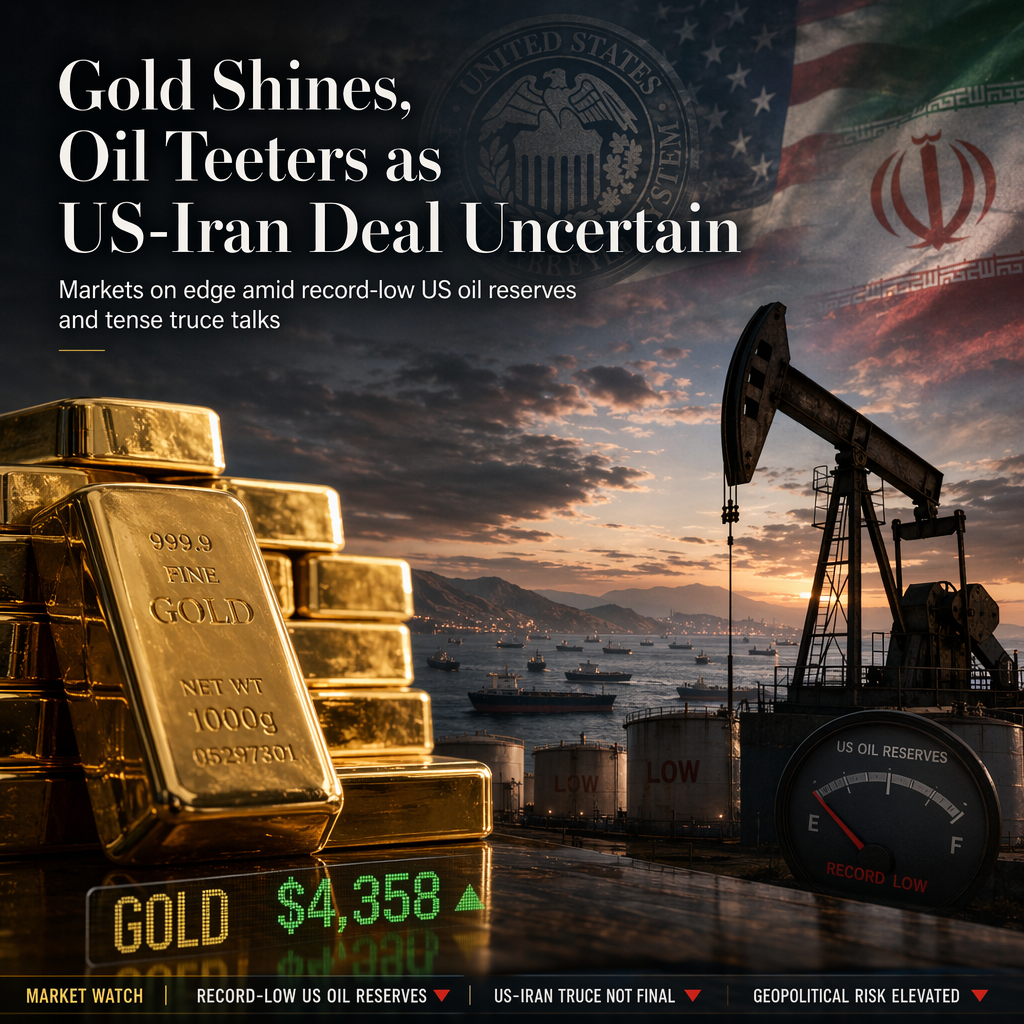
Gold (XAU/USD) climbed 0.77% on Wednesday, trading at $4,358, as investors awaited the Federal Reserve's first policy decision under Kevin Warsh. The market expects the Fed to keep rates steady, despite recent higher-than-expected US CPI and PPI data and a robust May Retail Sales report, which rose 0.9% month-over-month, surpassing the 0.5% forecast. Gas station sales increased by 3.4% due to higher gasoline prices amid Iran tensions. Traders estimate a 20% probability that the Fed might raise interest rates by the end of 2026. US Treasury yields and the US Dollar Index remained steady ahead of the Fed's decision. Geopolitical tensions have eased somewhat after the US and Iran agreed on a Memorandum of Understanding for a 60-day truce, though President Trump stated the agreement is not final and could be reversed if Iran does not comply. Gold technicals show resistance at $4,458 and $4,500, with support at $4,262 and $4,200 [1].
WTI crude oil stabilized around $75.70, down 0.22% on the day, after four days of heavy losses. The market is focused on an interim US-Iran accord expected to be signed in Switzerland on Friday, which could allow a rapid resumption of Iranian oil exports and a gradual recovery of shipping through the Strait of Hormuz. Shipping data indicates some Iranian tankers have already resumed movement, reinforcing expectations of increased global supply. This has pushed Middle Eastern crude benchmarks like Dubai Crude into contango and spot Oman and Murban into discounts, signaling more comfortable near-term supply. However, analysts caution that full normalization of physical flows may take longer, and options markets still price in residual risks. Société Générale notes uneven normalization across market indicators, while MUFG suggests the recent oil price decline could reduce near-term inflation risks and give the Fed more flexibility, though policymakers remain cautious [2].
Meanwhile, US crude oil stockpiles have plunged, with the Strategic Petroleum Reserve falling to its lowest level since 1983 and Cushing, Oklahoma inventories dropping to just 20 million barrels, a level described as 'operational stress.' During the second week of June, commercial stockpiles fell by 8.3 million barrels and the Strategic Petroleum Reserve by 8.9 million barrels, marking the tenth consecutive week of declining reserves. US refineries operated at 96.7% capacity, but this was insufficient to offset the loss of Persian Gulf supply. President Trump and Iran announced a peace deal on Sunday, with Trump stating the Strait of Hormuz would reopen immediately after the deal was signed, but as of Wednesday, the strait remained nearly shut. No text of the deal has been released, and shipping companies warn it could take weeks to reopen the strait even if an agreement is finalized. The anticipation of a deal and Trump's announcement pushed oil prices sharply lower, and US retail gas prices fell by over 50 cents to just above $4.00 per gallon. However, after the release of US petroleum stockpile data, crude oil prices spiked 1% on Wednesday, highlighting ongoing supply concerns [3].
CONCLUSION
Markets are reacting to a complex mix of geopolitical developments, central bank policy expectations, and critically low US oil reserves. While gold has benefited from uncertainty and oil prices have seen volatility tied to US-Iran negotiations, the underlying supply constraints and lack of a finalized deal keep market risks elevated. Investors remain cautious as the situation evolves, with both commodities sensitive to further news on the Fed and the reopening of the Strait of Hormuz.