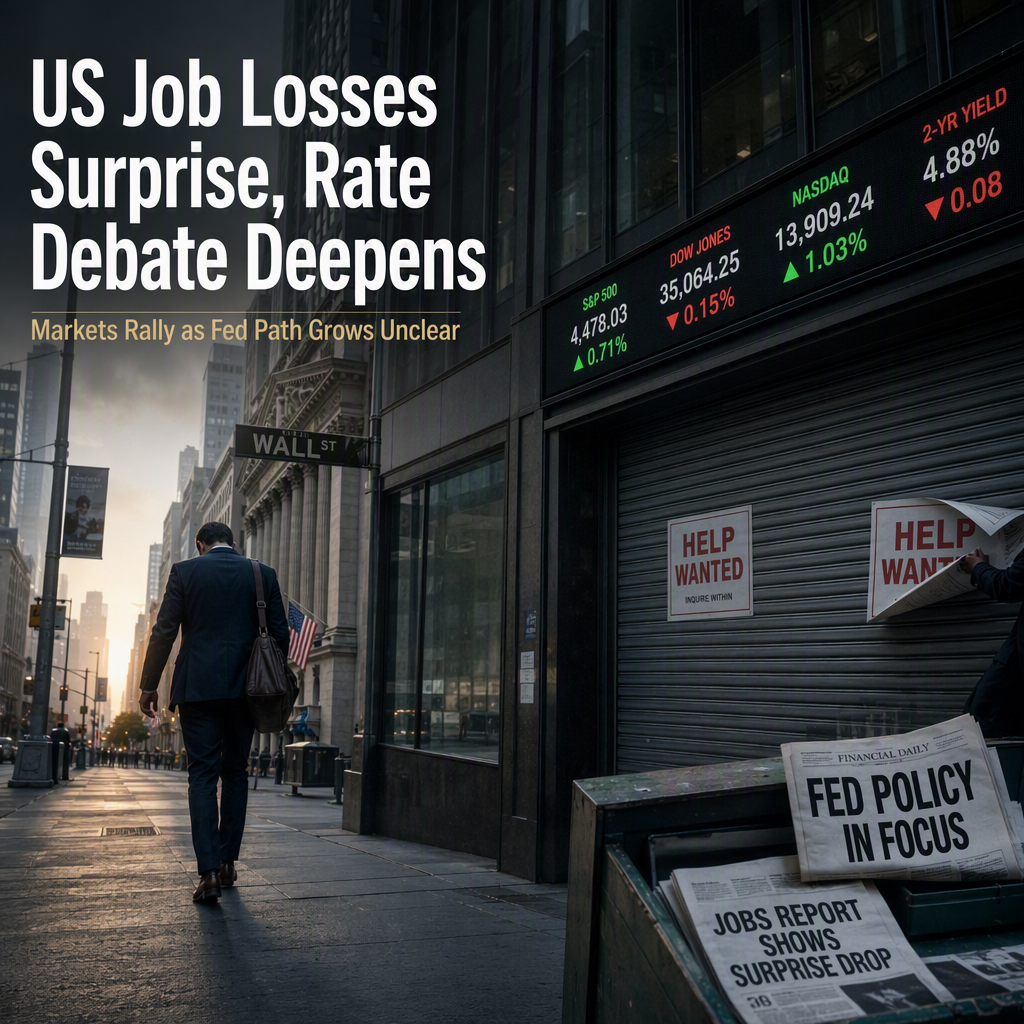
The U.S. economy unexpectedly lost 23,000 jobs in July 2026, according to the Bureau of Labor Statistics, marking a sharp contrast to economist forecasts which had anticipated job gains—80,000 according to LSEG and 83,000 according to Dow Jones consensus estimates [1][2]. The unemployment rate dipped to 4.1%, below the estimated 4.3%, as the labor force participation rate fell to 61.4%, its lowest in over five years [1][2]. Payroll numbers for May and June were revised downward, with May reduced by 66,000 to 63,000 and June revised down by 37,000 to 20,000, resulting in a combined reduction of 103,000 jobs from previous reports [1][2]. The 12-month average for job gains dropped to just 34,000 [2].
Sector-specific data showed private payrolls added 30,000 jobs in July, well below expectations, while government payrolls contracted by 53,000 jobs, led by a 50,000 decline in local government education [1][2]. Manufacturing added 5,000 jobs, slightly above estimates, and healthcare, the leading sector for job creation, added 22,000 jobs—below its 12-month average of 36,000 [1][2]. Retail lost 19,000 jobs, with supercenters and general merchandise retailers declining by 21,000 and gas stations by 5,000, offsetting gains in other retail categories [1]. Financial activities shed 14,000 jobs, with losses in credit intermediaries and insurance carriers [1][2]. Employment in the financial sector is now 121,000 jobs below its May 2025 peak [1].
Average hourly earnings increased by just 2 cents in July, bringing the 12-month average wage growth down to 3.2%, below the forecasted 3.5% [2]. The jobs report comes amid ongoing uncertainty regarding Federal Reserve policy, with inflation remaining above the central bank's 2% target. Fed policymakers are split on the direction of interest rates, and several officials have recently advocated for a rate hike as soon as September if inflation does not ease [2]. The Federal Open Market Committee voted 9-3 last week to hold its benchmark rate steady [2].
Following the release of the jobs report, traders adjusted their expectations for a Fed rate hike, with odds for a September move falling to 44% and October rising to 58.3%, according to CME Group's FedWatch [2]. Stock market futures responded positively, with Dow Jones Industrial Average futures up nearly 200 points and Treasury yields dropping sharply [2]. Osac Chief Market Strategist Phil Blancato advised investors to strip emotions from their investment decisions [1].
CONCLUSION
The July jobs report revealed unexpected job losses and a lower unemployment rate, prompting downward revisions to previous months and signaling a slowing labor market. Market reactions were positive, with stock futures rising and Treasury yields falling, as traders anticipated a more dovish Federal Reserve stance. The outlook remains uncertain, with Fed policymakers divided on future rate hikes and inflation still above target.