
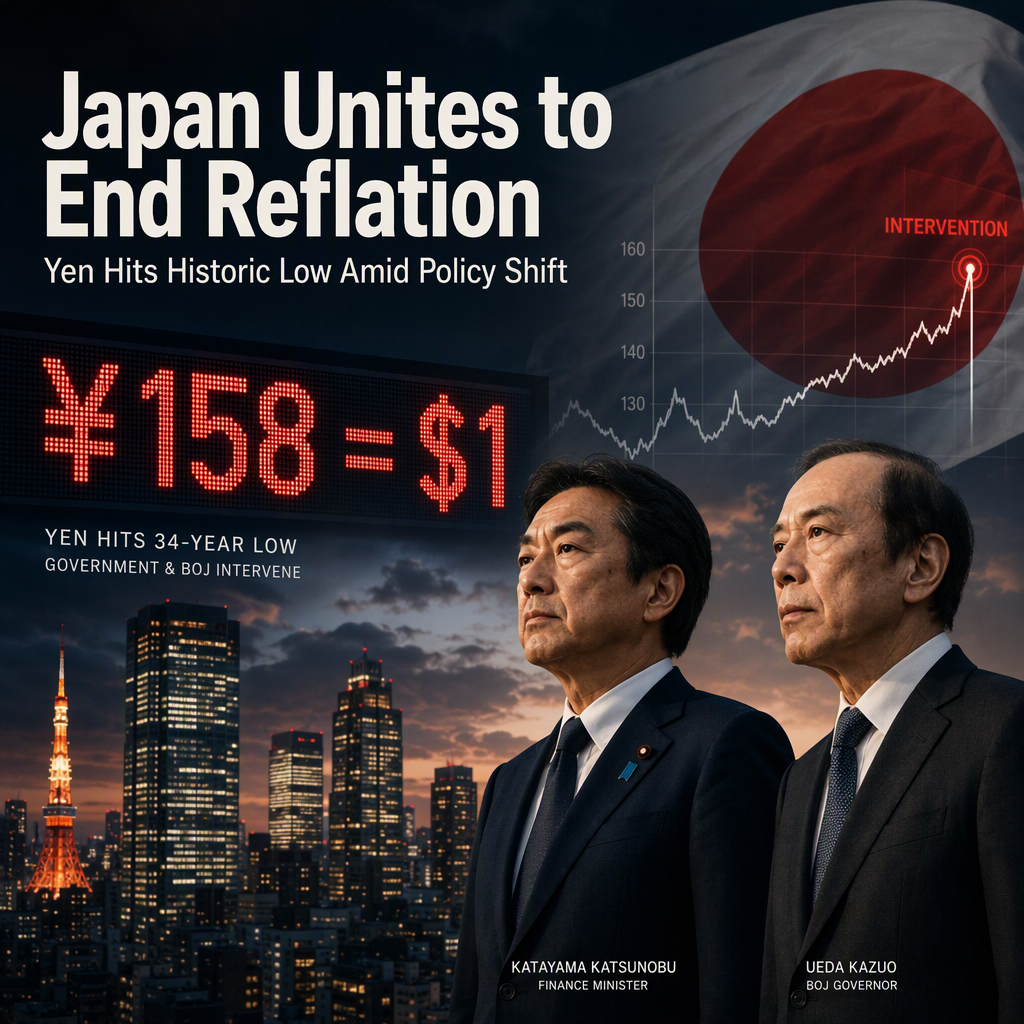
Japan's Finance Minister Satsuki Katayama announced that the government, under Prime Minister Sanae Takaichi, is unified in its stance that the era of reflationary policy has ended. This declaration comes amid the yen's rapid depreciation, which recently saw the currency touch 158 to the U.S. dollar, marking a historic low as markets assess the pace of further Bank of Japan (BOJ) tightening [1]. In response to the yen's weakness, the government disclosed a $96 billion yen-buying intervention conducted between July and August, aimed at stabilizing the currency [1].
The BOJ has also taken significant steps, including raising its policy rate to 1.25%. Governor Ueda described this as a shift from an accommodative stance to one focused on controlling inflation [1]. The BOJ's recent rate check temporarily strengthened the yen to the upper-156 range against the dollar, highlighting the market's sensitivity to central bank actions [1].
Katayama emphasized the close cooperation between the government and the BOJ, stating, 'There is no division in our determination to end the era of reflation. We are working closely with the Bank of Japan to ensure a stable financial environment' [1]. Technical analysts are monitoring key resistance at 158 yen to the dollar and support near 155, with market sentiment described as cautious. Traders are anticipating the possibility of further rate hikes or interventions if the yen's weakness continues [1].
The government's statements and recent actions underscore a clear policy shift toward prioritizing inflation control and currency stability, moving away from the reflationary measures of previous administrations [1].
CONCLUSION
Japan's government and central bank have presented a united front in ending reflationary policies, focusing instead on combating inflation and stabilizing the yen. With the yen at historic lows and significant interventions already undertaken, markets remain cautious and attentive to further policy moves. The shift signals a new phase in Japan's economic management, with potential for continued market volatility.