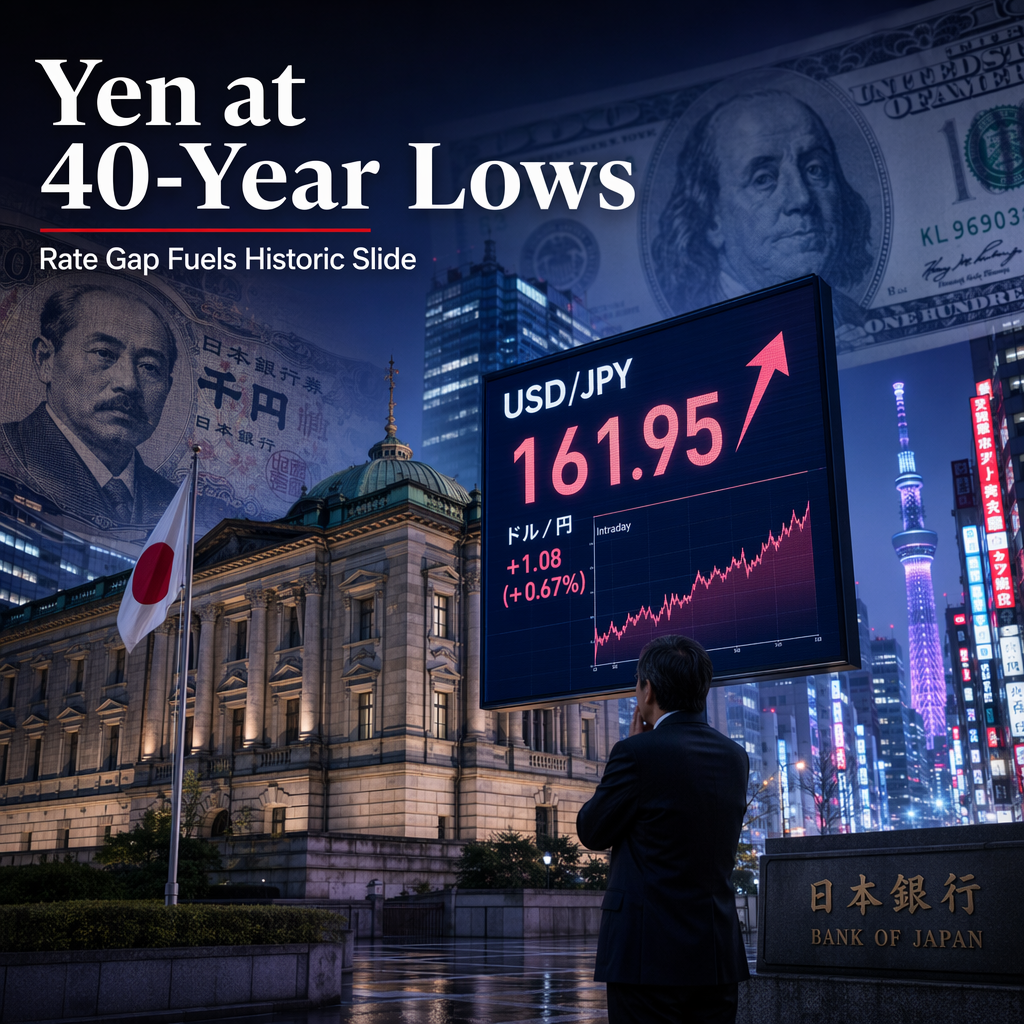
The Japanese Yen (JPY) remains under significant pressure against the US Dollar (USD), with the USD/JPY pair approaching 40-year highs at 161.95 on Wednesday [1]. The primary driver behind the Yen's weakness is the wide interest rate differential between the Bank of Japan (BoJ) and other major central banks, particularly the US Federal Reserve. This gap has made the Yen a preferred currency for carry trades, where investors borrow in low-yielding currencies and invest in higher-yielding ones, further intensifying downward pressure on the JPY [1].
Despite repeated verbal interventions from Japanese officials, including Finance Minister Satsuki Katayama's reaffirmation of Tokyo's commitment to "respond appropriately to currency moves at any time," the impact on the Yen has been minimal [1]. Katayama's recent online meeting with US Treasury Secretary Scott Bessent sparked speculation about a possible joint intervention to support the Yen, but this has not translated into any meaningful appreciation for the currency [1].
Market expectations for at least one more Fed rate hike this year are exacerbating the situation, as highlighted by former BoJ policymaker Sayuri Shirai at the Reuters Global Market Forum. Shirai suggested that the USD/JPY pair could rally as high as 165.00 if the Fed follows through with additional tightening, citing persistent interest rate differentials and skepticism about Tokyo's willingness to intervene as ongoing headwinds for the Yen [1].
The BoJ's historically ultra-loose monetary policy from 2013 to 2024 has contributed to the Yen's depreciation, and while there has been some gradual unwinding of this stance, it has not been sufficient to offset the current market dynamics [1].
CONCLUSION
The Japanese Yen remains near multi-decade lows due to the persistent interest rate gap between the BoJ and the Fed, with market participants expecting further weakness if US rates rise again. Despite official statements and speculation about intervention, the Yen's outlook remains bearish in the near term.