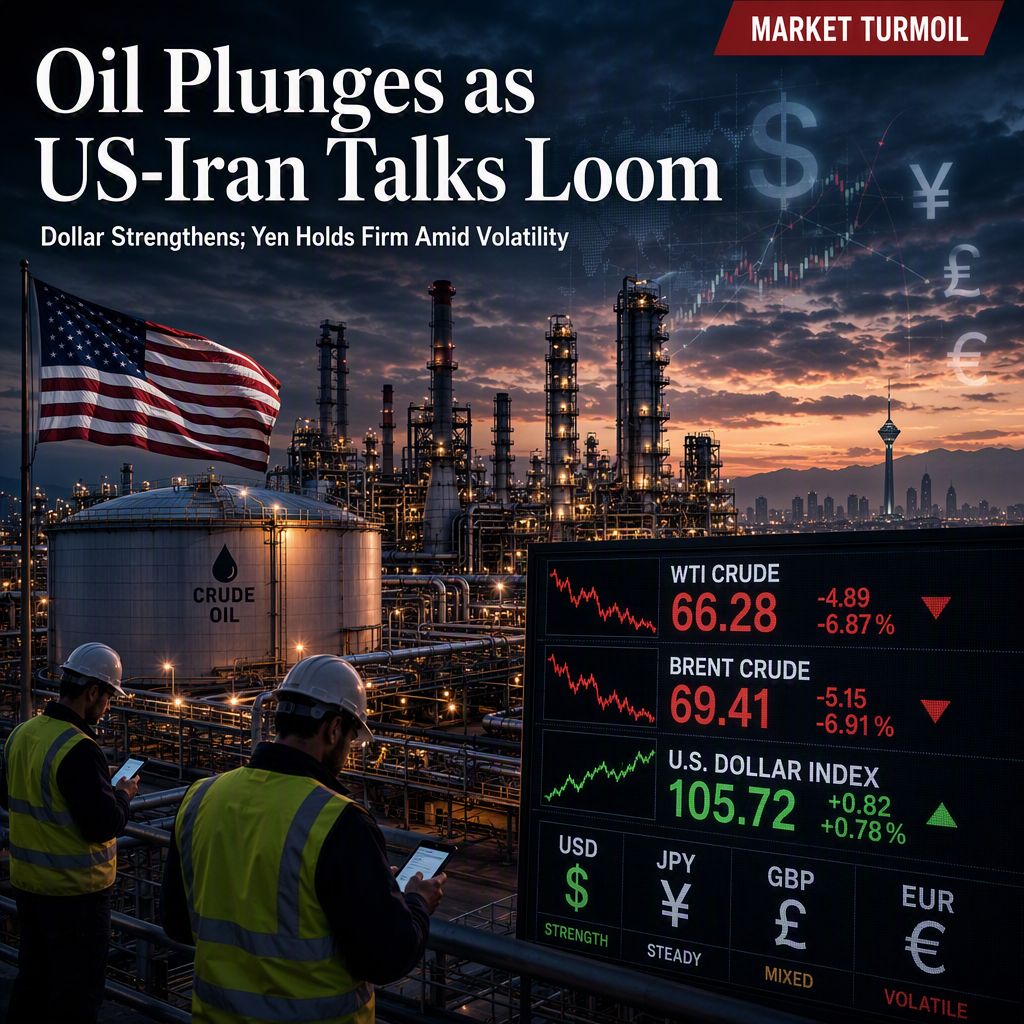
Oil prices experienced a sharp decline on Monday as expectations grew that talks between the US and Iran would resume soon. US President Donald Trump confirmed that conversations are underway, following Tehran's statement that it had no plans for direct negotiations at this time [1]. This development weighed heavily on oil markets, reflecting concerns about potential increases in supply if negotiations progress.
In currency markets, the US Dollar Index (DXY) rose approximately 0.1%, trading near 99.90 and holding just below the key 100.00 threshold [1]. The US Dollar was the strongest against the British Pound, which fell around 0.4% to settle near 1.3430, making it the weakest performer among European majors. The GBP/USD pair retreated from recent multi-week highs after the Bank of England's hawkish hold, with no domestic catalysts to counter the Dollar's rebound [1].
The ISM Manufacturing Purchasing Managers Index for July climbed to 55.6 from 53.3, surpassing the forecast of 54. The New Orders Index also improved to 56.7, while the Prices Paid component eased to 71.1 from 73, indicating that cost pressures persist despite some moderation [1]. These stronger-than-expected US economic data points contributed to the Dollar's strength and lifted US Treasury yields.
Elsewhere, EUR/USD declined around 0.2% to trade near 1.1510, giving back part of last week's advance, while AUD/USD slid about 0.5% to near 0.6990, falling below the psychological 0.7000 level [1]. USD/JPY dropped around 0.4% to trade near 156.90, extending its decline after last week's intervention and the Bank of Japan's hawkish hold. The pair's inability to recover alongside the broader Dollar advance highlights investor reluctance to rebuild Yen-short positions amid ongoing threats of further intervention by Japanese authorities [1].
CONCLUSION
The prospect of renewed US-Iran talks triggered a sharp sell-off in oil prices, while robust US economic data supported the Dollar's advance against major peers. The Yen remained resilient as intervention risks lingered, and the British Pound underperformed amid a lack of domestic catalysts. Market sentiment remains cautious, with currency and commodity markets reacting strongly to geopolitical and economic developments.