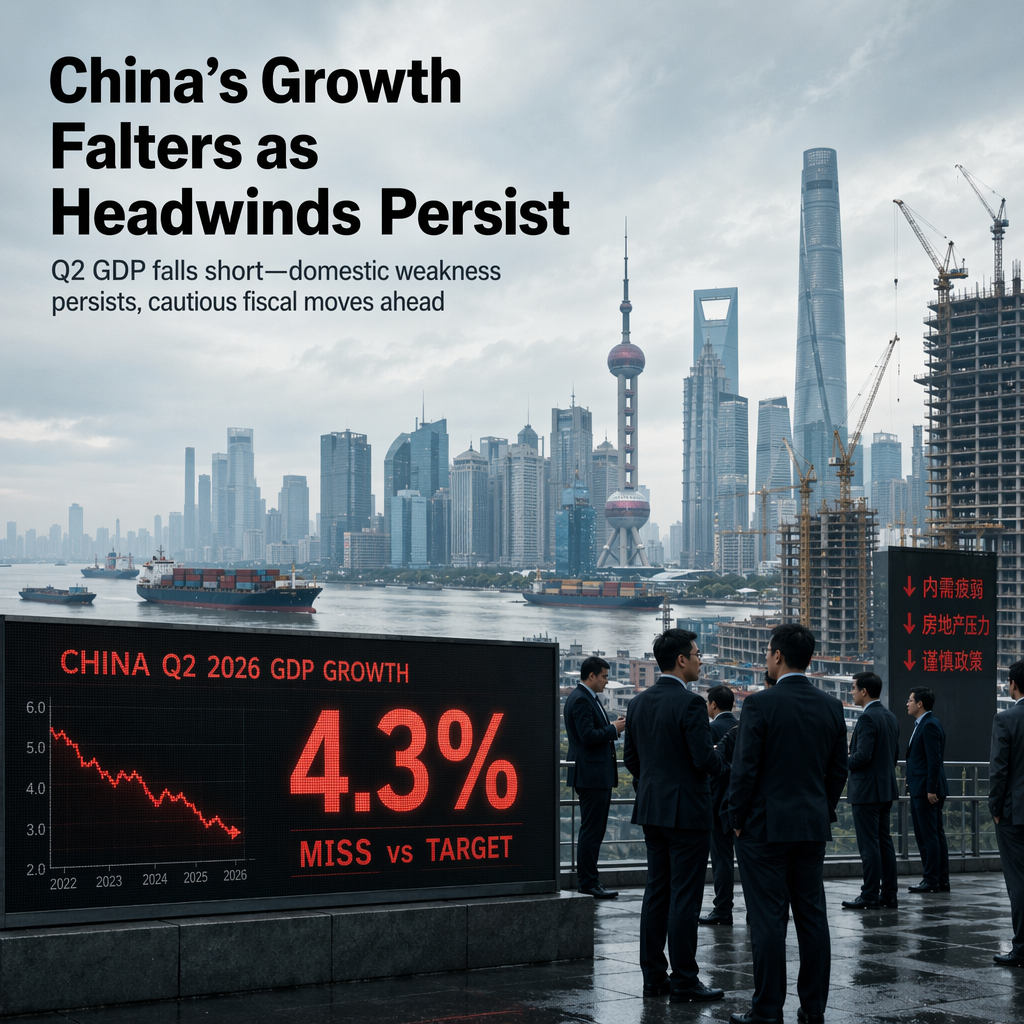
China's Gross Domestic Product (GDP) grew by 4.3% year-on-year in the second quarter of 2026, falling short of the government's official target range of 4.5–5% [1]. According to Commerzbank's Volkmar Baur, the shortfall was primarily due to ongoing weakness in the domestic economy, with the real estate sector and cautious fiscal policy weighing on overall demand [1]. The US-Iran conflict, particularly in April and May, also undermined economic performance during the quarter [1].
Despite these challenges, net exports made a significant positive contribution to growth, partially offsetting domestic headwinds [1]. Monthly data for June indicated a slight recovery in retail sales, industrial production, and fixed-asset investment, suggesting some stabilization in economic activity [1]. However, the Chinese government's slow pace in expanding fiscal expenditure was reflected in the fixed asset investment figures [1].
In response to these developments, the Politburo, during its July meeting, did not perceive an urgent need to alter the current economic policy course [1]. Commerzbank expects that modest fiscal expansion will be implemented, which should be sufficient to bring official growth figures back within the government's target range [1].
CONCLUSION
China's Q2 2026 GDP growth undershot official targets due to domestic weakness and external shocks, but signs of recovery are emerging. Modest fiscal support is anticipated, which may help return growth to the government's target range. The market impact is moderate, with no immediate policy shifts expected.