
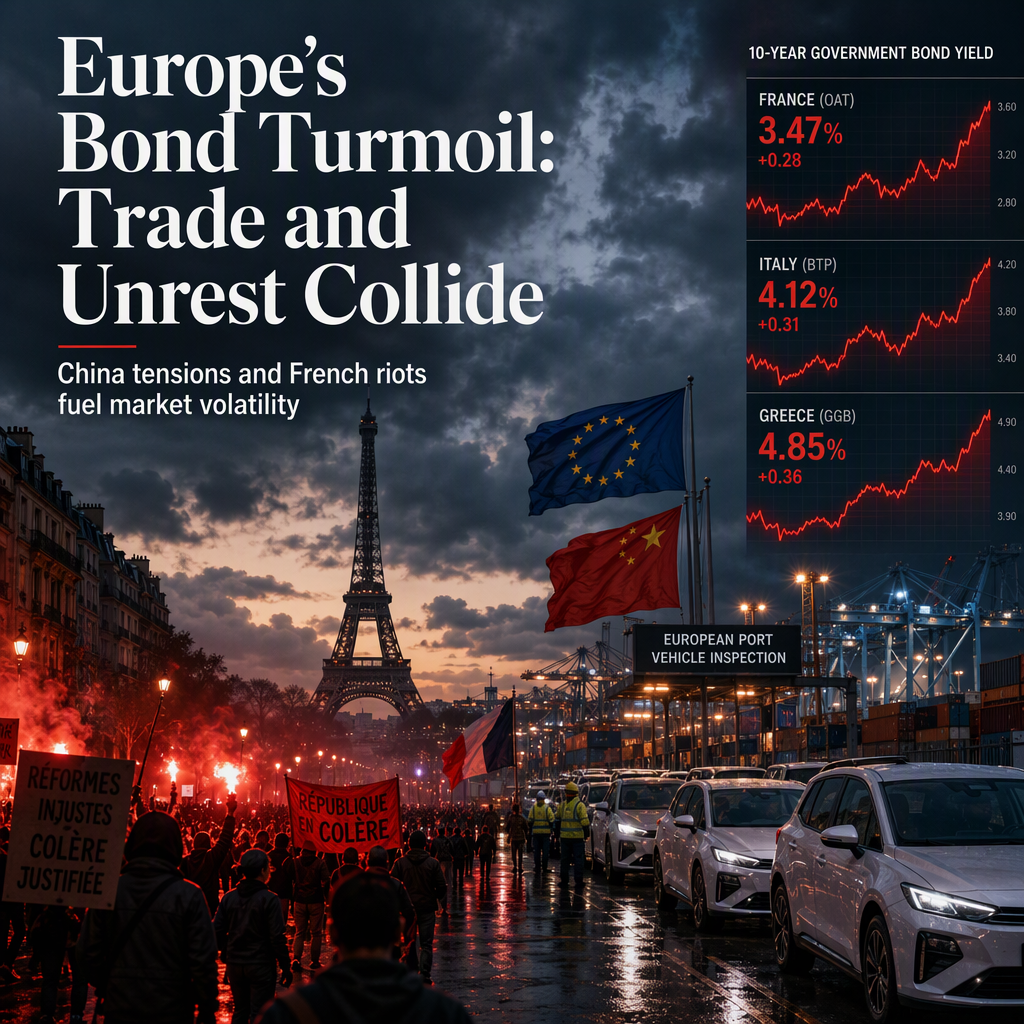
Rabobank’s RaboResearch Global Economics & Markets team highlights renewed pressure in European sovereign yields, with sharp moves specifically noted in French, Italian, and Greek bonds [1]. The report connects this market turmoil to ongoing political and economic tensions between Europe and China, particularly regarding Chinese hybrid vehicle imports [1]. China has rejected European calls to voluntarily limit exports of hybrid electric vehicles to the European market, a measure that was intended to reduce China’s market share from 30% to 15% and potentially avoid more overt trade restrictions and retaliatory measures [1].
The situation is further complicated by social unrest in France, described as 'riots across France,' which the report suggests is contributing to the negative sentiment in European bond markets [1]. The US is also cited as encouraging Europe to adopt a more assertive industrial policy to combat what it describes as 'mercantilist overcapacity' from China, aligning with ambitions outlined in the US National Security Strategy [1]. The report raises the question of whether Europe will now pursue a more assertive policy response, marking a potential shift from a decade of criticism of similar US actions [1].
No specific forward-looking analyst opinions or market forecasts are provided, but the combination of sovereign stress, trade tensions, and political unrest is presented as a significant risk factor for European markets [1].
CONCLUSION
European sovereign bond markets are experiencing significant stress, driven by political unrest and escalating trade tensions with China. The rejection of voluntary export limits by China and the potential for a more assertive European industrial policy signal heightened uncertainty and risk for the region’s markets.