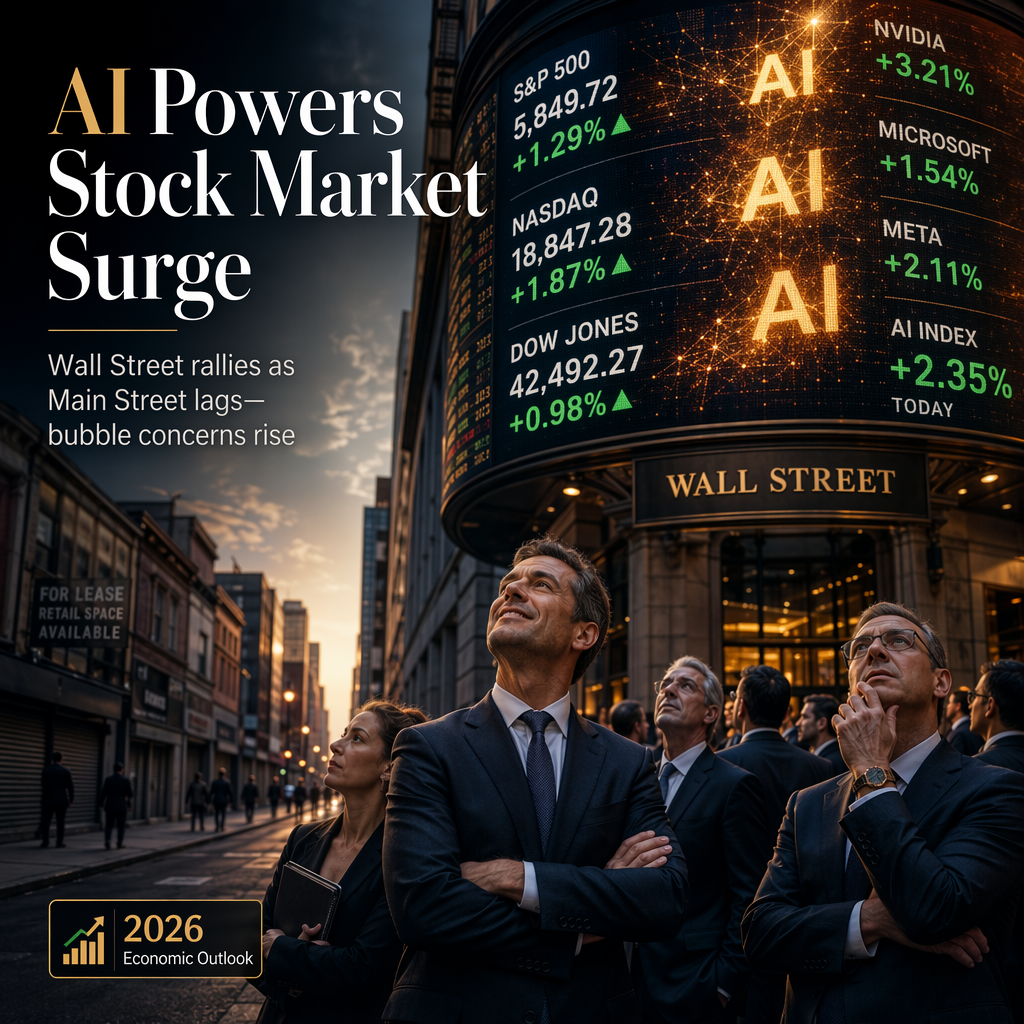
The U.S. stock market experienced significant gains in the first half of 2026, with the S&P 500 rising nearly 10% and the Dow Jones Industrial Average climbing almost 9%, marking the Dow's best first-half performance since 2021 [2]. These gains continue a strong multi-year trend, as the S&P 500 rallied 24% in 2023, 23% in 2024, and 16% in 2025, representing the second-best three-year win streak since 2000 [2]. Economists attribute this divergence between the robust stock market and more muted economic growth primarily to the artificial intelligence (AI) investment boom [1][2].
Commerzbank economists Dr. Jörg Krämer and Bernd Weidensteiner note that the AI-driven investment surge in U.S. high-tech and IT sectors is substantial but not yet excessive compared to past booms [1]. They highlight that the price-to-earnings ratio of S&P 500 stocks, based on expected earnings over the next twelve months, is currently 20, lower than the 25 seen at the peak of the dot-com bubble in early 2000 [1]. While they acknowledge elevated equity valuations and profit expectations, they do not view current valuations as a cause for alarm and believe the AI boom and associated stock market strength are likely to persist for now [1].
Despite the stock market's strength, U.S. economic growth has slowed, with "real" gross domestic product decelerating from about 3.3% in 2023 to roughly 1.9% so far in 2026, according to J.P. Morgan Private Bank's Joe Seydl [2]. Federal Reserve officials in June estimated economic growth at 2.2% for 2026, while consensus among economists centers around a 2% forecast [2]. Mark Zandi, chief economist at Moody's, described GDP growth around 2% as "soft" but emphasized that the economy is not in recession [2].
Labor market indicators show weakness, with labor force participation near its lowest level in about 50 years (excluding the Covid-19 pandemic), hiring at its slowest pace in over a decade, and long-term unemployment rising steadily [2]. Consumer sentiment also hit a record low in May due to inflation fears, rebounding somewhat in June but remaining unfavorable [2].
Commerzbank economists warn that while the AI boom is likely to continue in the near term, investment booms historically end in crises, often resulting in sharp stock price corrections rather than banking crises, given that much of the current investment has been financed from cash flow and overall corporate debt relative to GDP has been declining [1]. They do not expect a crisis in 2026 or 2027 but caution that the risk of a bubble remains [1].
CONCLUSION
The U.S. stock market's AI-driven rally continues to outpace the broader economy, which is experiencing slower growth and labor market challenges. While analysts see the current investment surge as sustainable for now, they caution that elevated valuations and historical patterns warrant vigilance for potential corrections in the future.