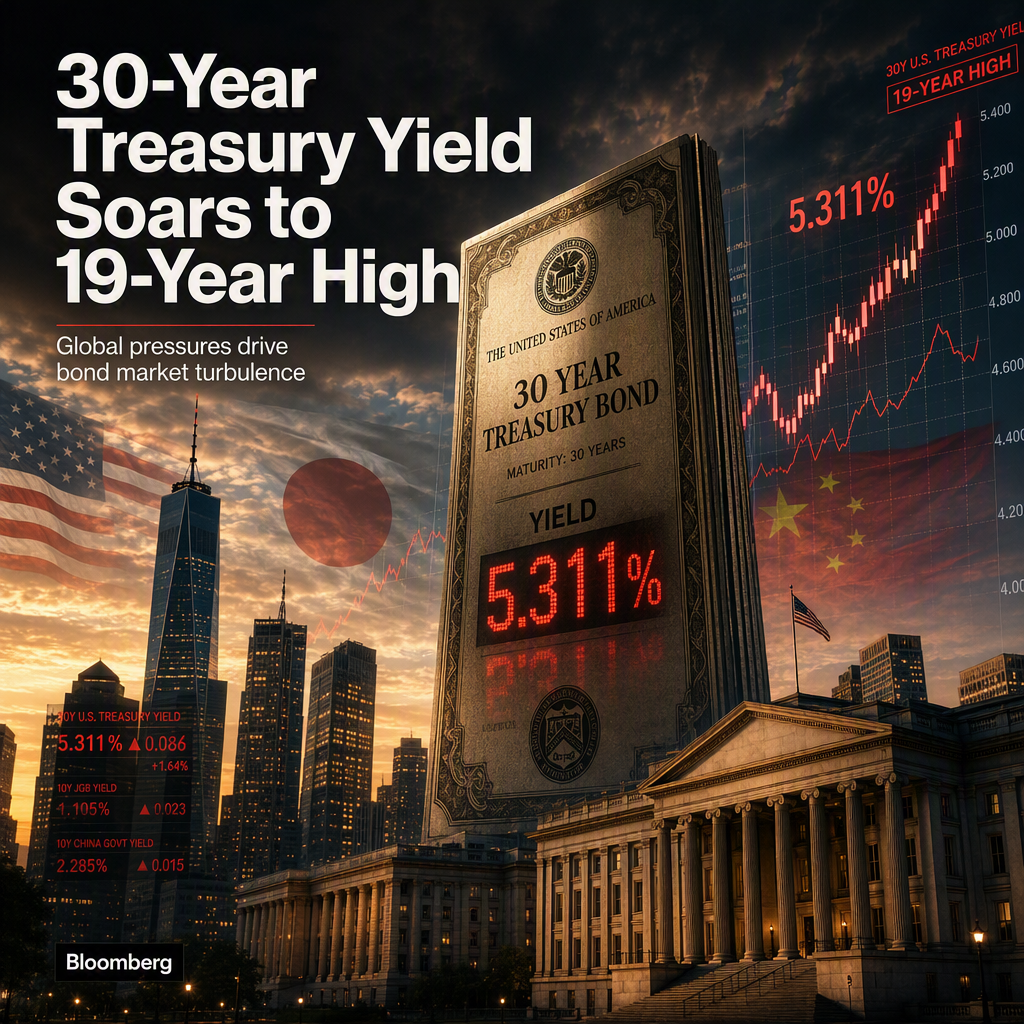
The yield on the 30-year U.S. Treasury surged to 5.311% on Monday, marking its highest level since June 2007, as long-dated government bonds experienced a significant selloff [1]. This rise in yields occurred despite recent U.S. economic data that would typically push yields lower, such as July retail sales being the weakest since May 2025 and labor-market data indicating cooling conditions [1]. Foreign holdings of Treasurys also declined in June, with major holders like the U.K., China, and Japan reducing their positions [1].
Fundstrat technical strategist Mark Newton suggested that long-term yields could climb further, potentially reaching 5.60%-5.70%, and may do so at a faster pace due to the resolution of a three-year triangle pattern [1]. Newton attributed part of the recent yield jump to developments in Japan, where weaker-than-expected economic growth and a hotter GDP deflator pushed ten-year and twenty-year JGB yields higher, subsequently impacting U.S. markets [1]. BMO strategists highlighted fiscal concerns across the U.S., Japan, U.K., and Europe as contributing factors to the weakness in long-dated bonds, suggesting that a global repricing of long-term borrowing costs could maintain upward pressure on Treasury yields even if U.S. economic data softens [1].
Another potential driver for higher yields is the prospect of more Federal Reserve rate hikes. Deutsche Bank noted that markets are currently pricing in resilient growth and record-high equities, limited only by additional central-bank tightening and contained commodity supply shocks [1]. Macro strategist Henry Allen from Deutsche Bank argued that strong growth and buoyant risk assets keep financial conditions accommodative, which could raise demand and push central banks toward faster rate hikes [1]. If growth remains robust and financial conditions stay loose, inflation could remain elevated, forcing the Federal Reserve to raise rates more than investors currently expect [1]. Deutsche Bank also pointed out that inflation remains above target, and historically, current inflation levels have been associated with multiple rate hikes [1].
Overall, the combination of global market dynamics, fiscal concerns, and the potential for further Fed tightening are seen as key factors that could drive the 30-year Treasury yield even higher in the near term [1].
CONCLUSION
The 30-year Treasury yield's surge to a 19-year high reflects a confluence of global and domestic pressures, including reduced foreign holdings, fiscal concerns, and the possibility of further Fed rate hikes. Analysts suggest yields could climb further if these trends persist, signaling heightened volatility and uncertainty for long-term government bonds. Investors should closely monitor global developments and central bank actions for further market direction.