
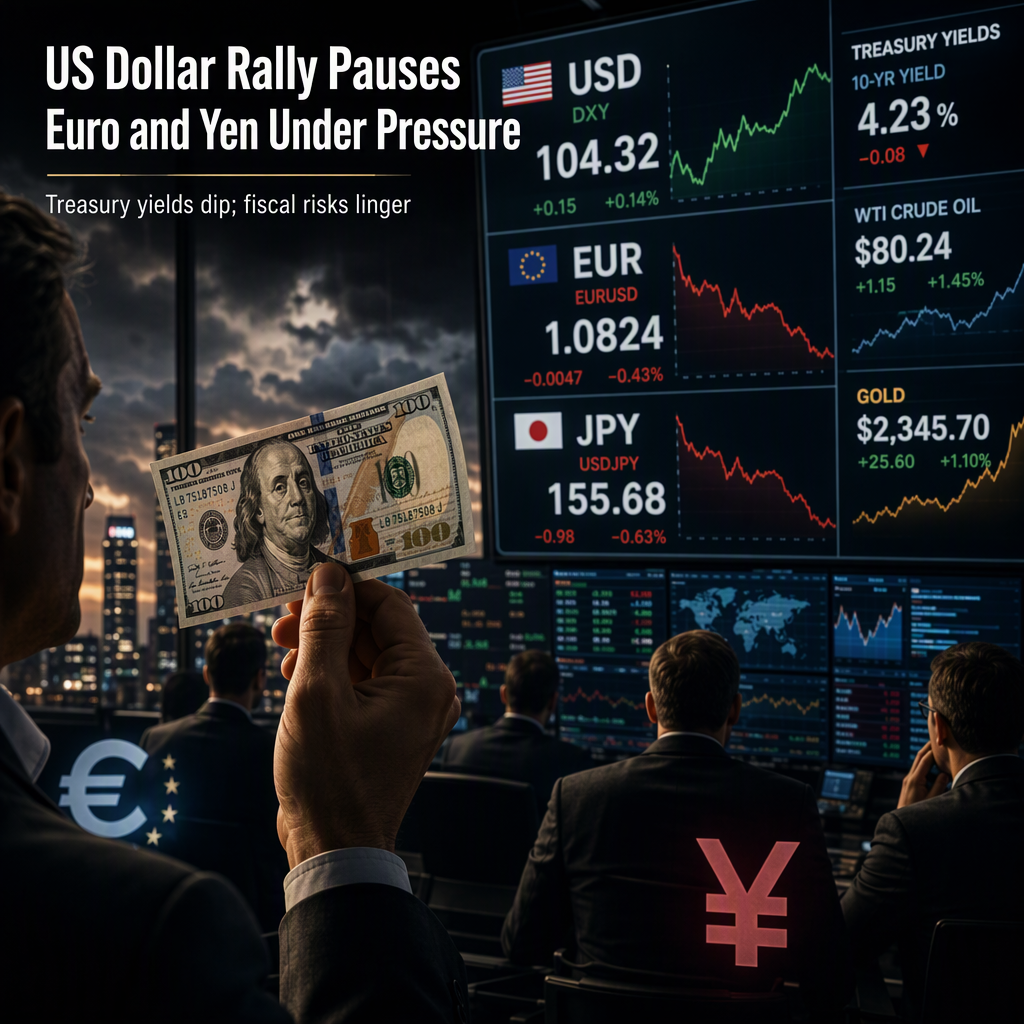
The US Dollar (USD) experienced a modest pullback as US Treasury yields retreated from multi-decade highs following a successful 30-year bond auction, which eased concerns about US government debt and led to a temporary decline in the Dollar Index (DXY) to around 102.14 before stabilizing near 102.19 [1][2][5][6]. Despite this, the Euro (EUR) failed to capitalize on the Dollar's weakness, with EUR/USD trading at 1.1214 and remaining on track for a 3.5% five-week losing streak, weighed down by high oil prices and persistent concerns over France's public debt and political risks [1][3]. ING analysts noted that the Euro's recovery prospects remain elusive, as markets continue to price in a French fiscal premium, with the 10-year OAT-Bund spread closing at 140 basis points, and see scope for EUR/USD to test the 1.110/1.112 area in the near term [3].
The Japanese Yen (JPY) underperformed against major peers, with USD/JPY rising 0.3% to near 158.25, as the currency faced pressure ahead of a potential meeting between US Treasury Secretary Scott Bessent and Japanese Finance Minister Satsuki Katayama at the IMF sidelines, where intervention to support the Yen may be discussed [2]. The Yen was the weakest against the Australian Dollar (AUD), which itself outperformed on Friday, with AUD/USD up 0.3% at around 0.6980, though struggling to extend gains beyond 0.6990 [2][7]. Market experts and strategists at Brown Brothers Harriman (BBH) and ING cautioned that the recent Dollar pullback may be temporary, as US growth outperformance and strong foreign demand for US securities keep USD risks skewed to the upside [2][5][7].
High oil prices, remaining above $100 per barrel, continue to threaten Eurozone economies with stagflation and keep inflation risks in focus globally [1][7]. This has reinforced expectations of additional interest-rate hikes by the Federal Reserve (Fed), with St. Louis Fed President Alberto Musalem and Fed Governor Christopher Waller both signaling that more monetary policy firming may be required to bring inflation back to the 2% target [1][5][6]. According to the CME FedWatch Tool, traders widely expect the Fed to leave rates unchanged at 3.75%-4.00% at the October 27-28 meeting, but price in an 85% probability of a rate hike in December [6]. The upcoming US Consumer Price Index (CPI) and University of Michigan consumer sentiment reports are seen as key data points that could shape expectations for the Fed's next move [1][5][6][7].
Gold (XAU/USD) recovered to around $4,182, up 1.20% on the day after testing $4,200, as lower yields and a softer Dollar provided support, but gains stalled as yields and the Dollar stabilized [6]. Meanwhile, the Mexican Peso (MXN) weakened by around 1% against the Dollar after Banxico's September minutes signaled a cautious stance on further rate cuts, with the board leaning toward easing but wary of narrowing the US-Mexico rate differential and renewed Peso depreciation, especially as USD/MXN has already risen about 7% since mid-September [4].
Across the board, technical indicators suggest stabilization but not a clear bullish reversal for the Euro, while the Yen remains under pressure and the AUD's upside is capped by expectations of resumed US yield strength and persistent geopolitical risks [1][2][3][7].
CONCLUSION
The US Dollar's rally paused as Treasury yields dipped, but underlying factors such as US growth and strong demand for US assets keep upside risks intact. The Euro and Yen remain pressured by fiscal and policy uncertainties, while high oil prices and upcoming US inflation data continue to drive market sentiment. Investors are closely watching next week's US CPI and Fed communications for further direction.