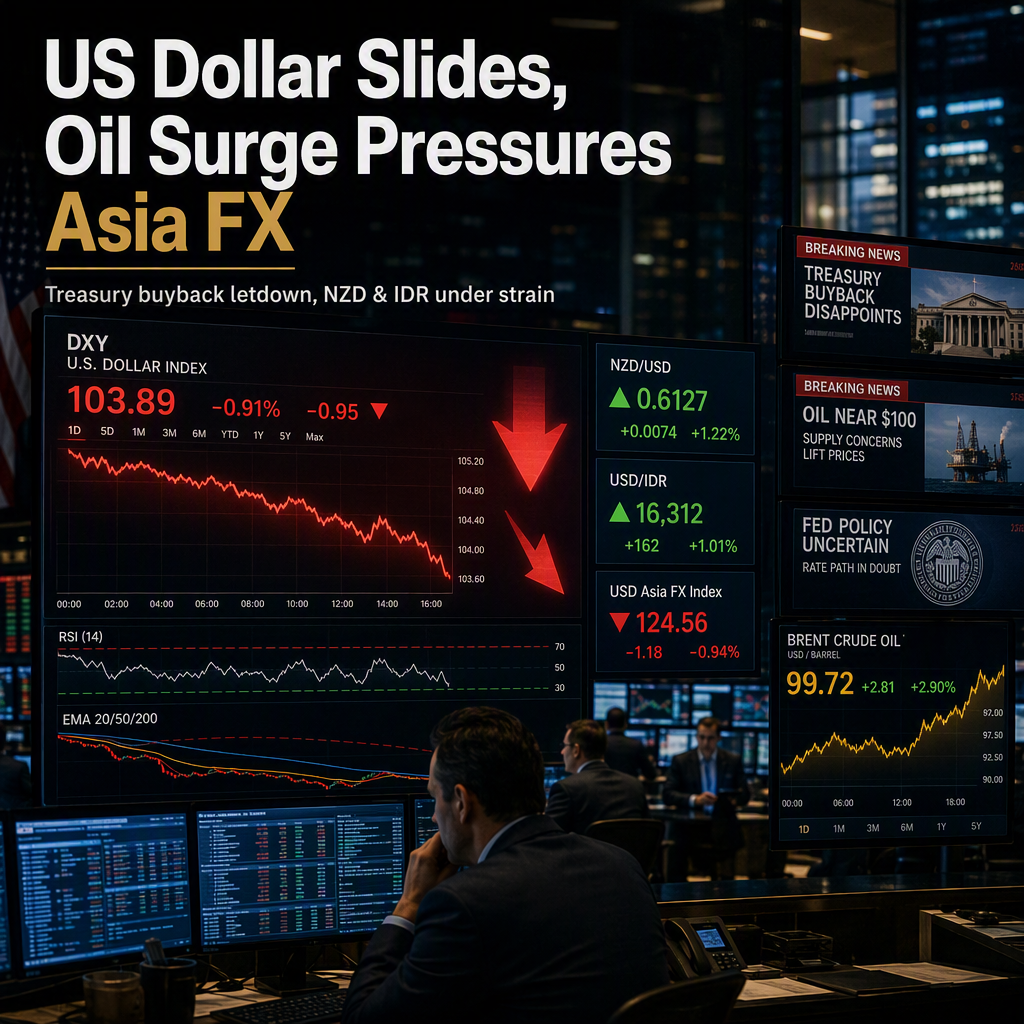
On Thursday, the US Dollar (USD) continued its decline, with the US Dollar Index (DXY) trading around 98.70 and marking its fourth consecutive day of losses. The DXY remains below both the nine- and 50-period Exponential Moving Averages, indicating persistent bearish momentum, while the 14-day Relative Strength Index at 37 suggests ongoing downside pressure [2]. The USD was the weakest against the New Zealand Dollar (NZD), which nudged higher but maintained a bearish trend, trading above 0.5850 and eyeing key support at 0.5800 [1][2].
Market sentiment was subdued due to high oil prices and surging global yields. Brent Oil prices hovered just below $100 following recent US-Iran tanker attacks, escalating hostilities and adding pressure on oil-importing economies like New Zealand and Indonesia [1][3]. The NZD/USD pair remains constrained by these factors, with technical analysis highlighting a bearish Head & Shoulders formation and momentum indicators in bearish territory. A break below 0.5802 could activate further downside targets at 0.5765, 0.5740, and potentially just below year-to-date lows at 0.5626 [1].
The US Dollar's weakness was further exacerbated by investor disappointment over the US Treasury's bond buyback program, which is set to start on Monday. Deutsche Bank analysts noted that the buyback size, up to $6 billion of longer-dated Treasuries, fell short of expectations, intensifying the sell-off in US government debt and pushing yields higher [1][3]. Despite the FXSFedSentiment Index remaining firmly in hawkish territory at 125.72, suggesting tighter policy expectations, the USD failed to gain support against peers such as the Euro and Yen in the short term [2].
In Indonesia, the Rupiah (IDR) faced renewed pressure as USD/IDR traded around 17,570, driven by elevated oil prices and fiscal strain. July retail sales showed a 1.1% year-on-year rebound, but monthly sales dipped 0.1%. Further gains for USD/IDR may be limited by the weaker USD, with most economists expecting the Federal Reserve to hold rates steady for the rest of the year. Market participants are awaiting US Producer Price Index and Consumer Price Index reports for clues ahead of the upcoming Fed meeting [3].
CONCLUSION
The US Dollar's continued weakness, driven by disappointing Treasury buyback plans and rising oil prices, has pressured oil-importing currencies like the NZD and IDR. While technical and sentiment indicators suggest further downside for the USD, upcoming US inflation data and Fed policy decisions remain key for future direction. Market participants are cautious, with risk sentiment subdued and rallies in risk-sensitive currencies likely to be limited.