
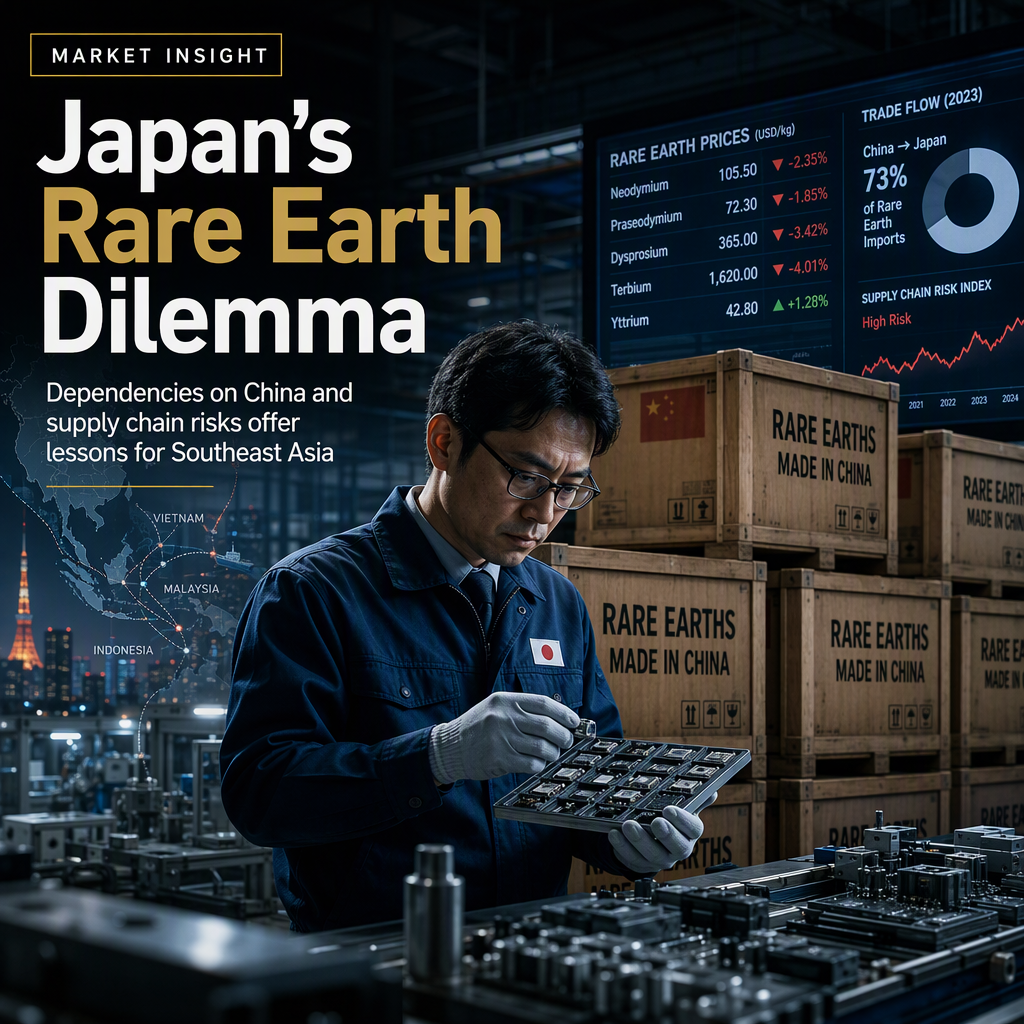
Japan continues to rely heavily on China for rare earth imports, with more than 50% of its rare earth supply sourced from China despite ongoing government initiatives aimed at diversifying supply chains and reducing dependence on Beijing [1]. This reliance is particularly significant for industries such as electronics and electric vehicles, where supply security remains a major concern for policymakers and businesses [1]. Financial data from Japanese customs reveals that imports of Chinese electronics components have declined by 12% year-on-year, yet imports of certain chemicals and rare earths have remained steady or even increased, highlighting the difficulties in reducing dependence in specialized sectors [1].
To mitigate risks, Japanese companies have shifted parts of their supply chains to Southeast Asia. However, these countries themselves import significant intermediate goods from China, creating indirect exposure and a complex web of dependencies that could amplify risks if China-Japan relations deteriorate or if broader geopolitical shocks occur [1]. The Japanese government has responded by providing subsidies for companies relocating production to countries such as Vietnam and Thailand, but analysts warn that without parallel investments in technology and capabilities within these host countries, supply chain disruption risks remain high [1].
Priyanka Kishore, founder and principal economist at Asia Decoded, emphasizes that "derisking is not about decoupling but about managing exposure more prudently," and suggests that Southeast Asian economies should learn from Japan's experience by diversifying their import base and strategically stockpiling critical materials [1]. For investors, the ongoing shift in regional trade and supply chain patterns presents both risks and opportunities. Companies with diversified sourcing strategies and robust risk management frameworks are likely to outperform those with concentrated exposures, and monitoring price movements in key commodities such as rare earths and semiconductors will be crucial as supply shocks could lead to sharp price volatility [1].
CONCLUSION
Japan's ongoing efforts to reduce its economic exposure to China have yielded mixed results, with persistent reliance on Chinese rare earths and indirect supply chain vulnerabilities through Southeast Asia. The situation underscores the importance of diversification and strategic risk management for both policymakers and investors, as supply shocks in critical materials could significantly impact market stability.