
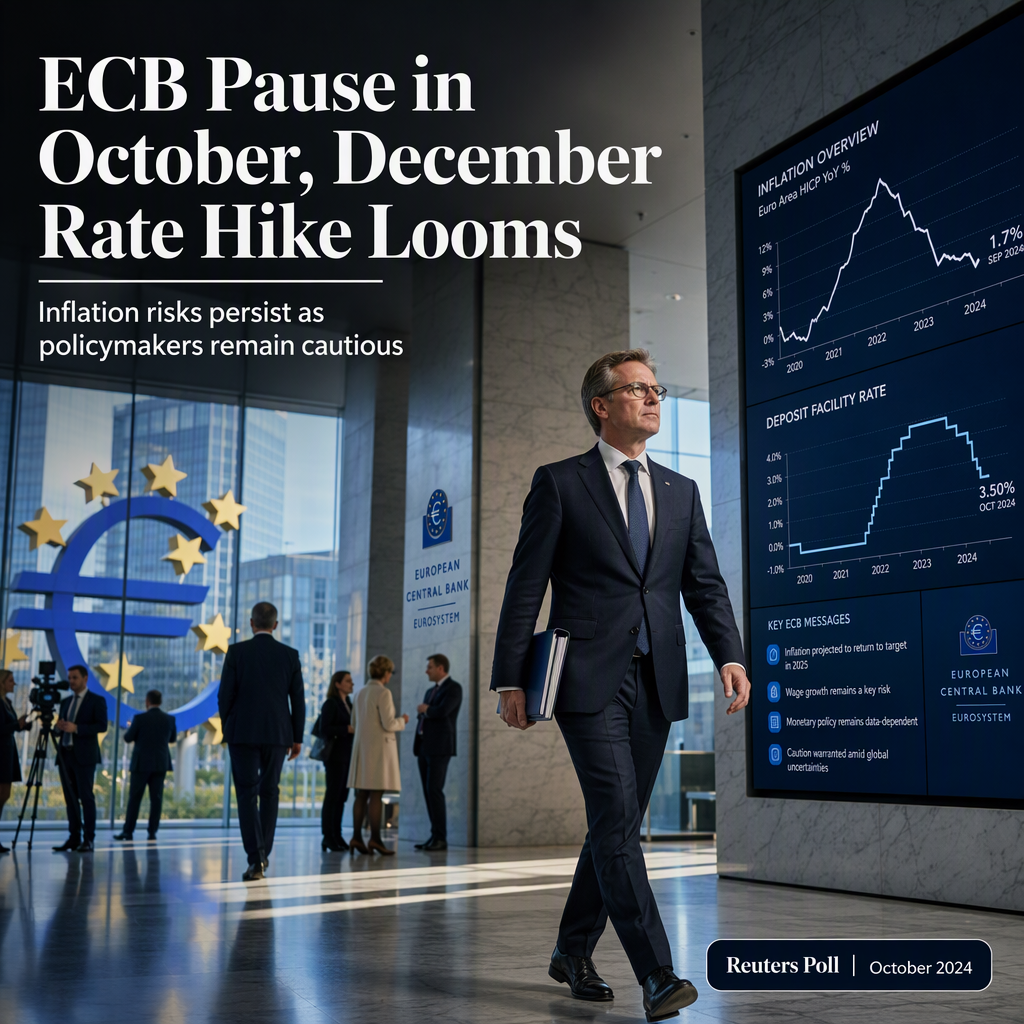
The European Central Bank (ECB) is widely anticipated to leave interest rates unchanged at its October meeting, with a majority of economists and analysts expecting a 25-basis-point hike in December, according to a Reuters poll conducted October 5-8. Specifically, 70 out of 73 economists surveyed expect the ECB to hold its deposit rate at 2.50% on October 29, while 64 of 73 anticipate a rate increase in December. The poll also indicates that 58% of respondents expect the deposit rate to peak at 2.75%, though 24 economists now see rates reaching 3.00%, a notable rise from just two last month [3].
The ECB's September monetary policy account, as interpreted by Nordea’s Chief Analyst Jan von Gerich, reinforces the central bank's focus on upside inflation risks, particularly from persistent energy shocks and resilient economic growth. The Governing Council remains cautious, avoiding pre-commitment and emphasizing data dependence amid high geopolitical and market uncertainty. Nordea’s baseline scenario aligns with further 25bp rate hikes in December and March, reflecting concerns that ongoing energy price shocks and a resilient economy could eventually lead to broader price pressures [1].
Recent inflation data has prompted economists to revise their forecasts upward. Inflation is now expected to average 3.7% in the fourth quarter, up from 3.3% in the third quarter and above last month’s 3.3% forecast. Annual inflation projections have also increased to 3.0% for 2026 and 2.6% for 2027, compared to previous estimates of 2.9% and 2.3%, respectively. The Eurozone economy is forecast to grow by 1.0% this year, with growth expectations rising to 1.2% in 2027 and 1.3% in 2028 [3].
The ECB’s communication remains neutral, with policymakers keeping their options open and refraining from providing explicit forward guidance. The outlook is described as highly uncertain and critically dependent on geopolitical developments, with risks skewed to the upside for inflation and to the downside for economic growth [1]. After recent market repricing due to concerns about France, current market pricing is once again close to Nordea’s baseline of further hikes [1].
No explicit market reaction or analyst opinions on the Euro or financial markets were provided in the sources, but the consensus expectation of a December rate hike and upwardly revised inflation forecasts suggest continued vigilance from the ECB and market participants.
CONCLUSION
The ECB is expected to pause rate hikes in October but deliver another increase in December as inflation risks remain elevated, particularly due to persistent energy shocks. Both analysts and economists highlight the central bank's data-dependent and cautious approach amid ongoing uncertainty. The market takeaway is one of continued vigilance, with further tightening likely if inflation pressures persist.