
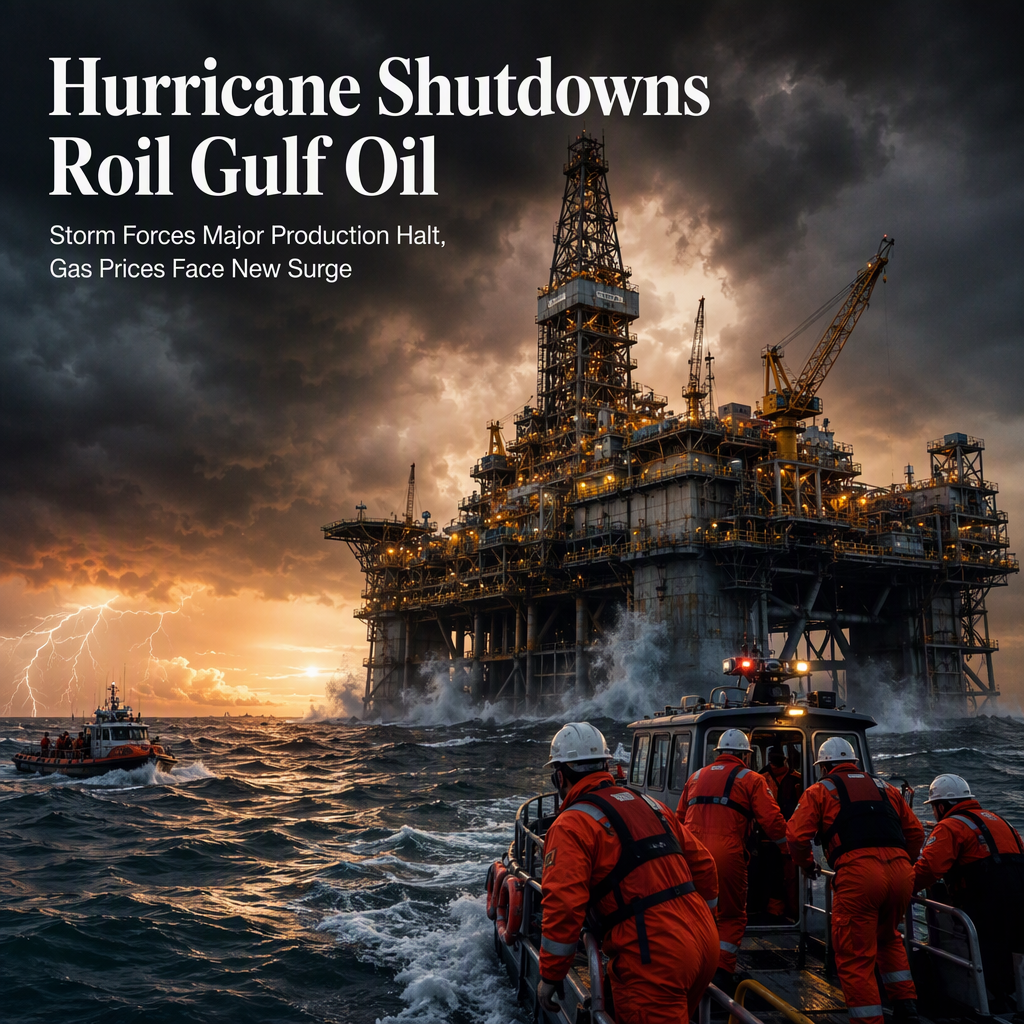
A rapidly intensifying Hurricane Isaias is threatening to disrupt U.S. oil and gasoline production as it approaches the northeastern Gulf shore, with landfall expected late Friday or early Saturday [1]. Major oil companies, including Chevron and Shell, have already begun shutting down production sites in the Gulf of Mexico. Chevron has shut down four of its assets, while Shell has halted production at five sites, resulting in approximately 25% of Gulf oil production being suspended as of Thursday morning, according to the U.S. Marine Minerals Administration [1].
The timing of this disruption is particularly problematic for U.S. consumers, as retail gas and diesel prices are already elevated due to ongoing global conflicts. The U.S.-Israeli war against Iran has led to broader regional instability, further disrupting energy supplies and driving oil and gasoline prices higher [1]. On Thursday, global benchmark Brent crude oil prices surged nearly 5% amid reports that President Donald Trump was considering renewed attacks against Iran. U.S. gasoline prices averaged $4.36, which is down slightly from a week ago but still $0.21 higher over the past month [1].
Industry experts warn that the impact of Hurricane Isaias could be significant. Andy Lipow, president of Lipow Oil Associates LLC, noted that nearly all U.S. offshore production is in the storm's path and estimated that 14% of the nation's refining capacity could be affected. With U.S. refineries already running at maximum capacity due to the global squeeze, there is 'no slack in the system,' Lipow wrote [1]. Any reduction in refined petroleum product supplies is expected to send prices higher globally [1].
Patrick De Haan, head of petroleum analysis at GasBuddy.com, stated that refineries in the storm's path could experience flooding, potentially taking them offline for up to 10 days and causing a short-term squeeze on U.S. gasoline prices. De Haan also highlighted that the more significant concerns for U.S. motorists are overseas, particularly in Russia, where ongoing attacks on refineries by Ukraine are expected to continue for at least three to six months, prolonging the global refining problem [1].
CONCLUSION
Hurricane Isaias has forced major oil companies to suspend a quarter of Gulf production, compounding already high gas prices driven by global conflicts. With refining capacity stretched and further disruptions likely, both U.S. and global gasoline prices are expected to face upward pressure in the near term.