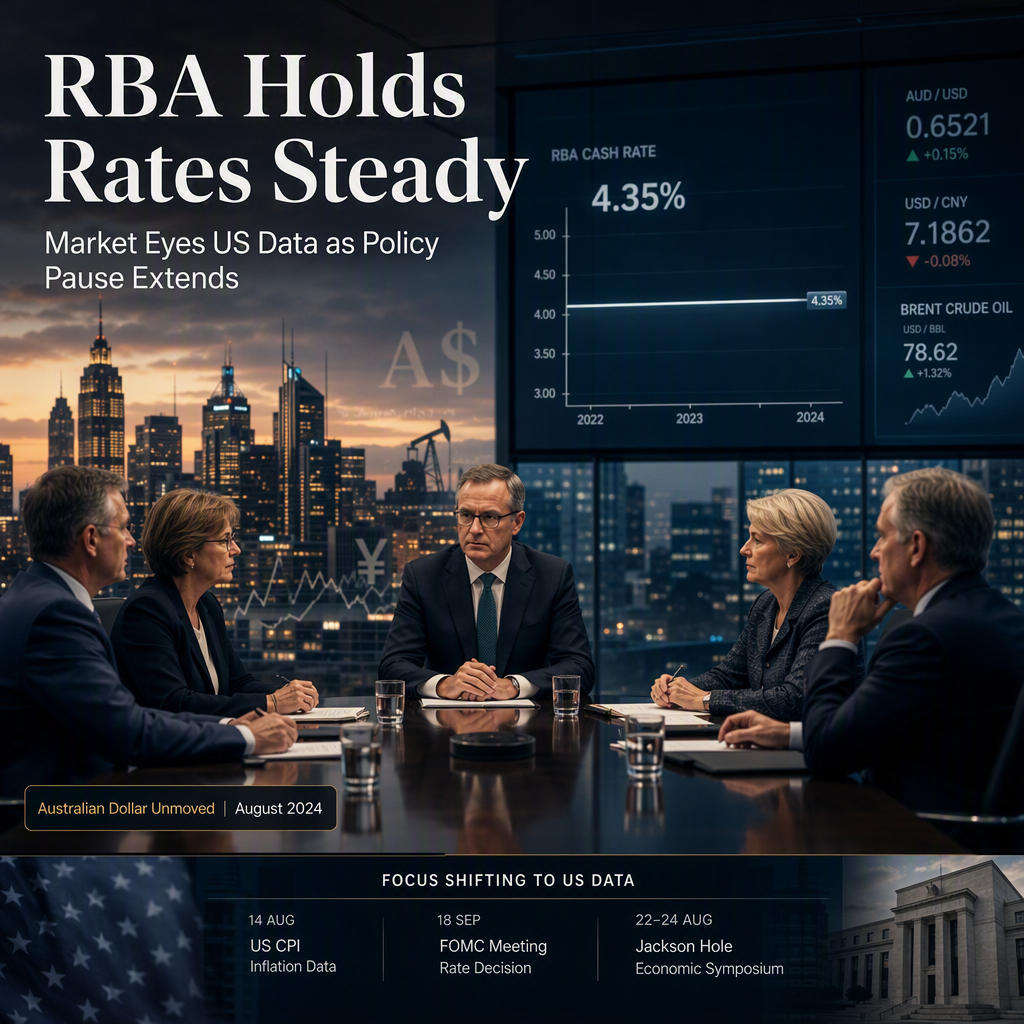
The Reserve Bank of Australia (RBA) left its cash rate unchanged at 4.35% in a unanimous decision, marking its fifth policy decision of the year. The Australian Dollar (AUD/USD) traded just above 0.7050 on August 11, showing minimal reaction and remaining within a 29-pip range, as the market appeared to have fully anticipated the outcome [1]. The RBA's next meeting is scheduled for September 29, creating a seven-week gap during which the US Federal Reserve will hold its own meeting on September 16, alongside several key US economic releases such as CPI, PPI, retail sales, and the Jackson Hole symposium. In contrast, Australia's economic calendar is relatively light, with only consumer inflation expectations, a speech by the Governor, and the monthly CPI scheduled before the next RBA meeting [1].
The RBA's updated forecasts project inflation returning to the midpoint of its target band only by late 2027, with risks skewed to the upside. Unemployment is expected to rise from 4.5% at the end of this year to 4.8% by the end of 2028. The board discussed the possibility of a rate increase but did not consider a cut, emphasizing that policy remains restrictive and that the cash rate could rise further if necessary. The recent surge in crude oil prices was cited as a factor increasing cost pressures, with firms intending to pass these costs on to consumers [1].
Market participants are now expected to focus on US economic data and Federal Reserve policy decisions, as these are likely to drive AUD/USD movements in the absence of further RBA action until late September. Futures markets currently price the September Fed meeting as a near coin flip between a hold and a quarter-point increase, reflecting the ongoing uncertainty and the influence of global energy prices on both economies [1].
CONCLUSION
The RBA's decision to hold rates steady and its cautious outlook on inflation and unemployment have left the Australian Dollar largely unmoved, with market attention shifting to upcoming US economic events. With no RBA meeting for seven weeks, AUD/USD is expected to be driven primarily by US data and Federal Reserve policy in the interim.