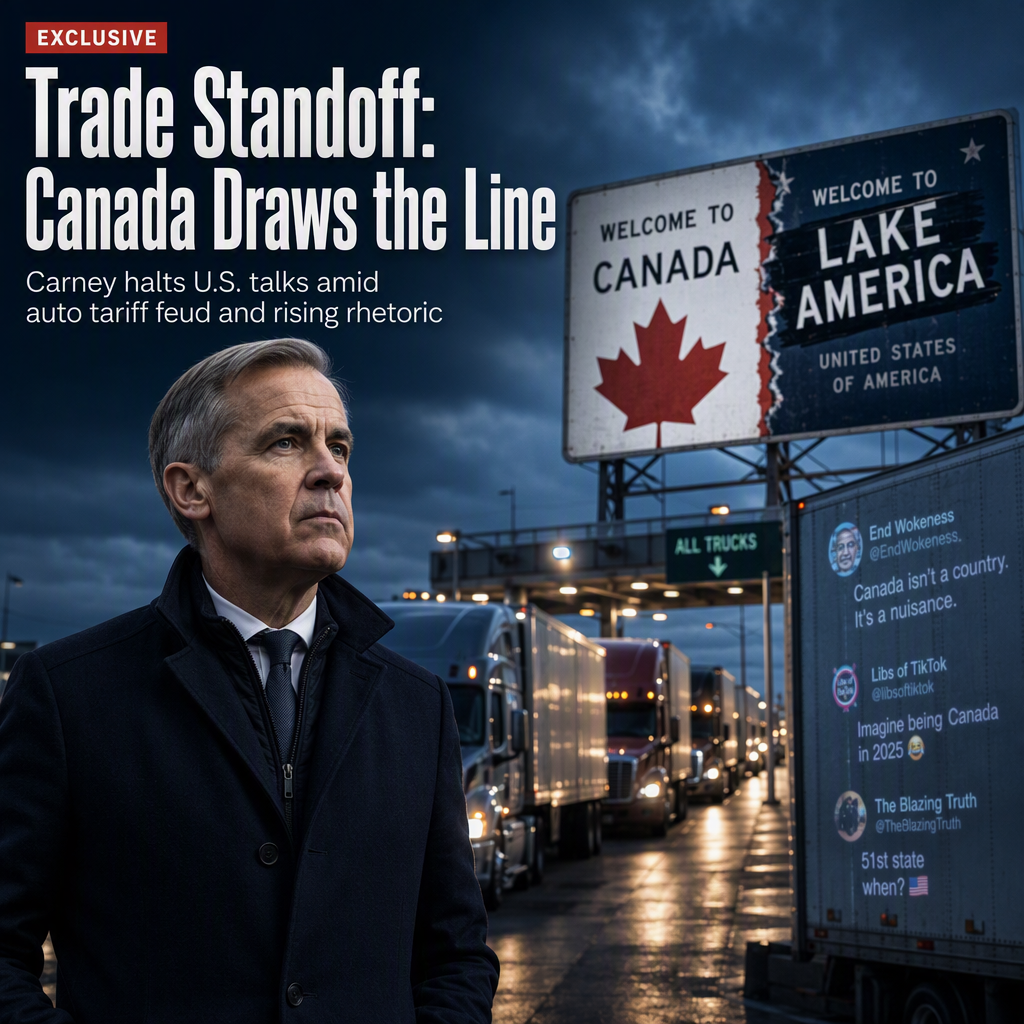
Canadian Prime Minister Mark Carney announced that trade negotiations between the U.S. and Canada, which he suspended on August 21, will only resume when the U.S. adopts a more serious and constructive approach. Carney stated, 'When the Americans stop doing memes, stop throwing shade, stop trying to be tough and start being serious about having those discussions, we can have those discussions' [1]. The talks, focused on automobile tariffs, were halted due to what Carney described as unconstructive behavior and unacceptable terms from the U.S., including restrictions on future trade deals and Canadian sovereignty, as well as provisions that would make core Canadian industries subsidiaries of U.S. industries or lead to their gradual decline [1].
Following the suspension of talks, President Trump signed an executive order renaming Lake Ontario to Lake America and accused Canada of exploiting the U.S. by imposing tariffs on American farmers. U.S. Treasury Secretary Scott Bessent and War Secretary Pete Hegseth also mocked Canada on social media, with Bessent claiming Canada could not compete economically and Hegseth posting a disparaging photo of Canadian military members [1]. Carney responded to these actions by calling them 'beneath their office' and reiterated that the U.S. attitude and terms were unacceptable for Canada [1].
Carney emphasized that the U.S. auto industry benefits from collaboration with both Canada and Mexico, countering the U.S. administration's stance. He also rejected the U.S. demand for influence over Canada's future trade partners, calling it 'a bridge too far' and labeling the U.S. view of the trade relationship as 'misguided' [1].
No specific market reactions or analyst opinions were mentioned in the article. However, the suspension of talks and the escalation of rhetoric suggest heightened uncertainty for industries affected by cross-border trade, particularly the automotive sector [1].
CONCLUSION
The suspension of U.S.-Canada trade negotiations marks a significant escalation in tensions, with both sides exchanging public criticisms and taking symbolic actions. The lack of progress and the hardening of positions, especially regarding auto tariffs and sovereignty, signal ongoing uncertainty for key industries and bilateral economic relations.