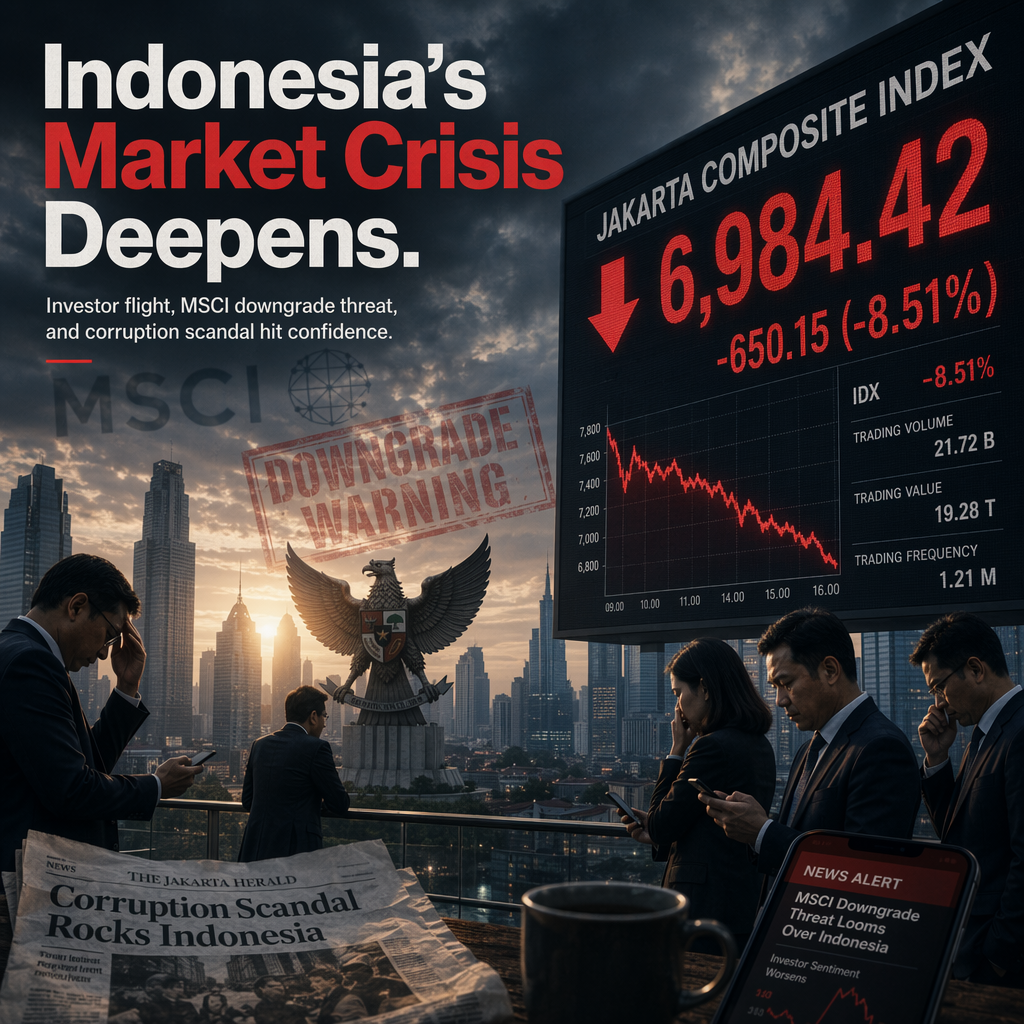
Indonesia's financial markets are experiencing significant pressure, with the Jakarta Composite Index declining nearly 35% year-to-date and 7.9% in the past month, as the country grapples with a series of negative developments impacting investor sentiment [1]. A major factor is a warning from MSCI, the global index provider, about a potential downgrade of Indonesia's market status to 'frontier market,' which has heightened concerns about stock-market governance and investibility [1].
Investor confidence has been further shaken by a high-profile corruption conviction involving former education minister Nadiem Makarim, who was sentenced to 10 years in prison and fined 1 billion Indonesian rupiah ($55,870), with an additional order to pay 809.6 billion rupiah in restitution. The case centered on allegations that Makarim and other officials manipulated procurement processes in favor of Google products for the country's education digitalization program, resulting in inflated Chromebook prices [1].
Policy uncertainty under President Prabowo Subianto's administration is also cited as a key concern. Jayden Vantarakis, head of Asean equity research at Macquarie Capital, noted that the administration's populist policies have raised red flags with credit ratings agencies and are viewed unfavorably by offshore investors [1]. S&P Global warned in February that rising fiscal pressures, particularly higher debt-servicing costs, have increased downside risks for Indonesia's sovereign credit profile [1].
Foreign investors have responded by selling a net $4.11 billion of Indonesian stocks in 2026, and a Bank of America survey from mid-June found Indonesia has become fund managers' least-preferred market in Asia, overtaking India [1]. Additional policy moves, such as the 'single gate' export system launched in May, have added to investor wariness. This system, which funnels exports of palm oil, coal, and ferroalloys through the state-owned PT Danantara Sumberdaya Indonesia, is seen by some as creating new bureaucratic hurdles and signaling increased government intervention in natural resources [1].
CONCLUSION
Indonesia is facing a confluence of challenges, including a potential MSCI downgrade, a major corruption scandal, and fiscal policy concerns, all of which have led to significant capital outflows and a sharp decline in its stock market. Investor sentiment remains negative, with experts and surveys indicating Indonesia is now among the least attractive markets in Asia.