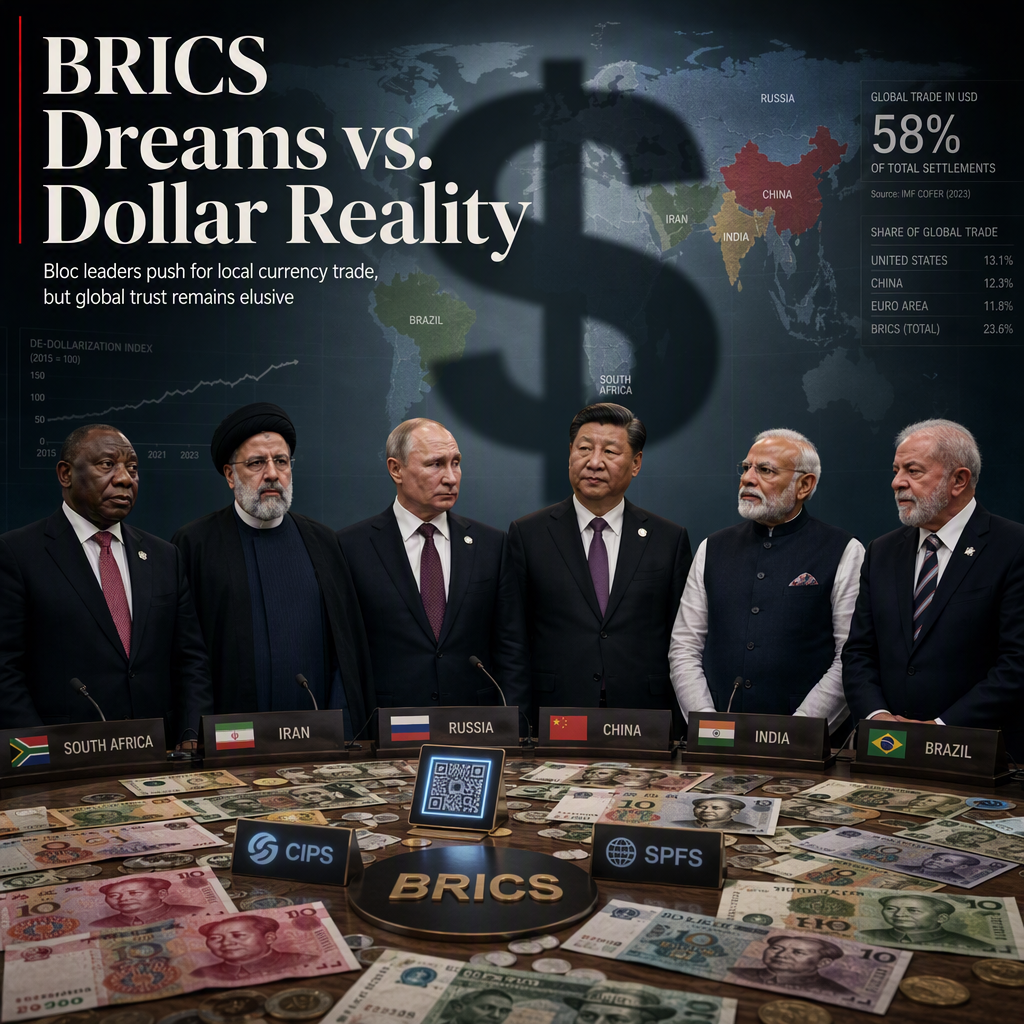
At the recent BRICS Summit, leaders from the bloc—including South Africa, Iran, and Russia—emphasized the need to increase the use of local currencies in intra-BRICS trade, aiming to reduce reliance on the U.S. dollar. This push is driven by concerns over geopolitical tensions, economic sanctions, U.S. tariff policy, and frequent devaluation of BRICS member currencies. The bloc accounted for 27% of world output, 24% of merchandise exports, and 22% of foreign direct investment inflow in 2024, according to a United Nations Trade and Development (UNTAD) report [1].
South African President Cyril Ramaphosa called for 'greater use of local currencies, stronger cross-border payment systems and deeper financial interconnectivity.' Energy-rich members such as Iran and Russia, whose ability to trade in dollars has been restricted by U.S. sanctions, also advocated for the development of payment, settlement, and depository infrastructure within BRICS. Iranian President Masoud Pezeshkian argued that the current financial system is 'vulnerable to political shocks due to its concentration on a limited number of currencies,' highlighting the need for diversification away from the dollar [1].
Despite these ambitions, experts cited significant obstacles to de-dollarization, including a lack of financial and macroeconomic integration, wide trade imbalances, and deep distrust between key member states such as China and India. Jayant Krishna, senior fellow at the Center for Strategic and International Studies, stated that BRICS lacks the unified institutional, financial, and macroeconomic infrastructure needed to substitute the 'inherent liquidity and trust' of the dollar globally [1].
Data from the Bank of International Settlements shows that as of April, the U.S. dollar made up 89% of the forex market—an increase of 1 percentage point from the previous year—while the euro and yen accounted for 29% and 17%, respectively. The U.S. dollar continues to underpin most of the world's financial systems, with commodities like oil and gold denominated in the greenback. While de-dollarization discussions intensify when confidence in the U.S. is shaken, the article notes that actual progress remains limited, with BRICS taking only 'baby steps' toward reducing dollar dependence [1].
CONCLUSION
While BRICS leaders are vocal about reducing reliance on the U.S. dollar and increasing local currency trade, significant structural and trust-related challenges remain. The U.S. dollar's dominance in global finance persists, and experts suggest that meaningful de-dollarization among BRICS is still a distant prospect. Market impact is moderate, with no immediate shifts expected.