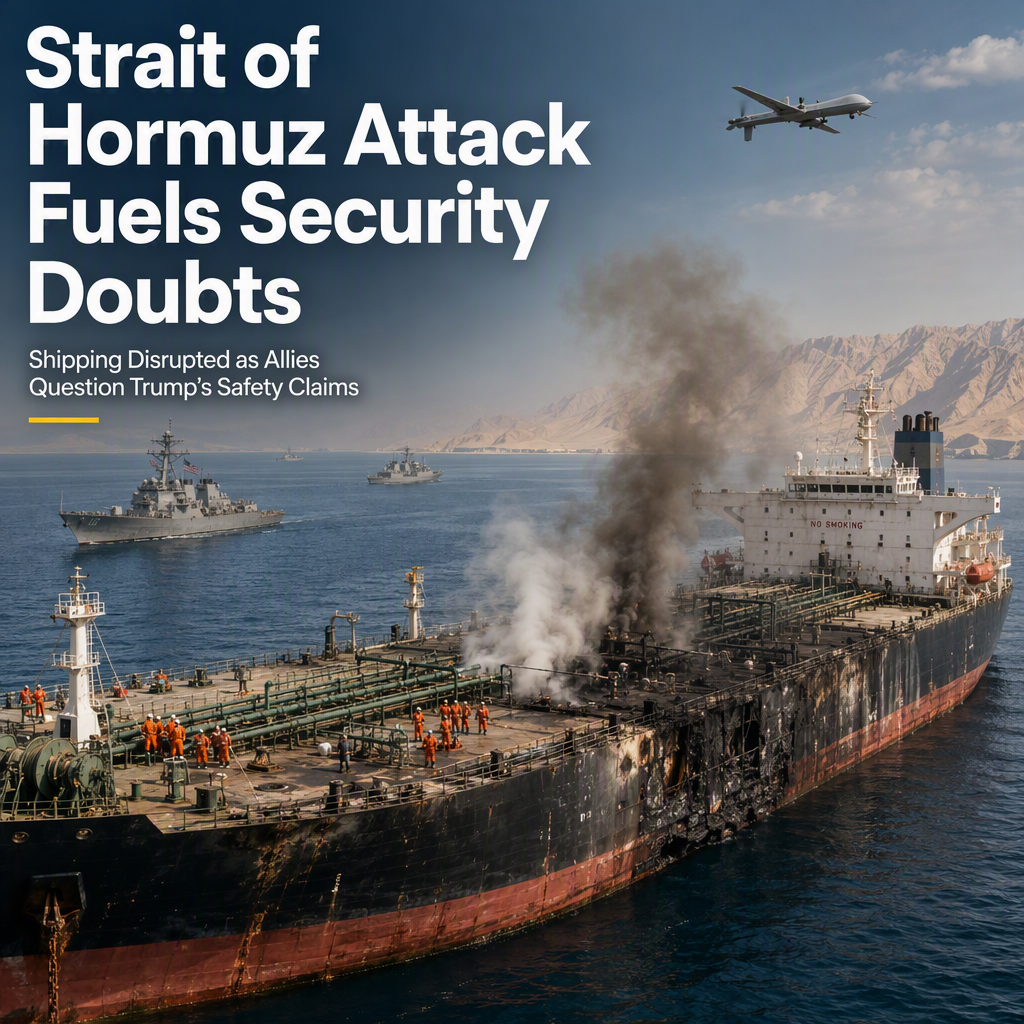
An oil tanker was struck by an unidentified projectile in the Strait of Hormuz, according to the UK Maritime Trade Operations agency (UKMTO), marking another incident in a series of attacks that have disrupted shipping in the critical energy corridor [1]. The attack occurred off the Omani coast on Tuesday, resulting in a fire that was extinguished, with all crew members reported safe. An investigation into the incident is underway [1]. This follows a previous attack last week on a cargo ship transiting the waterway, which resulted in the death of a crew member [1].
Shipping traffic through the Strait of Hormuz has declined significantly, with only five ships making confirmed crossings on Tuesday, compared to seven the day before and more than 130 vessels daily before the war. All recent crossings have used the unilateral route designated by Iran, according to tracking firm Kpler [1]. Despite U.S. efforts to escort vessels along the Omani side of the strait, traffic remains far below pre-war levels [1].
U.S. allies have expressed skepticism regarding President Donald Trump's assertion that the strait is free of Iranian mines and safe for passage. Bloomberg reported doubts among allies about the thoroughness of mine clearance, following Trump’s statement that the Hormuz waterway was “a functioning strait” and fully cleared of mines [1]. Trump acknowledged sporadic incidents, saying, “Yes, every once in a while there will be a drone or a rocket or something shot, but it is a very functioning strait. A lot of oil is pouring out” [1].
Iran and Oman have agreed on a temporary maritime corridor to restore safer passage, but Iran’s Deputy Foreign Minister Kazem Gharibabadi warned that the waterway will not fully reopen until the U.S. fulfills its commitments under an interim peace deal framework signed in June, which has since lapsed [1]. The U.S. military continues to maintain a naval blockade against Iranian ships and uses the southern Omani lane to escort oil tankers [1]. In response to ongoing U.S. sanctions, Iranian Foreign Minister Abbas Araghchi called on the UN and its member governments to condemn the U.S. “economic terrorism,” arguing that the UN has a “legal and moral responsibility” to denounce the sanctions campaign as “illegal and criminal” [1].
CONCLUSION
The recent tanker attack in the Strait of Hormuz has intensified concerns over the security of the vital shipping route, with traffic remaining well below pre-war levels and U.S. allies questioning President Trump’s claims of safety. Ongoing diplomatic and military tensions, combined with unresolved issues around mine clearance and sanctions, suggest continued instability and high market risk for energy transit through the region.