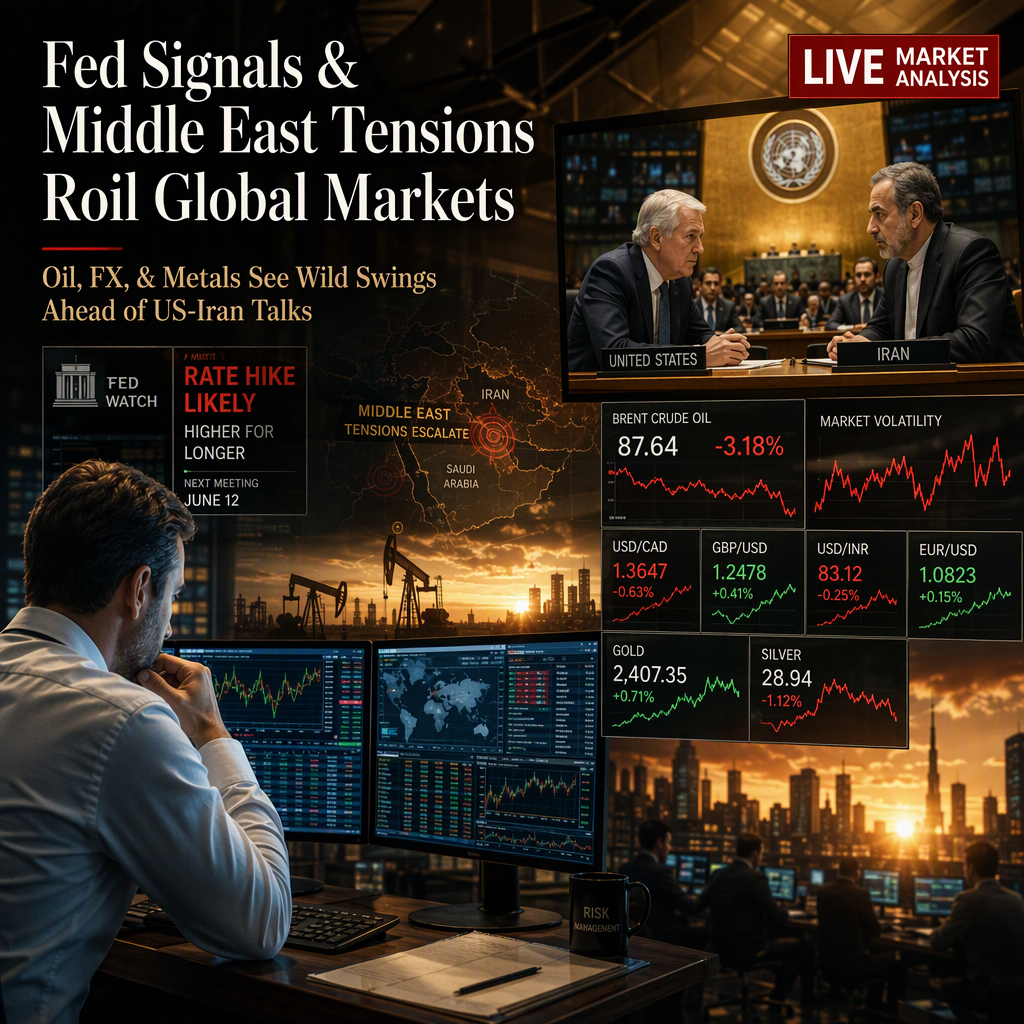
Across global financial markets, the dominant theme on Tuesday is the interplay between hawkish US Federal Reserve signals and heightened geopolitical tensions in the Middle East, particularly involving Iran, Saudi Arabia, and the US. The USD/CAD pair declined to around 1.4025, supported by rising oil prices and anticipation of potential US-Iran talks at the UN General Assembly. However, strategists at Scotiabank note that wider US-Canada front-end spreads are the biggest drag on the Canadian Dollar, with spot remaining overvalued relative to their fair value estimate of 1.3910. They caution that a weaker CAD is unhelpful for the Bank of Canada as it considers inflation risks, and technical analysis suggests a bullish USD/CAD bias above the 100-day SMA, with resistance at 1.3990 and potential gains toward 1.4050/1.4125 [1].
The British Pound (GBP) is 0.15% higher at 1.3385 against the US Dollar, as the USD is slightly under pressure ahead of high-stake talks between US and Gulf leaders regarding Middle East energy supply. The US Dollar Index (DXY) trades slightly lower near 100.35. Fed policymakers are expected to deliver one more rate hike this year, with elevated oil prices and strong economic growth fueling inflationary pressures. GBP/USD technicals remain bearish, with the pair below the 20-period EMA at 1.3467 and resistance at 1.3495, while the RSI at 37.7 hints at weakening downside momentum [2].
The Indian Rupee (INR) gained against the USD, with USD/INR dropping to near 95.65, as oil prices remain close to a 12-day low. Lower oil prices benefit oil-importing economies like India, but analysts at OCBC warn that recent attacks on Saudi Arabia by Iran-backed Houthis keep supply and geopolitical risks alive, potentially limiting further downside in oil prices. Leaders from Gulf nations and the US are expected to meet at the UN General Assembly to discuss increasing oil supply, with US President Donald Trump also expected to meet Iranian President Masoud Pezeshkian. A positive outcome could ease global inflation fears. The Fed's recent 25 bps hike to 3.75%-4.00% and signal of at least one more hike this year have strengthened the USD, but experts note that hawkish expectations need validation from upcoming US data [3].
Silver (XAG/USD) trades near $66.00 per troy ounce, holding losses amid reinforced Fed rate hike bets. Fed's Musalem and Goolsbee delivered distinctly hawkish tones, warning that inflation is likely to remain above the 2% target without further policy restraint, and emphasizing the need for earlier, incremental hikes. The FXS Fed Sentiment Index rose by 0.42 points to 149.96, signaling solid reinforcement of hawkish expectations. However, silver could find support from declining oil prices, driven by diplomatic efforts to resolve Middle East conflicts and indications of uninterrupted energy supplies [4].
WTI crude oil prices snapped a four-day losing streak, trading just below $93.00 and up 1.40% for the day. Geopolitical risk premiums remain in play after Iran's IRGC warned of escalating the conflict if the US intervenes, but improving shipments through the Strait of Hormuz and hopes for US-Iran talks may cap upside. Technical analysis shows WTI holding a bullish bias above the 100-day SMA at $85.05, with resistance at $95.10 and cycle highs near $101.79. Weakness below $90.96 would expose deeper retracement levels [5].
EUR/USD trades in positive territory around 1.1475, buoyed by improved risk sentiment as traders anticipate US-Iran talks. However, political instability in Germany, with Chancellor Merz's CDU suffering a historic defeat, could undermine euro confidence. Analysts at MUFG highlight rising political risk and potential negative impact on the euro. Fed's Musalem leans hawkish, backing earlier incremental rate hikes, with the FXS Fed Sentiment Index at 149.96, confirming intensified expectations for sustained higher policy rates [6].
Across all sources, the market is reacting to a combination of hawkish Fed signals, ongoing Middle East tensions, and technical factors in oil and currency markets. The anticipation of US-Iran talks at the UN General Assembly is a key focus, with potential implications for oil supply and inflation expectations globally.
CONCLUSION
Markets are highly sensitive to both Fed hawkishness and geopolitical developments in the Middle East, with oil, FX, and precious metals showing significant volatility. The prospect of US-Iran talks and ongoing supply risks are keeping energy prices and inflation expectations in focus. Forward-looking sentiment remains cautious, as traders await concrete outcomes from diplomatic meetings and further US economic data to validate Fed policy direction.