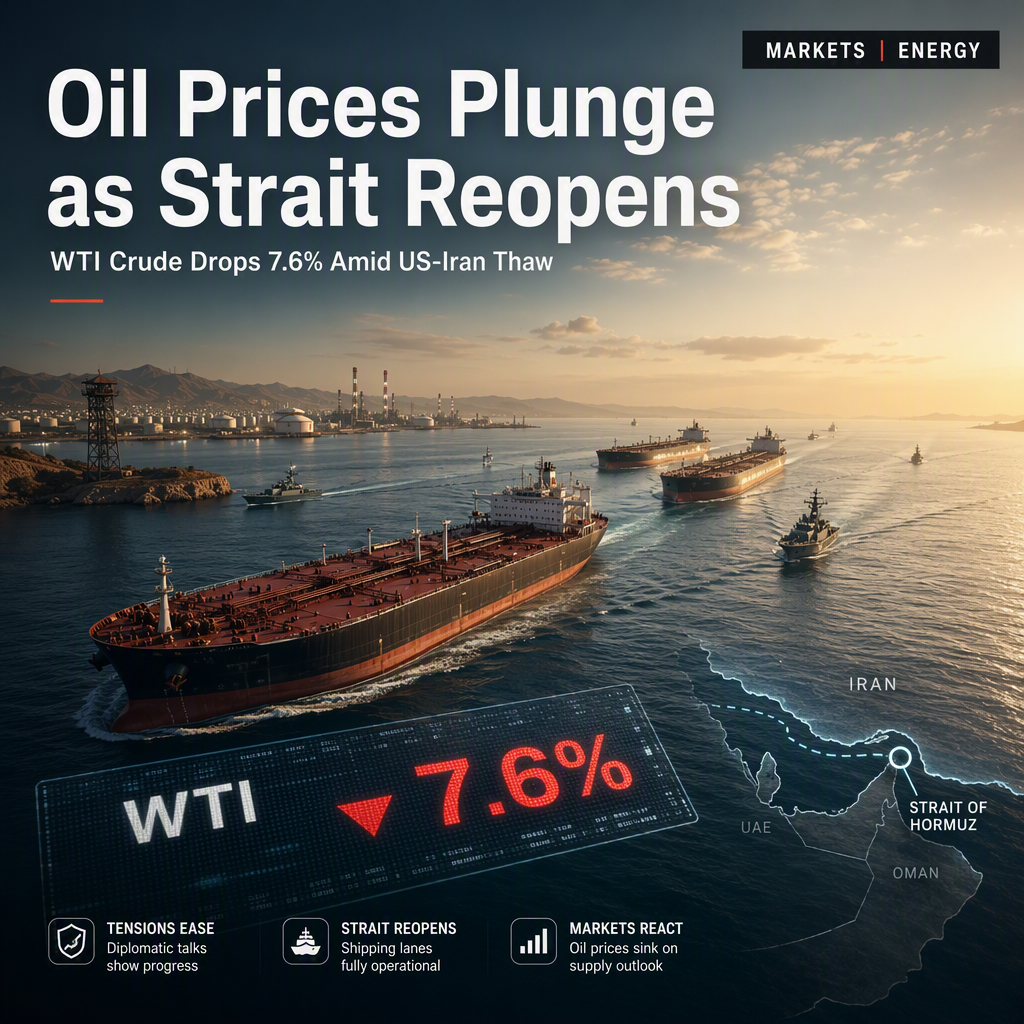
West Texas Intermediate (WTI) crude oil futures on NYMEX experienced a sharp decline, trading 7.6% lower at approximately $78.60 during the Asian session on Monday, as selling pressure intensified following a major geopolitical development [1]. US President Donald Trump announced via Truth Social that planned attacks on Iran have been suspended after Iran agreed to surrender its nuclear ambitions and to fully reopen the Strait of Hormuz, a vital passageway for nearly 20% of the world's energy supply [1]. Trump stated, 'We have just been asked by Iran, and other Middle Eastern Countries, to hold off any attack in that the perimeters of a deal has been agreed to. This would include the Immediate, Complete, and Total OPENING OF THE HORMUZ STRAIT, and an end to Iran’s nuclear threat' [1].
The announcement has increased the likelihood of renewed peace talks between the US and Iran, reducing fears of a prolonged disruption to global energy supplies [1]. In contrast, WTI oil prices had surged over 22.5% in July due to heightened military aggression between the US and Iran after President Trump previously called off a ceasefire [1]. Despite the current de-escalation, financial markets remain cautious about the durability of the ceasefire, with ongoing concerns about whether the agreement will hold [1].
Analysts at IG Markets, as reported by Reuters, highlighted that the market's focus is now on whether this week will mirror last week's volatility, with the possibility that hopes for a deal could collapse if Iran resumes leveraging its control over the Strait, potentially through renewed attacks on US assets or oil tankers [1].
From a technical perspective, WTI is trading below the 20-hour exponential moving average (EMA) at $81.18, indicating a bearish near-term bias, with the Relative Strength Index (RSI) at 34.20, just above oversold territory [1]. Key support is identified at the July 28 low of $77.16, with further downside risk to the July 13 low at $72.53 if this level is breached [1].
CONCLUSION
WTI crude oil prices have fallen sharply amid easing US-Iran tensions and the reopening of the Strait of Hormuz, alleviating immediate supply concerns. However, market sentiment remains cautious as analysts warn of potential renewed volatility if the ceasefire falters. Technical indicators suggest further downside risk if key support levels are broken.