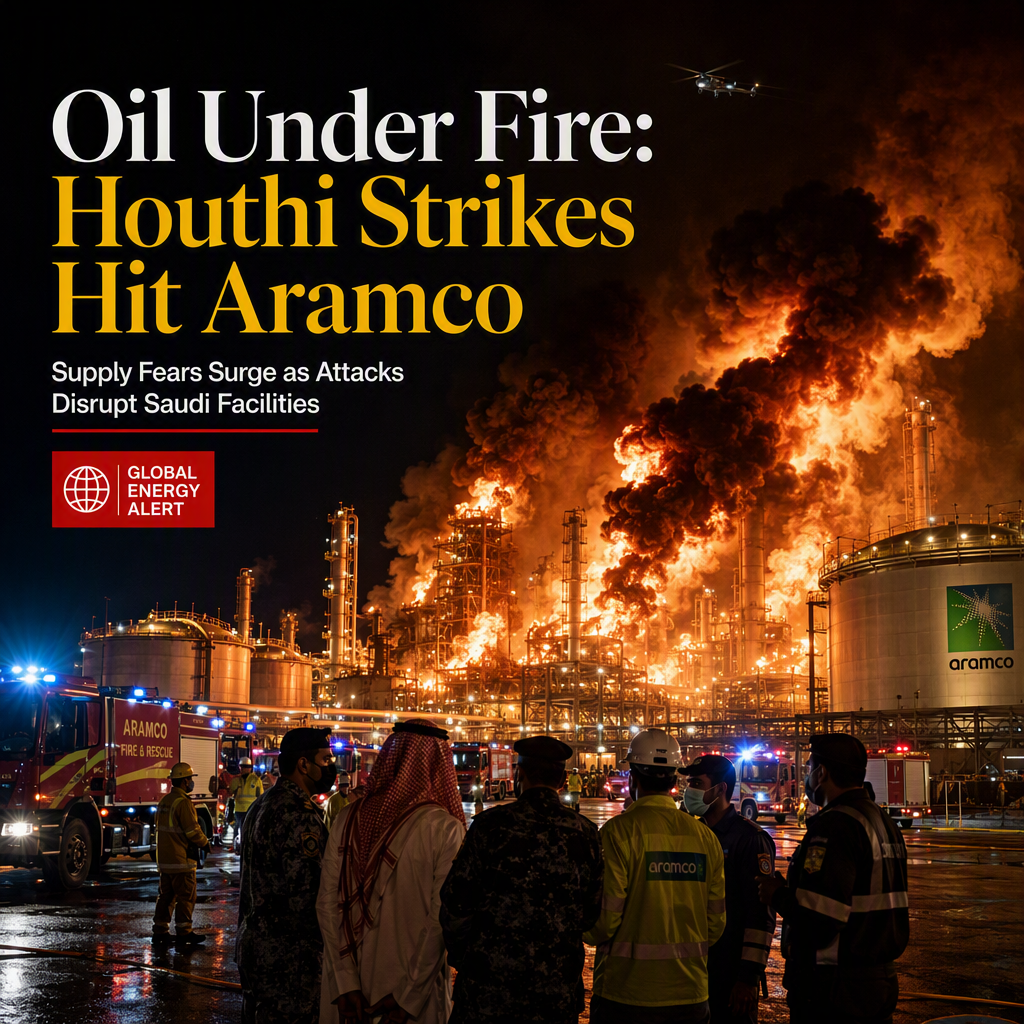
Iran-backed Houthi rebels launched a significant attack on Saudi Arabia Tuesday, targeting multiple energy facilities, including those operated by Aramco, the world's largest oil company. The strikes involved dozens of ballistic missiles and drones and hit the southern Saudi cities of Jazan, Najran, Abha, and Khamis Mushait, resulting in 73 injuries and fires at energy sites. Some operations were temporarily halted, according to Saudi officials [1]. The Jazan facility, which was among those targeted, has a refinery capable of processing approximately 400,000 barrels of crude per day [1].
Aramco, the state-owned oil giant, produces 10 million barrels of oil per day and supplies about 10% of global oil demand. The attacks threaten to tighten pressure on a second critical oil route, as ongoing conflict has already restricted shipping through the Strait of Hormuz. Saudi Arabia has redirected more crude toward the Red Sea, increasing reliance on the Bab el-Mandeb, where the Houthis have previously threatened and attacked Saudi-linked shipping [1].
According to the Energy Information Administration, oil flows through the Strait of Hormuz dropped to 4.9 million barrels per day in Q2 2026, down from 21.6 million barrels per day before the conflict. Before the conflict, 20% of the world's oil moved through Hormuz. Meanwhile, traffic through Bab el-Mandeb averaged 8.1 million barrels per day during the same quarter, reflecting Saudi Arabia's efforts to bypass Hormuz [1].
Brent crude was trading near $99 per barrel on Tuesday, indicating market concern over supply disruptions. The Houthi military spokesman, Yahya Saree, claimed responsibility for the strikes, stating that the operation was retaliation for Saudi airstrikes in Yemen and warning of "stronger and wider strikes" if Riyadh's military campaign continues [1]. The escalation raises the risk of higher oil, shipping, and transportation costs, which could impact U.S. consumers in the coming months, coinciding with the 2026 midterm elections [1].
CONCLUSION
The Houthi attacks on Saudi Aramco facilities have heightened concerns about oil supply disruptions and rising costs, with Brent crude nearing $99 per barrel. The dual threat to both the Strait of Hormuz and Bab el-Mandeb underscores the vulnerability of global energy markets. Market participants and consumers should brace for potential price increases and volatility as tensions persist.