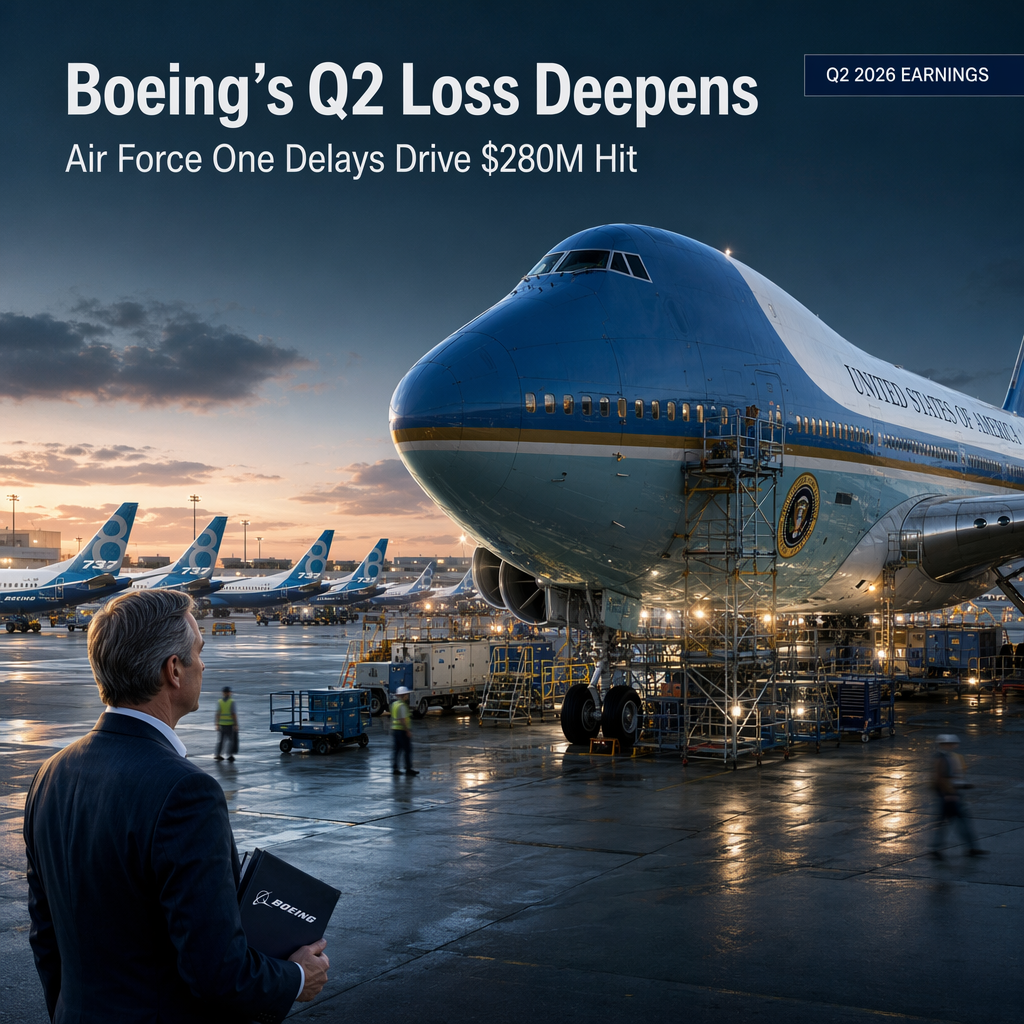
Boeing posted a larger-than-anticipated loss for the second quarter of 2026, primarily due to a $280 million charge related to its long-delayed Air Force One program. The company reported an adjusted loss per share of 76 cents, significantly wider than the 30-cent loss per share expected by Wall Street analysts surveyed by LSEG. Revenue, however, came in at $24.56 billion, surpassing the $24.25 billion consensus estimate and marking an 8% increase from the previous year, driven by gains across Boeing's businesses and a 14% rise in commercial aircraft deliveries to 171 planes from 150 a year earlier [1].
Despite the headline loss, Boeing's free cash flow was a positive $631 million, far exceeding analyst expectations of a $177 million cash burn and a notable turnaround from the $200 million cash burn in the same quarter last year. The company reported a net loss of $428 million, or 67 cents per share, compared to a net loss of $612 million, or 92 cents per share, in the prior year. Adjusted for one-time items, the loss was 76 cents per share [1].
CEO Kelly Ortberg acknowledged the ongoing challenges, particularly with the Air Force One program, but emphasized progress on development programs and the company's focus on safety, quality, and on-time performance. Ortberg stated, "While we're making progress on our development programs, you're never done until you're done," and added that if the company stays focused, it could be set up for a strong second half of the year [1].
Looking ahead, Boeing is preparing for key milestones, including the certification of delayed aircraft programs such as the 737 Max 7, which is expected to be the first among them. Executives are also expected to address questions regarding the certification timelines for the 737 Max 10 and the new 777X wide-body aircraft during an analyst call [1].
CONCLUSION
Boeing's second quarter results were negatively impacted by a substantial charge on the Air Force One program, resulting in a wider-than-expected loss. However, strong revenue growth and positive free cash flow signal operational improvements. The company's outlook hinges on successful execution of upcoming aircraft certifications and continued focus on core performance metrics.